
Mega Archive CD: Part XI: From Racing Aces to Mad Dog McCree
by mento
Well, here we are, the final Sega CD games of 1993 and the very last Mega Archive to cover that same year—something I started on back in 2021 . Preliminary plans to cover 1994 are... well, demoralizing is probably the way I'd put it. My favorite part of exploring the libraries of older systems is seeing the way trends shift based on trailblazing headliners like Sonic the Hedgehog and how there'...

Well, here we are, the final Sega CD games of 1993 and the very last Mega Archive to cover that same year—something I started on back in 2021. Preliminary plans to cover 1994 are... well, demoralizing is probably the way I'd put it. My favorite part of exploring the libraries of older systems is seeing the way trends shift based on trailblazing headliners like Sonic the Hedgehog and how there's a whole hidden side to my favorite consoles that only their Japanese audiences saw. How many obscure beauties still lie behind that language barrier? Yet for as far into the console's lifespan as 1994 is, where you'd expect some real polished stuff from developers long since acquainted with the Mega Drive and Sega CD and what they're capable of handling, the vast majority of games from here on out are some real unexciting trash, to put it kindly. I guess there's value in that stuff too, going back to observing trends and who the big deals were that everyone felt the need to imitate, but if I could do a more curated feed of 1994 games—maybe giving the less compelling annual sports games and licensed dreck a mere footnote while gushing for whole paragraphs about a Treasure game or some neat MD RPG I'd never seen before like King Colossus—that would probably serve both myself and readers of the Mega Archive far better. Hate to turn this feature into a meritocratic process and declare that certain retro games are more important than others, but it'd be an important consideration for my sanity given how many more games 1994 has in store for this feature.
Of course, if I decide I just want to stick with the Sega CD alone from here on out that'd make for a much easier project. From my notes (seen in this delicious Mega Archive spreadsheet) there's only 103 more Sega CD and Mega CD releases to go before that system's official retirement in early 1996: just nine or ten more entries of this size would be enough for the remainder of that entire library. It would mean exposing myself to many more scratchy FMV games though, so I'll stick that on the "maybe pile" for future content ideas.
Speaking of scratchy FMV, let's take stock of this final batch of nine Sega CD games for 1993. With the exception of two Genesis "enhanced editions" and the inexplicable appearance of a Neo Geo SNK brawler almost everything here heavily relies on FMV for what it laughingly calls gameplay, giving you all the data you might need about whether or not anyone had figured out how to make CD gaming appealing yet (spoilers, they hadn't). Even so, this is our very last hurdle to complete Mega Archive '93 so let's just hold our noses and get stuck in:
Part X: CD95-CD103 (December '93)
CD95: Racing Aces

- Developer: Hammond & Leyland
- Publisher: Sega
- JP Release: N/A
- NA Release: December 1993
- EU Release: N/A
- Franchise: N/A
- Genre: Racing
- Theme: Racing Aces Glid So That Diddy Kong Racing Could Soar
- Premise: Hop into the cockpit of your chosen WW1/WW2 plane and take on opponents in a race to the finish.
- Availability: Nope. If Sega published, I guess the license belongs to them? They already have a racing game series where Sonic and pals fly around in airplanes, so I don't think they'll see a need to revive this.
- Preservation: The first of our final batch of SCD games might also be its most interesting. Racing Aces takes after those other Genesis/Sega CD flight sims with their early attempts to create a polygonal 3D environment to fly around in and turns it instead into something like a kart racer, as you pilot around simple courses in multiple laps while availing yourself of power-ups like speed boosts, weapons, and repair modules to get the edge over your opponents, though with the drawback being that you have to ascend to grab many of these collectibles which in turn slows you down. There's a selection of genuine military aircraft to choose from, including old-fashioned WW1 planes like the Fokker (always love saying that) to modern fighters like the F-16. I'm guessing there's some kind of rubberbanding or weight class system in play here, since a biplane doesn't have a whole lot of hope of outperforming a twin-engine jet. Developers Hammond & Leyland are just the names of some vets that worked together on this one project and then went their separate ways afterwards: Hammond (there's actually two, Eric and Gregory; they're brothers) worked on a few LucasArts games prior to this and Robert Leyland was involved with the first two Star Controls, which were very different types of flying sim.
- Wiki Notes: A header image and a little bit of text clean-up.
CD96: Stellar-Fire

- Developer: Infinite Laser Dog
- Publisher: Dynamix
- JP Release: N/A
- NA Release: December 1993
- EU Release: N/A
- Franchise: Stellar 7
- Genre: First-Person Shooter
- Theme: The Interstellar War With the Draxon Drags On
- Premise: Pilot! We're sending you in to defeat the entire Draxon fleet on your own, despite the fact they've already conquered most of the galaxy. Also, you're not allowed to fly up and down. Godspeed.
- Availability: Nooope. Dynamix were bought by Sierra!Vivendi towards the end there so I guess their IPs are in the hands of Microsoft by way of the Activision-Blizzard merger. Probably not a high priority.
- Preservation: Dynamix had a pretty busy few years there in the early '90s, creating many of their most noteworthy games like The Adventures of Willy Beamish (a previous Mega Archive CD subject), The Incredible Machine, Betrayal at Krondor, and Rise of the Dragon, but one that must've meant a lot to the company's senior employees was a remake of Dynamix's very first game: the sci-fi tank sim Stellar 7, Stellar 7: Draxon's Revenge, which was released on the 3DO close to the original game's tenth anniversary. For whatever reason, instead of a direct port, the Sega CD saw a modified version of that same remake with a few changed details (you're in a ship instead of a tank, but still stuck to horizontal movement regardless) but more or less the same action. Stellar-Fire saves its compulsory FMV for the opening cutscenes, as TV's Worf intones a lot of meaningful drivel about mankind's losing battle with the overwhelming Draxon forces as your two attractive squadmates immediately get killed off and leave you on your lonesome. Then the game starts and... well, it definitely feels like an up-rezzed version of a game from the early '80s. It's not terrible, sort of with that uncomplicated arcade vibe as you drive around (technically flying, but c'mon) a bunch of alien worlds trying to find crystals while shooting vague polygonal approximations of vehicles. This would be Dynamix's third Sega CD and the second to use their admittedly pretty cool Infinite Laser Dog label which would sadly be retired after this: Dynamix only has one more Sega CD game to go, 1994's Bouncers (not The Bouncer, alas), which did not use it.
- Wiki Notes: Skeleton page, so it needed everything.
CD97: Psychic Detective Series Vol. 4: Orgel

- Developer: DataWest
- Publisher: DataWest
- JP Release: 1993-12-10
- NA Release: N/A
- EU Release: N/A
- Franchise: Psychic Detective Series
- Genre: Adventure
- Theme: Haunted Doll Watch, Beep Beep Beep
- Premise: The psychic detective, so-named for being psychic and a detective, is tasked once again to solve a spooky mystery after some weird lady's doll goes missing. You have better shit to do? Not really, not when you're going around calling yourself a psychic detective.
- Availability: It also came out on PC Engine CD-ROM and FM Towns if they're somehow more handy than a Mega CD.
- Preservation: It's the Psychic Detective series again! Whoo! Japan loves its detective adventure games (Portopia Renzoku Satsujin Jiken having gotten the whole ball rolling on that genre) and the supernatural element just makes things more fun, since you can't ever discount the possibility a ghost did the murder with a ghost knife. Despite being the fourth game in the series, it's only the second to be released on Mega CD—after Vol. 3: Aya—as well as the last. Every preceding and succeeding game in the series besides those two would stay FM Towns exclusives. Not much to say about this one without some Japanese fluency because it's entirely menu- and dialogue-driven, though there is voiceover if you're better at hearing the language than reading it. Data West, no relation to Data East, is a prolific PC-based developer but these two Psychic Detective games are all we're going to see of them on this feature. They eventually departed the game industry and took the next left into developing SatNav systems instead, though reportedly they've recently become interested in producing (or at least re-licensing) games again.
- Wiki Notes: Text, images, releases.
CD98: Mansion of Hidden Souls / Yumemi Mystery Mansion / Yumemi Yakata no Monogatari

- Developer: System Sacom
- Publisher: Sega (JP/EU) / Vic Tokai (NA)
- JP Release: 1993-12-10 (as Yumemi Yakata no Monogatari)
- NA Release: February 1994 (as Mansion of Hidden Souls)
- EU Release: March 1994 (as Yumemi Mystery Mansion)
- Franchise: N/A
- Genre: First-Person Adventure
- Theme: These Souls Can't Be That Hidden If They Keep Coming Up and Talking to Me
- Premise: Jonathan chases his sister Samantha into a spooky mansion after she's distracted by a butterfly and now he must find her and escape before they become a lepidopterist's plaything. Nothing is more scary than a lepidopterist.
- Availability: It's on the Sega Genesis Mini 2. There's also a Saturn sequel with the same name but that one's apparently less good.
- Preservation: Mansion of Hidden Souls is an early champion, and one of the few to hail from Japan, of the FMV first-person puzzle-adventure format best typified by Cyan's Myst franchise. With the haunted house setting it's structurally and thematically close to Kenji Eno's D but with a bit more of a lighthearted vibe as you go around a big mansion looking for your sister while getting hassled by the spirits already trapped within, most of which would be grateful for the company of two new residents. In terms of its appeal, I'd say it's similar to that '70s House (Hausu) horror movie: there's some real camp VA performances and visuals here that makes it a game perfect for those who prefer not to take Halloween all that seriously (The 7th Guest is another great example). The alternative titles all essentially have the same meaning: the Japanese title translates to "The Story of the Illusionary Mansion", but it is weird that butterfly imagery features so heavily and the titles don't mention them at all. Tokyo-based PC game developers System Sacom only released one game each for the Mega Drive (Jennifer Capriati Tennis) and Sega CD but were a little more prominent on the Sega Saturn, if I ever get around to it.
- Wiki Notes: A very minor amount of clean-up.
CD99: Sengoku Denshou

- Developer: Dragnet / Kan's / SNK
- Publisher: Sammy
- JP Release: 1993-12-28
- NA Release: N/A
- EU Release: N/A
- Franchise: Sengoku
- Genre: Brawler
- Theme: Sengoku the Polls if You Don't Want to Be Ruled By a Despotic Warlord
- Premise: A particularly shitty daimyo was defeated in the Warring States era (16th century) by a couple of elite samurai, and has resurrected in the modern age where only the descendants of said samurai can stop him.
- Availability: The original arcade game is part of the ACA Neo Geo range for Xbox One and Switch. Prior to that it was on Wii Virtual Console and some PS2-era compilations.
- Preservation: Sengoku Denshou, or simply Sengoku, was an arcade brawler SNK put out in the early '90s that would become a big hit on the Neo Geo and see multiple sequels. Its unusual theme where you go around with guns and swords in a post-apocalyptic modern city to defeat an army of samurai spirits is still right in line with SNK's usual interests and one of the big gimmicks of the game is that you could pick up orbs that grant you special weapons, as well as the ability to transform into stronger or faster forms. At this point in time was rare to see SNK ports given they had their own home system to champion, and rarer still when they had a hand in their development. This particular port was largely handled by contractors Dragnet (they also did the Caliber .50 port for Mega Drive) and Kan's (Densha de Go! EX for Saturn) so it's not clear what SNK contributed, besides the license. Still, outside of a Rising Zan there's very few places where you can see a cowboy shoot a samurai.
- Wiki Notes: SNES double-dip. Box art and a release.
CD100: Chuck Rock II: Son of Chuck

- Developer: Core Design
- Publisher: Virgin Interactive (NA) / Core Design (EU)
- JP Release: N/A
- NA Release: 1993
- EU Release: January 1994
- Franchise: Chuck Rock
- Genre: Platformer
- Theme: How Much Son Could a Chuck Rock Chuck Before Social Services Got Involved? (90% sure I already did this joke format once before.)
- Premise: Chuck Rock evidently got rewarded well for rescuing his wife from the bad guy of the previous game, because a year later there's a kid in the picture. Good thing too, because someone needs to rescue Chuck Rock after he gets abducted by a business rival, and who better than a newborn infant?
- Availability: Nope. No idea who owns Core Design's non-Tomb Raider IPs. Rebellion? Maybe we can get a Sniper Elite: Prehistoric Edition where I can shoot a T.rex in the balls with a catapult.
- Preservation: The first of a couple of Genesis ex-pats, Chuck Rock II is of course one of the many prehistoric platformers available from the 16-bit era and not even the only one with a cavebaby in the lead (Hudson's Bonk reigns supreme in that field). That said, these Chuck Rock games have a few aces up their missing sleeves: the music's good and the puzzle mechanics around picking up and stacking boulders makes the platforming a little more elaborate than most of its neolithic peers. I'm far less familiar with this sequel but its many presentational enhancements, including the use of sprite-scaling, provide more evidence that the UK-based Core Design wanted to step things up as they entered the CD era and got ever closer to their destiny of putting a well-endowed adventuress in frequent peril. Also, the villain's name in this is Brick Jagger: that's not even a good Flintstones-level pun, since bricks weren't invented until 7,000 BC. Get it together, game designers. Gah!
- Wiki Notes: Mega Drive double-dip. Just some SCD releases.
CD101: NHL '94 / NHL Hockey '94

- Developer: High Score Productions
- Publisher: Electronic Arts
- JP Release: N/A
- NA Release: 1993 (as NHL '94)
- EU Release: March 1994 (as NHL Hockey '94)
- Franchise: NHL Hockey
- Genre: Hockey
- Theme: Hockey
- Premise: Hockey
- Availability: NHL Hockey continues to see new games, with NHL '25 being the most recent as of writing. They're going to run into problems when it rolls back around to NHL '93 in 2093. Fortunately, none of us will be around to see it.
- Preservation: EA Sports's NHL Hockey is a reliably strong performer on Sega systems even if the sport itself is usually last among the big four in real life, and EA saw fit to bring at least one of them (purportedly the best) to the Sega CD so it could precede the gameplay with some grainy B-roll of those armored hockey types skating onto the rink to hit a tiny disc around for an hour. I guess while there wasn't a whole lot of reason to get this game again if you already had the Genesis original, it did make for a compelling purchase if you hadn't picked it up yet and were looking for some retroactive justification for buying a Sega CD at great expense. They didn't screw it up with crazy loading times or anything, at least. EA Sports only released this and Bill Walsh College Football (a prototypical NCAA Football) on Sega CD some time in 1993 and then a FIFA game the following summer, having presumably shifted their CD-ROM game development to the upcoming Saturn and PlayStation while continuing to produce annual games on cart for the core Genesis. Probably a smart distribution of resources.
- Wiki Notes: Mega Drive double-dip. SCD screenshots and box art. Minor release clean-up.
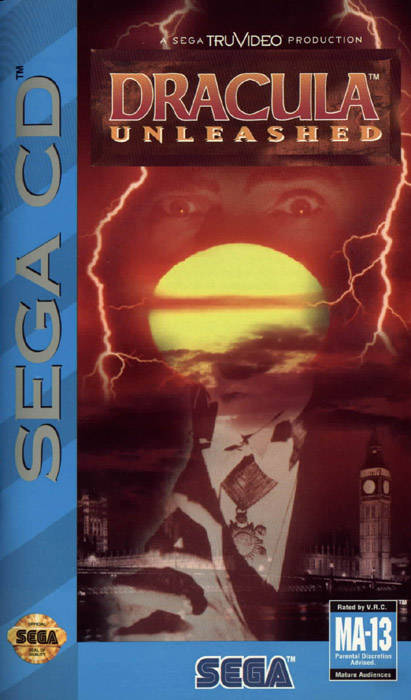
CD102: Dracula Unleashed
- Developer: ICOM Simulations / Viacom New Media
- Publisher: Sega
- JP Release: N/A
- NA Release: 1993
- EU Release: May 1994
- Franchise: N/A
- Genre: Adventure
- Theme: Tonight, I'm Going to Suck... at Reading Comprehension Puzzles
- Premise: Dracula has been defeated and Victorian London is at peace, or at least until co-slayer Quincey Morris is found dead (his head fell off) which raises the possibility of the Count's return, or possibly some kind of decapitating flu. Quincey's American brother Alexander is here to set things straight with some old-fashioned investigation.
- Availability: Nothing more recent than a 2002 DVD game adaptation, but then these classic FMV adventure games get remasters all the time. Not like you have licensing issues to worry about with an IP this old.
- Preservation: Dracula fever hit in the early 1990s with that Coppola movie adaptation of the original Stoker novel, and so adventure game veterans ICOM sought to jump on that Bramwagon with an original story that takes place after the events of said book. Created by the same team that put together the Sherlock Holmes: Consulting Detective series, Dracula Unleashed features a combination of live-action FMV cutscenes and a whole bunch of pain-(and vampire-)staking investigation work as Alexander travels across various locales while perusing his notes and an ever-increasing hoard of clues. The FMV here does looks a bit cleaner than in the Sega CD Sherlock Holmes games but I'm not sure if I have the patience to play too much of it, even with the promise of sexy vampire ladies (that darn Lucy Westenra, always with the biting). The last thing I'll say is that when your Dracula game starts with O Fortuna instead of Toccata and Fugue in D Minor someone messed up somewhere. (The D in "D Minor" stands for Dracula, after all. That's a verifiable fact, you can find it on the internet.)
- Wiki Notes: Just some screenshots (with header) and minor edits.
CD103: Mad Dog McCree

- Developer: American Laser Games
- Publisher: American Laser Games
- JP Release: N/A
- NA Release: 1993
- EU Release: N/A
- Franchise: Mad Dog McCree
- Genre: Light Gun Shooter
- Theme: The Violent Bandit, Mad Dog McCree, Has Already Defeated the Town's Sheriff, Courteous Dog McCallister, and You're Next
- Premise: A nameless stranger wanders into an equally anonymous Wild West town (some real dedication to worldbuilding here) and finds himself embroiled with some local trouble with the notorious titular rogue, whom has the mayor's daughter as his hostage.
- Availability: The most recent remaster was for PlayStation 3 in 2013.
- Preservation: We conclude the 1993 season of Mega Archive CD with one of the most famous (or maybe infamous) FMV light-gun games out there, Mad Dog McCree, which was first released to arcades in 1990 before eventually becoming a staple of almost any western-made console with a CD drive. The relative simplicity of the game coupled with the hammy performances of its cowboy cast made it a quick favorite for those looking for an arcade experience without a whole lot of investment required. Just shoot a few dudes, have the undertaker (not that one) make fun of you when you inevitably get shot by some tiny dude from a window, and just mosey on down to the OutRun cabinet or whatever else grabs your attention next. A harder sell as a full-price console release, of course, but American Laser Games did relatively well for itself on this platform regardless. No firm idea when in 1993 this came out on Sega CD but the developer would go on to port over Mad Dog's sequel Mad Dog II: The Legend of Curly's Gold* in 1994 along with the mechanically if not stylistically similar Crime Patrol and Who Shot Johnny Rock?. (*Remember to fact check this later.)
- Wiki Notes: Just some box art.