
Tuesdays* of Terror: Shiryou Sensen: War of the Dead
by mento
(*sometimes Wednesdays) I intimated when I covered Sweet Home a fortnight ago that it was popularly considered the first "survival horror" game as we understand the subgenre—restrictive item limits, high risk encounters, and adventure game puzzles that had you following a circuitous route around a haunted location for the maximum amount of spooks—but really that designation better belongs to th...
(*sometimes Wednesdays)
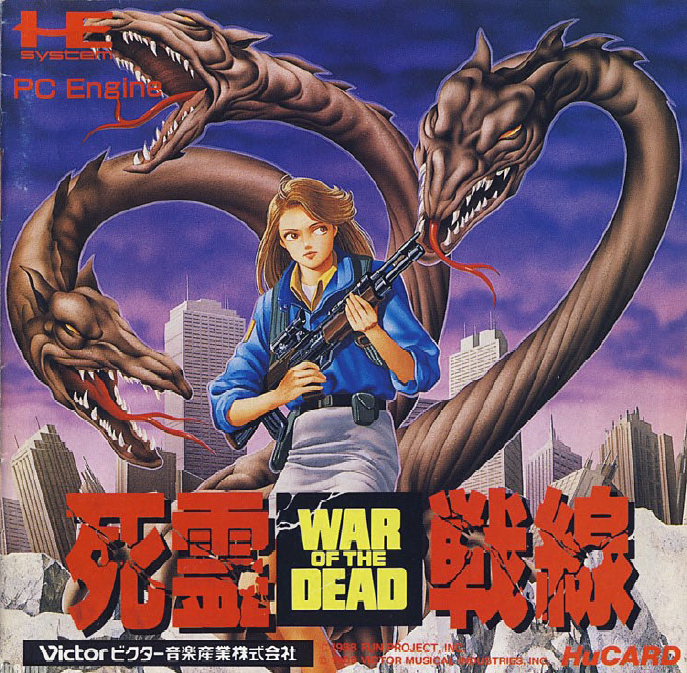
I intimated when I covered Sweet Home a fortnight ago that it was popularly considered the first "survival horror" game as we understand the subgenre—restrictive item limits, high risk encounters, and adventure game puzzles that had you following a circuitous route around a haunted location for the maximum amount of spooks—but really that designation better belongs to this week's game, Shiryou Sensen: War of the Dead, which first launched on MSX2 in 1987. War of the Dead also carries many of the trademarks that would go on to codify this specific interactive incarnation of the horror genre, including all of the above, as you go about saving what's left of the citizenry of Chaney's Hills from a sudden invasion of the undead and demonic. It also happens to be a game that manages to combine all the worst elements of the subjects covered by Tuesdays of Terror so far—The 7th Guest's obtuseness, ...Iru's bizarre and logically disconnected series of flags to hit, and Sweet Home's unbalanced difficulty and constant random encounters—so this turned out to be a pretty fitting conclusion to this feature. Which of course was the intent all along. Cough.
The protagonist Lila is the youngest member of S-SWAT, a special task force set up to combat supernatural forces, who uses a combination of psychic powers and firearms to defeat her monstrous foes: she and her team are dropped into Chaney's Hills to take stock of what's happening and how it might be foiled, soon splitting up much like the S.T.A.R.S. of Resident Evil. A large chunk of the early game involves finding out what happened to the rest of your team as you go around saving the townspeople one by one. The game's not shy about its thematic influences, with most characters having familiar names like Carpenter (the local priest), Romero (S-SWAT's commander), Cronenberg (S-SWAT's most senior female officer and Lila's mentor), or Cameron (S-SWAT's second-in-command): all of whom, I shouldn't need to point out, are surnames of famous horror movie directors. Likewise, the involvement of an old Native American woman who understands the cause of the undead plague due to the mystical history of the land or the great deal of gun types you can find definitely hearkens more to American horror fiction than Japanese or European.
 Fortunately, shooting your friends in the face with a shotgun was already a popular pastime in Cheney's Hills, so the undead rising en masse was no sweat to deal with.
 In the MSX2 version of the game, Romero resurrects as a zombie and tries to kill you. Kinda on the nose?
Gameplay-wise, there's a few versions of War of the Dead and they all play somewhat differently: the original MSX2 game is a standard action-RPG that uses a top-down format, though the 1989 PC Engine port that I've been playing here (owing to the fact it's the only one to have a fan translation and RA support to my knowledge) uses a Zelda II style side-scrolling format for combat but a top-down approach for everything else. The normal loop boils down to visiting the NPCs in the local church, the only safe haven from the monsters, and figuring out what you're doing, where you're meant to be going, and who might still be out there needing saving. Some survivors refuse to budge until you've either performed some manner of fetch quest for them or they just change their mind depending on how far through the story you are, so you'll be visiting in on them several times throughout the game to see if anything's changed. Otherwise, the vast majority of the runtime is spent wandering around the unnecessarily large and convoluted overworld map that is unusually barren in terms of buildings that people might theoretically live in if this was meant to be a whole town, getting into frequent random encounters with small groups of monsters that you can either confront to earn resources or run away from by quickly exiting either side of the encounter area (a la Zelda II).
Resource management is a major factor here, as you might imagine from that lede about this being a prototypical horror survival game, and though you earn a very small amount of consumable items you can activate from the inventory menu (but only outside of combat) most of your healing will come from red orbs dropped by enemies. Monsters also drop pink ammo boxes, green orbs that replenish your psychic power (used sparingly to buff your damage temporarily), and blue orbs that give you experience points. Each level you go up increases your max health and damage output, so it's worth it early on to grind a bit before taking on the more dangerous interior locations like the school or the hospital. Max psychic power goes up at significant story moments and new weapons periodically show up as quest rewards or from looting a handful of dead bodies. However, the stronger weapons burn through your universal ammo total way quicker—the SPAS-12 shotgun fires a devastating spread but consumes nine bullets per shot, for example—so against anything besides bosses you're better off with the machine gun you find early on. Usually, while ammo and XP drops are always needed, if you know what enemy types (including palette swaps) drop what kind of item you might, for example, choose to avoid the red orb enemies if you already have full health since otherwise you'd be wasting ammo on them. The encounter rate does this odd thing where it goes quiet for long stretches and then gets very aggressive, popping almost every other step, so there are times when you'll want to quickly elude the current batch of ghoulies just to keep things moving along. The game is dreadfully slow due to the combination of the encounter rate, the huge overworld map, and the labyrinthine nature of some places like the ominous ruins, and so random encounters definitely become a nuisance before too long.
 Water travel is usually much faster owing to how you can get to places directly without having to take detours around mountains and trees. Though you do occasionally have to contend with whatever the hell this thing is. Me and my dinghy are outta here.
 The church only has two people in it when you start, but it slowly starts filling up as you make progress saving folks. Not too dissimilar to that maintenance area in Dead Rising. Of course, this just means more people you have to talk to before you can leave...
Another irritating factor are those flags. Before you can make much progress in some areas, or characters actually appear and can be spoken to, you need to talk to all the people holed up at the church until one of them says something useful to the story like "how is that dude over by the drugstore doing?" and that's the flag that'll make the drugstore guy suddenly more communicative. Sometimes you'll need to talk to one person at the church before someone else there says something different, so a normal sweep might involve talking to everyone once, talking to them all again once one of them says something different, and then ensure everyone's repeating their last line of dialogue before finally leaving. It's better to be safe than sorry, since you'll often have to cross the entire map to talk to characters like Omadan (the Native woman) or a man named Wes who has fortified himself underneath a castle that inexplicably sits on the periphery of this small American burg and if you get all the way there just for them to repeat their one default line of NPC dialogue it's a huge timesink. Unless you peruse a guide beforehand you'll keep hitting these irksome progression barriers on a regular basis, causing a game that generously speaking has about two hours of content take about five times that to actually complete.
Finally, before we're through here, I also need to address the passwords the game uses in lieu of a battery back-up save system (since PCE HuCards weren't typically built for that):
 The true horror.
To expound on the above screenshot, each password is 54 characters long out of a maximum of 128 character types. The strange dip into symbols and Greek letters was due to an imaginative change implemented by the fan translation: in the original Japanese version, it includes all 46 katakana, 46 hiragana, 10 numbers, and the 26 letters of the Latin alphabet. Either way, this is kind of ridiculous as a means of saving your progress in a game that starts out as very difficult due to the limitations enforced by the format; though it does at least get way easier once you've built up your initial 20 hit points to triple figures and have found something better than the starting knife and handgun. In many cases, when I hit an early game over I just started anew rather than attempt to input these nightmare wingding passages like I was typing a letter to the San Francisco Chronicle hinting about all the murders I'd done.
Shiryou Sensen: War of the Dead is a fascinating game from a historical perspective, presenting the seeds of what would eventually become a beloved genre from the PS1 era onward, and though those mechanics don't quite coalesce as well here in their inchoate forms you cannot dismiss the innovations this game brought to the table. This game was created by a company named Fun Factory (or sometimes Fun Project); an obscure Japanese developer that popped up and vanished almost as quickly, with its PCE publisher Victor Interactive Software (later Marvelous Interactive) potentially having some influence with the changes this port saw. For all its esoterica though there's no doubt this was a pivotal game in the long process of figuring out how to properly translate horror to video games, and deserves to be lauded as such. Should you actually play it though? Well, maybe on an emulator with save states...
 Happy end! Except for all the dead people.
There are... no more Tuesdays of Terror (or Wednesdays). Happy Halloween! Here's everything we covered:
| The 7th Guest (Trilobyte, 1992) | Sweet Home (Capcom, 1989) |
| ...Iru! (Soft Machine, 1998) | Shiryou Sensen: War of the Dead (Fun Factory, 1987-89) |