
RetroPiece Theater: Secret of Evermore
by mento
When it comes to retro gaming there are the classics that have been iterated upon ad nauseum, there are the derivative also-rans that history's mostly forgotten, and then there are those so singularly strange that they've yet to be imitated, even by Toby Fox. Guess which one I'm drawn to most? Guess which one Square's Secret of Evermore is?
Secret of Evermore, the inaugural (and only) game from the experimental Square USA branch, is not a game that enjoys a sparkling reputation. Part of that is in how it's a watered down variant of the Mana games, specifically Secret of Mana, with a whole lot of surreal humor (which wasn't butchered by a poor localization, at least, since it was written in English to begin with) and some occasionally irritating maze-like dungeon design and a pervasive sense that some of the game was rushed to meet deadlines. Despite that, it remains one of my favorite SNES games largely because it feels so bizarrely singular in its construction. To me, it has the same appeal as something like an EarthBound or Marvelous: Mohitotsu no Takarajima: distinctive oddities that maybe shouldn't exist but we're all richer for the fact that they do.
Secret of Evermore, looking to emulate its Japanese peers as best it can, is an action-RPG with an isekai-adjacent plot of some kid and his dog from Podunk, USA (literally the town's name) accidentally getting teleported into a fictional world created by the eccentric Professor Ruffleburg populated by a handful of Podunk's locals and a whole lot more virtual NPCs and monsters. Each region of Evermore, as this fantastical world is called (it'd have to be, given it's the name of the game), was deliberately designed to appeal to each of its visitors: a prehistoric region for the dino-obsessed granddaughter of the professor; a gilded age of antiquity for the local museum owner; a medieval castle surrounded by dragons and wizards for the romantic head librarian; and a sci-fi space station from which the professor could monitor his creation. Naturally, something went awry long before the player-named protagonist got there, and his story sees him visiting each region in turn as he works on the mystery of whom this mystery saboteur might be as well as finding a way home.
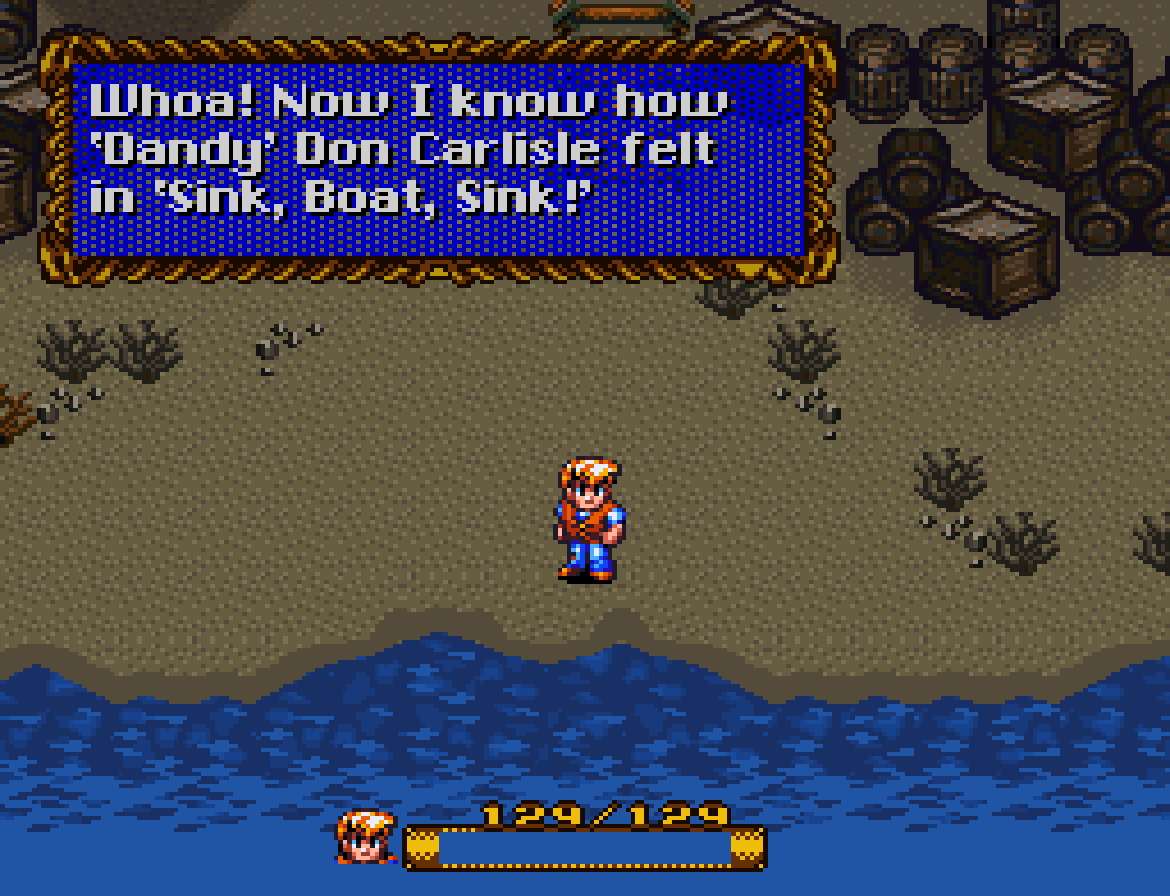
He has like a hundred of these. It's as if Troy McClure headlined his own game.
The game, as discussed, is an action-RPG built to closely resemble the Mana series: your normal attacks operate on a cooldown, with quick subsequent hits given significantly less impact if you don't let the bar refill after your last attack (though might still offer some utility in stun-locking your foe), and by mastering your weaponry through repeated use you can apply extra charge bars to get more bang for your buck. This works especially well on bosses and tough enemies that only occasionally leave themselves open for damage. The game also sports an original "alchemy" magic system that runs off reagents: you have to find these reagents in the wild first (your dog partner will sniff many of them out in the environment) as well as the recipes to cast them from teachers and notes. The standard heal spell, for instance, requires one water and one root: ingredients you're likely to find almost anywhere. Like Secret of Mana, the game can be very picky about adequate distance and hit boxes, with enemies likely to strike you before you can reach them. Both characters have dramatic knock-back whenever they're hit too, so you might find yourself batted around by fast-moving enemies unless you resort to ranged options like throwing the spear (which requires charging it up) or your alchemy. Enemies are also stunned after getting hit the same way, so a good method is to soften them up with a spell and run in with a physical attack before they wake up again. The difficulty's pretty gentle overall, barring a few nasty boss encounters, and you have plenty of healing options between the alchemy and a whole stack of curatives.
Where the game shines most is in its presentation, however. Visually it's on the higher end of what SNES RPGs could pull off, what with Square's investment and it being roughly contemporaneous with the launch of Chrono Trigger, with plenty of well-designed (and occasionally bizarre) sprites for its enemies and remarkable architecture for some of its backdrops. The largely ambient soundtrack alternates between serene and ethereal, a sharp contrast to the sound design which goes for more comical bangs and squelches whenever an enemy is defeated, and this music gives the game an eerie, otherworldly vibe that is perhaps far more emotive than the game and its tongue-in-cheek script really deserve. (The composer, Jeremy Soule, began his video game composing career here and would later go on to score many major western RPGs like Icewind Dale, Star Wars: KOTOR, and TES: Oblivion/Skyrim before being ousted from the industry for sex pestery.) Between this OST and its surreal sense of humor, the game projects a mysterious aura that helps to obfuscate its more derivative roots and concepts; it often gives more the sensation of a trailblazing passion project rather than a stitched together also-ran from a fledgling studio still learning the ropes.
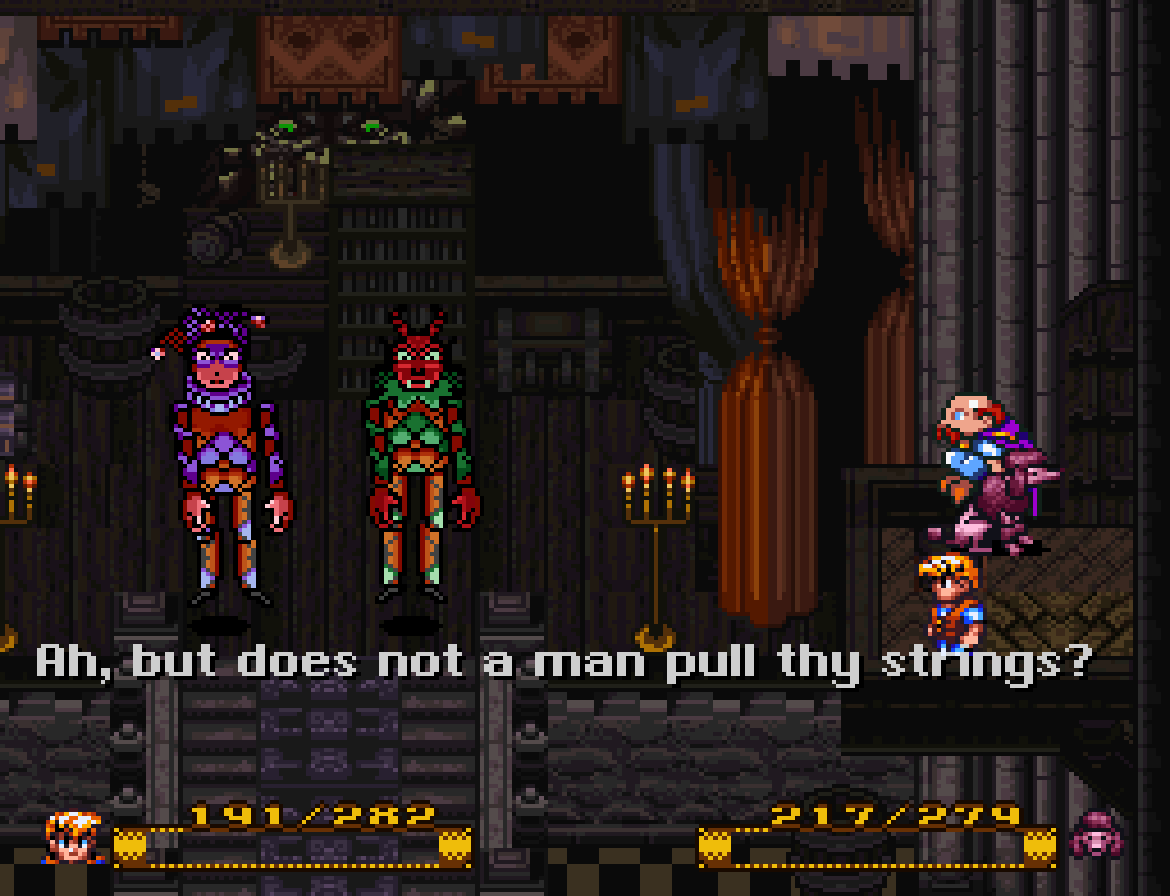
The Final Fantasy allusions in this game are both overt and subtle, a case of the latter being that instead of FFVI's opera you have this whole-ass production of Faust going on.
At any rate, it's one of those games from my youth that I might struggle to justify as a timeless hall-of-famer worthy of a retrospective panegyric like this, yet one that—thanks largely to its many idiosyncrasies—I find myself thinking about far too frequently. As with most RetroPiece Theater entries so far, attempting its RA set was just the flimsiest of excuses I needed to finally revisit the thing. I will say that the RA set for Secret of Evermore isn't that exceptional—it feels like one put together when the site was still new and hasn't seen any subsequent waves of revisions that a bigger game like Final Fantasy VI or A Link to the Past may have received to make those sets pop all the harder—but there's a baby's handful of fun challenges and discoveries to be found there.
RA Challenges
For the most part, the RA set for this game is less about going out of your way to add some extra layer of difficulty for the sake of those revisiting the game looking for a greater challenge, like for example some no-damage runs or the like (which would be nearly impossible given how most boss fights are internecine as heck), so instead the "challenging" aspects of the set really boil down to easily missable treasures and a whole lot of time spent grinding weapon and alchemy spell levels. A missables guide wouldn't be a bad thing to have open somewhere on the side.
The one big challenge in here is completing Secret of Evermore's notorious trade side-quest within the game's own sorta imposed time limit. This involves the bazaar at Nobilia, the major city in the Antiquity era, and how it operates almost entirely on a barter system. On your first visit to this city, the game also enforces a 15-minute limit before a town meeting is held and, from the results of that cutscene, the story is able to progress. The challenge has you collect every available piece of armor and charm (which provide passive bonuses as long as they're in your inventory, though some don't actually work) through this barter system, swapping back and forth spices, rice, pottery, tapestries, perfumes, chickens, beads, jeweled scarabs, golden jackal statues, limestone tablets, and something called an Amulet of Annihilation which doesn't sound like the kind of object you'd want to disseminate commercially. Each has a price equivalent that might go back three or four trades before you get to the standard legal tender (which changes with each region also) where you're expected to start. Doing all this within fifteen minutes gets a whole lot easier with a step-by-step guide, of course, but back in the day writing all this shit out and figuring out how to score a whole bunch of strong passive items relatively near the start of the game made it worth the trouble. Honestly, as long as you have a pen, a pad of paper, and maybe an abacus for the sake of verisimilitude it was a pretty original way to set up a puzzle. An irritating puzzle, perhaps, but one novel enough to be forgiven.
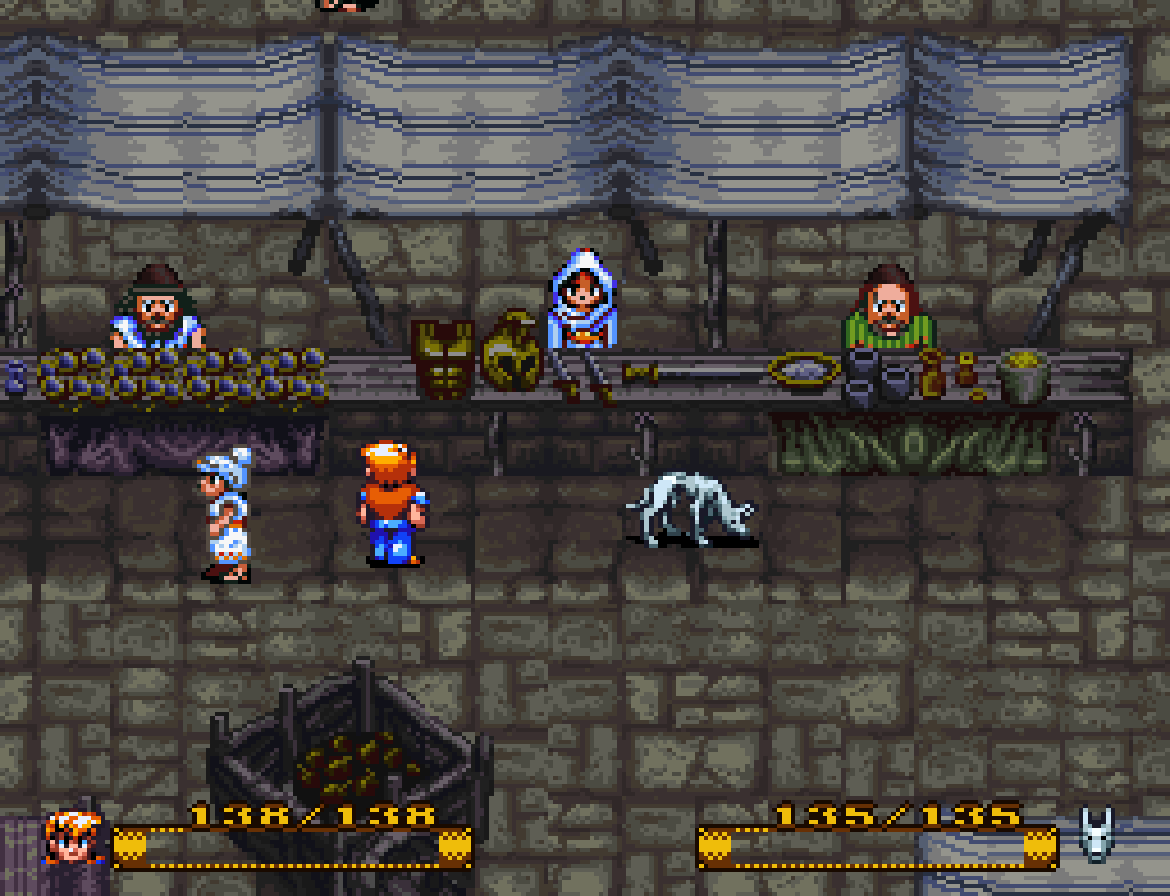
This armor looks sturdy, and it's only going to cost me five bananas, ten bushels of corn, a purse full of 20-carat rubies, three bottles of unicorn bile, two tickets to a Taylor Swift concert, my firstborn child, and a silver statue shaped like a horse's ass. Who the hell walks around with that many bananas on them?
The only other achievement that really qualifies as demanding something tougher than what you'd get in a standard playthrough is a mini-boss fight with a pack of fast-moving velociraptors just a few minutes after starting the game in earnest. You're not necessarily meant to win this fight—if they knock you out you wake up in the nearby village, where the story is waiting for you—but it's entirely doable, even with just the starting weapon and no alchemy to fall back on. The achievement's name ("Clever GIrl") is but one of many movie references in this RA set; germane, given how often the protagonist references (fictional) schlocky B-movies himself.
RA Discoveries
I did learn a few extra tidbits while perusing the set here, some of which I think I must've figured out through trial and error way back when and have since forgotten about as the decades rolled past. One thing I'm near certain I didn't know about a Zelda Easter egg involving the chickens in the above marketplace: if you really hammer the action button to the point where the rapid series of chicken bawks becomes an electronic drone you'll eventually get struck down by some manner of chicken guardian angel. There's an achievement in this set where you have to incur this entity's wrath twice over: if you try the same thing with a goat in that marketplace after the first strike, the mysterious voiceover says something akin to "oh, yeah, you can annoy the goats all you want, just leave the chickens alone", and then you go right back to bothering the chickens for another zapping.
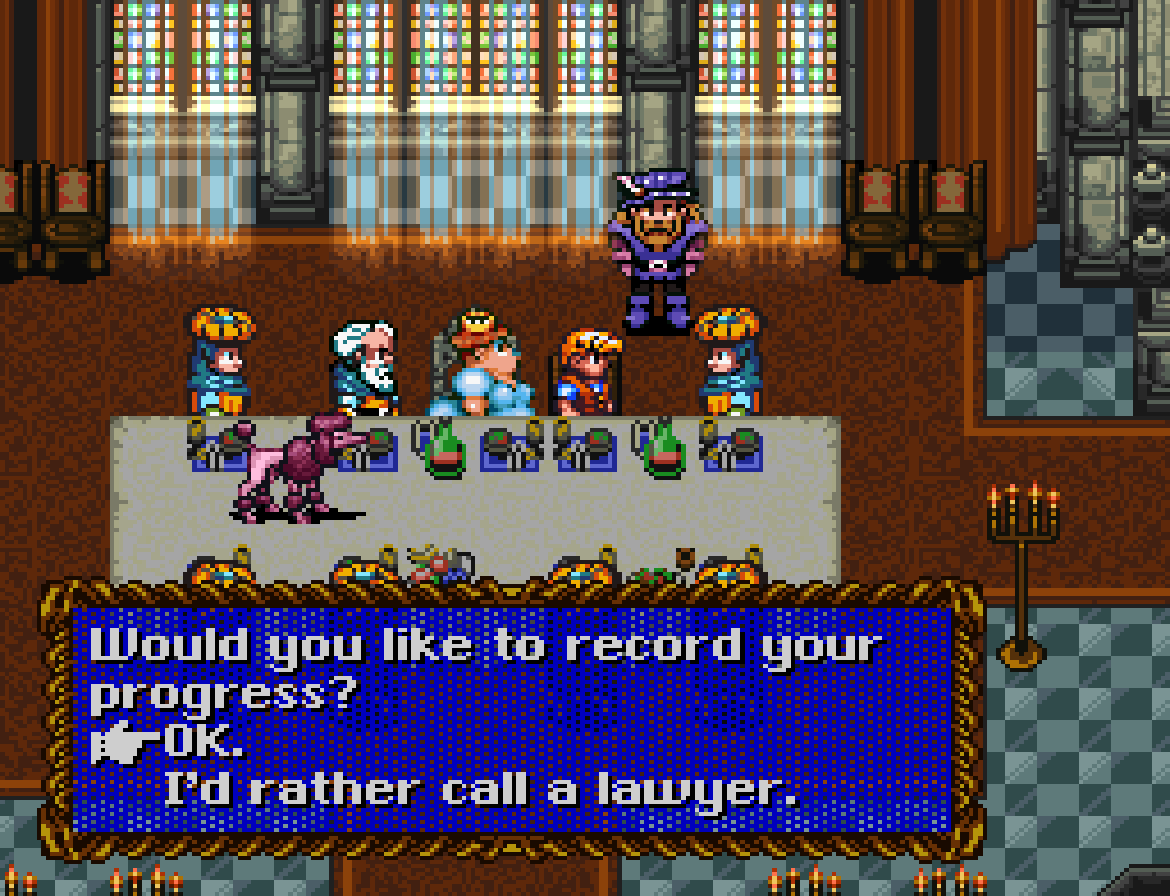
Protag gets thrown in jails a lot. I'm guessing it's the hair. Or maybe Marty McFly copyright infringement.
The other weird discovery was that the game's sole superboss has a 1 in 27 chance of being impossible to reach, and thus the achievement attached to it becomes inaccessible for that playthrough. Apparently this flag is determined the moment you start a game, so you've got some 20-25 hours of gameplay before you know whether or not the game screwed you on a very unlucky diceroll. Like I said, the game's not exactly perfect and I've seen a few comments in that achievement's section that are somewhat bitter about drawing the RNG short straw. I guess fingers crossed that I prove a little more fortunate.