
The Dredge of Seventeen: April
by mento
When it comes to game releases every year has its big headliners and hidden gems, but none were more packed than 2017. As my backlog-related project for this year I'm looking to build a list of a hundred great games that debuted at some point in 2017, making sure to hit all the important stops along the way. For more information and statistics on this project, be sure to check out this Intro bl...
When it comes to game releases every year has its big headliners and hidden gems, but none were more packed than 2017. As my backlog-related project for this year I'm looking to build a list of a hundred great games that debuted at some point in 2017, making sure to hit all the important stops along the way. For more information and statistics on this project, be sure to check out this Intro blog.
Welcome to the end of April, fellow Dredgeneers, as I run down what has been - and probably will be - the busiest month for this feature yet. My chief reason for going all out in April is that May usually follows and I traditionally dedicate that month to a completely different kind of backlog-clearing madness, which won't leave a whole lot of time to spend on more 2017 games. I'm also starting to run low on my 2017 supply, so after this month it's probably going to be a trickle of major tentpoles rather than the current hosepipe of whatever Indies I found stashed away in my Steam or PSN libraries.
At least fewer games will make these regular updates easier to read! Certainly not the case this month! Enjoy!
Alicia Quatermain: Secrets of the Lost Treasures

We'll start with a game I acquired for free through a SteamGifts raffle that utterly perplexed me. Not in the sense that the game was difficult to understand or required a high level of skill - quite the opposite for both, in fact - but that it introduced to me an entirely new genre construct that I was momentarily surprised I'd never seen before, until I realized it may well be a format very familiar to those who play a lot of mobile games: an arena I have less than a little experience with. (The developers are also behind a series called 12 Labors of Hercules, which has like a thousand entries and plays just like this.)
The goal of Alicia Quatermain (granddaughter of famous literary explorer Allan) is to order workers to clear paths to the next stage or hit a target goal of a stockpiled resource. It's essentially the farming/building stage of an RTS but not the combat: you send goons to collect loose piles of junk, activate mines and other resource spawners, and then spend that junk to fill in holes, clear detritus blocking the road, or build bridges over gaps. You're rated on how quickly and efficiently you can complete the stage goal and getting three stars on a stage (the maximum) puts a new trinket in your protagonist's office, which slowly turns into a museum as you progress through the game. While it starts simple enough, you learn to prioritize important steps: freeing other trapped workers or upgrading the worker's tent means having more workers to complete tasks, which greatly increases the speed at which you accomplish goals; ditto for clearing the way to resource generators like mines or endless resource respawners like fruit trees, both of which are reliable ways to build up the stockpiles you need; it's best to figure out early which "bottleneck" resources you'll be struggling to acquire from a lack of generators - there's food, building materials, and gold, and each construction job requires specific combinations - and making sure to acquire those first so you don't get stuck; and remembering to find the not-so-hidden puzzle piece on each map before leaving, as grabbing them unlocks bonus missions.
I actually found Alicia Quatermain: Secrets of the Lost Treasures oddly compelling in a casual gaming context; the same way I feel about those HOPAs or something like Regency Solitaire but with the added benefit of being something I'd never encountered before. I'm only supposing that those who spend a lot of time downloading whatever's free from the Google App Store for something to pass the time while waiting for the bus has probably seen a hundred different variations on this, and probably utters "oh, it's one of those" while scrolling through the week's new apps, but as a simple-to-pick-up plate-spinner with enough variance and deeper strategies to glean as it progresses I had a fine experience with it. It's also the first time I've really enjoyed playing an RTS game in a long while, so that's something.
 These zoomed out maps always reminded me of Heroes of Might and Magic, wondering why all these brave knights and shrewd wizards kept leaving piles of valuable junk everywhere.
 The overworld map is just as visually cluttered, as is Alicia's office once you've earned enough treasures. This game is a nightmare for the fastidious.
Ranking: C. (It gets a bit of a boost for being novel, to my eyes at least, and from me acknowledging that even as a """"serious"""" gamer I can still occasionally be taken in by a well-crafted casual game.)
A Hole New World

If you've read enough of my previous reviews, you'll know that I like my platformers with a healthy dose of collectables. Some games, though, de-emphasize the presence of these glowing doodads in ways that seem almost hostile to the idea of having them at all, which I can understand objectively as a means of saying "hey, this shit doesn't matter, focus on the puzzles and combat please" but personally can feel like a knife through the heart (or maybe something way less dramatic, like a splinter through the pinky).
A Hole New World, a retro 8-bit styled platformer from Spanish developers Mad Gear Games, is one such game that cares little for attending to the obsessive-compulsive treasure-grabbers that follow the genre: each of their stages cannot be revisited, and will frequently have drops or other one-way passages that prevent you from backtracking to collect whatever you missed. What rankles is that there is a "collectathon" mode that tracks how many items you've found on each stage, but you can only activate it by going into a special menu for "mastery runs" that includes options such as adding a timer for speedrun attempts.
Move past that indignity though, and A Hole New World is a fairly compelling platformer seemingly inspired by that bonus Shovel Knight campaign featuring Plague Knight: the protagonist uses potions as weapons, acquiring more as they progress through the game, and each performs a slightly different fire pattern that works optimally against some enemies and not so well against others. Switching between potion styles on the fly while staying evasive seems the best way to make it through the game, and like collectables the number of enemies on a stage is also tracked if you feel like genociding the entire region. A Hole New World's other distinctive angle is the titular "new world": a shadowy realm that sits parallel to the protagonist's home plane, which can be travelled to by falling into any pit. Doing so deposits you on a darker, vertically-inverted world which feels a little discombobulating to navigate - in strict mechanical terms this is because the controls are not reversed even though you're upside-down, but it also feels like one of those cases of ludonarrative harmony in that an eerie, reversed upside-down world (like, say, the Stranger Things's Upside-Down) ought to feel somewhat disorienting despite - or perhaps because of - having a familiar layout.
It's evident that the developers' predilections for retro platforming do not mirror my own, but that didn't entirely diminish the game experience for me. It does have a few other odd sensibilities, like a difficulty curve which is very gradual until the final two bosses at which point in rises precipitously into low orbit, and managing the potions and memorizing their throwing arc distances is a bit of a pain until you unlock the much more reliable final potion upgrades. It's still an otherwise well-made game that'll keep you on your toes between its many dogged enemies and nasty traps (bit closer to Mega Man than most retro platformers, perhaps). Plus, and it's always worth mentioning this, it was included in that Itch.io Racial Justice and Equality bundle so you probably have a free copy of it lying around in your Itch library.
 The hardest boss in the game, easily twice as hard as anything else you've encountered, this guy spends a lot of time mocking you and then swooping in for the kill. Like Red Arremer but somehow worse.
 The actual hardest boss in the game, though I eventually discovered a trick. These projectiles fan out to cover 80% of the real estate over here, and I can only get hit by them six times before dying. (For some reason, I forgot to screencap anything but bosses. I guess because I was stuck here for a long time and wanted something else to do?)
Ranking: D. (I've many retro platformers on this top 100 I prefer because they cater more to my particular kleptomania psychoses, but I can't kick a game this competently made too far down the list either.)
The Lego Ninjago Movie: The Video Game

Normally, I wouldn't go out of my way to play a Lego platformer based on a license - in-house this time, rather than third-party - that I have zero familiarity with, but if you recall The Lego Ninjago Movie: The Video Game was given away for free on every platform just recently. While it is based specifically on the 2017 Lego Ninjago movie, the Ninjago franchise is significantly larger: there was a TV show that aired for fifteen seasons (!) and, of course, the Ninjago playsets themselves have been around even longer. It's undoubtedly one of those phenomena like Yu-Gi-Oh or Ben 10 that entirely passed by my late-millennial ass. Ninjago's setting is a very nostalgic mishmash of Asian cultures, once so popular in the 1980s and 1990s, in which a bunch of mostly Caucasian teens with American accents are taught how to become Japanese ninjas by a Chinese kung fu master. It's equal parts The Karate Kid, 3 Ninjas, and the Mighty Morphin' Power Rangers, the latter specifically because the six-person team (including a green one, who is also the strongest) are all color-coded and they all have mechs for some reason.
Anyway, despite the new martial arts trappings it has the same Traveller's Tales Lego platformer dynamic that all those games have. You run and jump across stages solving puzzles by building things, fighting off hordes of goons, and then doing it all again later on "free play" mode when you have access to characters with the specific abilities you need to reach all the collectables. Since it's only following the plot of one movie rather than several, it's a little more svelte than a Lego Star Wars or Lego Harry Potter: just eight story missions, though the stages themselves are a bit longer than normal. The story mode should take about four or five hours, and then that amount of time again to hit 100% completion. In addition to the free play mode, there's a bunch of dojos - which are all wave-based combat challenges with rewards for high scores - and a multiplayer mode that seems fairly half-baked since all it has are three variants of "hold onto a thing the longest."
Ninjago is a bit more combat-heavy than other games I've played in the Lego series, owing to that whole martial arts movie aesthetic. There's a handful of techniques that all have names like "Art of the Stinging Bee" that the game advises you mix up, as enemies tend to block attacks if you stick to the same predictable moves. As you play through the story, you acquire "Ninjanuity Tokens" - acquired from solving each major obstacle puzzle - which upgrade these individual combat moves three times each, adding more damage, bigger shockwaves, or increasing the stud multiplier. Speaking of which, the game no longer requires a specific stud total per stage to earn a collectable: instead, it works closer to an experience point system that persists across the whole game and provides unlocks for each new milestone hit. This also takes the pressure off losing a lot of studs from the same pitfall trap or difficult boss. Instead of being cheats you can activate, stud multipliers are earned by racking up large combos during battles.
Despite these many changes, some of which may have been around longer (the most recent Lego game I'd played prior to this was 2013's Lego City Undercover, and there's been like twenty more since then), Lego Ninjago: The Toy: The Movie: The Video Game has many of the same issues that have been plaguing this franchise since forever: activating the double-jump is frequently unreliable, as is sticking to points when ninja-jumping across spikes; your AI partner can get lost or hung up on something and be miles away when you switch to them; the collectable indicators aren't always helpful and the developers have yet to figure out a way to convey scenarios like "hit five targets to make the gold brick appear"; and random surfaces can be slippery and impassable, and there's no obvious coding for active and inactive platforms to tell which is which. It's wild that after twenty years and dozens of iterations, these games still kinda play like trash in the same ways they always have. It also crashed several times, so just a premium experience all round.
 The Great and Terrible Meowthra is, of course, a regular tabby. Still kaiju-sized for Lego people though.
 The vehicle sections must use George Lucas's action choreographer guy, because I can barely follow what's happening with all the visual stimuli on the screen.
Ranking: D. (I realize I can't kvetch too much about a free game and these Lego platformers are fun in small doses, but they also do less between each iteration than Assassin's Creed or Call of Duty or even Madden. Couple that with this homespun derivative teen ninja nonsense and my interest in the game dips closer to "purely academic." I did like Meowthra though.)
Rex: Another Island

Rex: Another Island, despite being both smaller than The Lego Ninjago Movie: The Video Game and less imaginative than A Hole New World, is much closer to my particular idea of platformer nirvana. As a little T-rex who washes up on a mysterious island, the whole thrust of the game is finding and banking collectables. That is, you have to collect the many shiny objects strewn across each of this game's areas but then also hit a checkpoint without dying to make them all "count" as permanently collected. It's a no frills type of platformer - there's a double-jump except it's available from the outset - but one that is cute, straightforward, not too easy, and has a few surprises and detours if you're inclined to seek them out.
Besides the usual golden ring collectables, there's also magic gems (five in total) and teleporters that you can use as a fast-travel system. In both their cases, you see signposts directing you towards them which makes them hard to miss, even for as labyrinthine as the world design can be. Some areas - like a lighthouse early on - are purely optional but for the fact they contain more stuff to find, and the game's best ending is reserved for those who deign to collect everything. It's a trivially short game - about two hours if you aren't rushing it - but also utterly delightful with its minimalist and small-scale look, along with handy quality-of-life features like the aforementioned teleporters (which you can warp to any at time, not just at another teleporter), a lack of any downtime between deaths, and a button that lets you zoom out the screen to see your surroundings better which also provides a stage-by-stage breakdown of all the collectables you've found. There are still a few challenging sections, especially if you're trying to grab all the trinkets and make it safely back to a checkpoint to bank them, but on the whole it's a pleasant if brief playthrough. (NB: It was also included in the Itch.io Racial Justice and Equality bundle.)
 You can still play while zoomed out, but it makes everything even dinkier than usual. Might be a problem. A dinky problem.
 A possible ending. Don't read if you don't want spoilers. I gotta put this here to show off is all.
Ranking: C. (It's nothing exceptional in terms of its ideas or presentation, just a charming little platformer that gets everything right. The soundtrack's great too: a good balance of atmospheric ambience and jaunty tunes.)
Tokyo Dark: Remembrance

The Japanese adventure game genre is one that's interested me in a while, if anyone was around to see my (slightly inaccurate) rundown on how the genre shook out differently in the east, though it's rare to see too many Indie adventure games from that part of the world. Mostly, you're looking at visual novels from those lower-budget corners of the Japanese game marketplace. Tokyo Dark is as classic a format as you're likely to see in this day and age, taking little aspects from all the major pillars: there's stat management akin to a dating sim, albeit mostly focusing on sanity and professionalism rather than academics and hotness; there's some very simple inventory and environment puzzles that don't ever require you to roam too far, including a few crime scene investigations, which tended to be the case in the more narrative-focused forebears of the Japanese adventure game genre like Portopia; and there's many branching paths and different endings contingent on answering some binary choices, which are common to those aforementioned visual novels.
To elaborate on the last of those: the decisions you make are often borne of taking the easy and unprofessional route over the slightly more invested and lateral approach. For instance, if an NPC is giving you sass and being unhelpful, there's sometimes an immediate option to threaten them which will "solve" the puzzle but might hit you with some negative stat changes or create problems further down the road. Conversely, taking the time to find an alternative solution that makes them happy will add busywork to your tight schedule (not that there's any in-game timers to worry about) but will be beneficial to your own well-being as well as your relationship to this NPC. Considerations like those pay off towards the end where endings are gated behind certain stats being high enough, though there are also some fun ones that involve the opposite: being as brash, disruptive, and crazy as possible can put you on one of several roads to eventual ruin.
As you might've surmised from this talk about sanity meters (and possibly the name) Tokyo Dark is a supernatural horror-themed game that follows some similar vibes as other J-Horror affairs like The Ring (and its cursed murderous moppet), or the Fatal Frame and Silent Hill video game franchises: as detective Ayami Itou, your by-the-book reputation is thrown into disarray when you are possessed by unseen forces to resolve a hostage situation by shooting the slightly manic kidnapper in the head, who is dressed like an idol for reasons that become apparent later. Though your past professionalism means you only get off with a reprimand and a few therapy sessions to get over your apparently stress-induced trigger happy proclivities (keep in mind this is set in Japan, where cops executing criminals is the exception rather than the norm), this violence rears its head again six months later when the same woman takes your partner (in both senses of the word) Kazuki Tanaka prisoner in the sewers of Shinjuku and murders him in front of you. Now under closer psychological scrutiny and temporarily suspended from duty, Itou is determined to figure out how a dead person can still be going around taking hostages and is determined to dig into what happened six months ago and the many eerie aspects surrounding the case. Things get progressively more surreal from there, suffice it to say.
There's a lot I appreciate about Tokyo Dark's slow-burn of a supernatural mystery plot, and it has a handful of fun characters and ideas to lean on, but for the most part the gameplay mechanics generated more trouble than it was worth dealing with to see the game through to its end. A part of this is how the branching format and the stats-determinant aspect meant a lot of repetition, and the game has some very basic fetch quest puzzles they get tiresome quick if you're playing them over and over. The first playthrough is auto-save only and won't make any checkpoint saves - I guess the idea is to have a "pure" playthrough based on gut reaction decisions before letting you go back into NG+ to see how other decisions conclude the story - but even on subsequent runs you can only make so many saves and only at arbitrary checkpoints. Even with that feature, any saved progress won't help if you're aiming for a specific ending and don't have the stats to activate it, as opportunities to raise or lower your sanity or professionalism (the two that seem to make the biggest difference, as opposed to neurosis and investigation which serve as a stat increase/decrease modifier and a measure of how thorough you're being respectively) aren't all that common in terms of significant boosts. You can choose to execute a perverted salaryman in his sex dungeon in the sewers for a big sanity and professionalism drop, for instance, but those radical occurrences are few and far between. Of course, none of these ending-wrangling issues are applicable if you only intend to play the game the one time and settle for whichever ending you reach naturally, though it's advised to play the NG+ at least once because there are a few significant dialogue changes and some endings that are available on a subsequent playthrough.
The atmosphere of Tokyo Dark is excellent, though other parts of the presentation can be a little lacking. Character designs besides Itoh herself, for instance, tend to be a bit plain and unremarkable to the extent that it can sometimes be a little tricky to tell people apart. However, the world design is pretty good: you spend time in Shinjuku, Akihabara, Kabukicho, and Asakusa, and each of their distinctive personalities is keenly felt the moment you step into their respective areas of Tokyo. I did also enjoy the game's macabre tone and its forays into psychological horror - there are parts that reminded me of the movie Perfect Blue, especially when it calls the protagonist's delicate mental state into question - and the heavy themes of fate and determinism, criminal negligence, suicide cults, police brutality, child abuse, and a riff on the Izanami/Izanagi underworld myth means it's a little more weighty than most adventure games are comfortable being (for those that have played it, it's like an anime version of The Cat Lady; cats even play a major role in Tokyo Dark's lighter moments). It also has the creepiest video game mask since Super Mario Bros. 2's Phanto, if that's something that piques your interest.
 Eating food is a good way to restore sanity in a hurry, though there aren't too many opportunities to tuck in. This isn't Yakuza where you can fill up on takoyaki every time you stub your toe.
 Some dialogue options are easier than others. Sorry, Pocky, but the Mask commands me.
Ranking: D. (I enjoyed Tokyo Dark but I have many adventure games from that same year that didn't require me to jump through quite so many hoops to get the most out of them. It's also a little rudimentary in terms of its puzzles, even if I appreciated how there was always a nice way and an asshole way to resolve situations. I definitely think it's worth experiencing one of its ending, if not trying to do all the stat manipulation and decision tree navigation to get the other ten.)
Persian Nights: Sands of Wonders
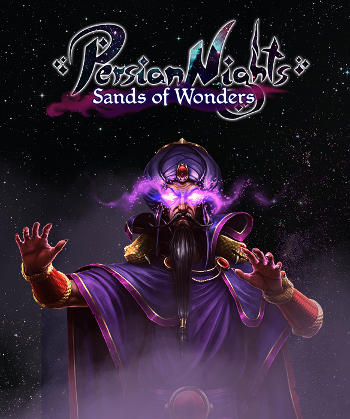
Back once again with yet another culturally sensitive HOPA (Hidden Object Puzzle Adventure). You know what they say, HOPAs spring eternal. I randomly pluck one of these from a pile whenever a new month rolls around, so any similarities to previous ones played so far this year are either coincidental or an indictment of how formulaic these games can be. To whit, this game - like last month's Queen's Quest 2 - also has a heavy alchemy element where you have to find reagents and brew potions to get past certain plot barriers.
However, this one also has some ideas I don't think I've seen before: there's a deuteragonist, a handsome prince love interest named Darius (since, like in all HOPAs, your protagonist is a straight woman), who actually takes over for certain puzzles and sequences that require a bit of acrobatic finesse. You may now have gleaned that the game is doing a not-so-subtle Prince of Persia riff, but it's having fun with djinns and evil Viziers and these bird-dragon things called Simurghs so I don't mind a little narrative pilfering if it keeps them away from the usual elves and wizards and ghosts for a while. Beyond that it's not too remarkable, though if you except the character animations (typically lousy, but I guess good CGI character models can be prohibitively expensive) the backdrops and visuals are some of the most attractive I've seen in a HOPA.
 Due to the odd way characters are animated in these HOPA games, my first impression of Darius wasn't 'what a hunk' like the developers intended but 'oh god, he's shambling ever closer to my delicious brains'.
 This is the first HOPA puzzle in a long while that really gave me a run for my money. I've seen a thousand of these laser reflecting puzzles, but it took forever to figure out how to hit these snakes in one uninterrupted line.
Ranking: E. (The new mechanical twist and the pretty graphics aren't enough to raise this above the GOTY list's graveyard region, but I'll say it's one of the better HOPAs I've played so far. That's really not saying too much though; like me, if you're playing these things it's probably because you're bored out your skull or too tired for anything more elaborate.)