
May Millennials 10: Enclave (Intro)
by mento
Enclave 's been another unexpected treat this month, though it's not without its faults. A third-person action-adventure game - that sort of is and isn't an RPG - Enclave was a 2002 release for a fledgling Starbreeze Studios, their second game after the sci-fi RTS The Outforce . Starbreeze is better known these days for the Riddick games, the first The Darkness , the Syndicate reboot that Jeff...
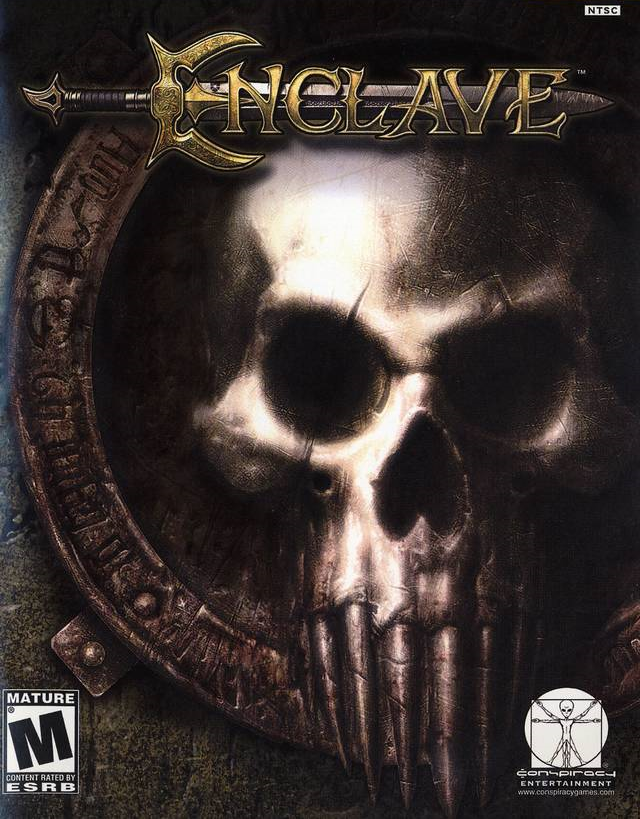
Enclave's been another unexpected treat this month, though it's not without its faults. A third-person action-adventure game - that sort of is and isn't an RPG - Enclave was a 2002 release for a fledgling Starbreeze Studios, their second game after the sci-fi RTS The Outforce. Starbreeze is better known these days for the Riddick games, the first The Darkness, the Syndicate reboot that Jeff likes, and for acquiring Overkill - the developers of the Payday games. For a game rapidly approaching its 20th anniversary, Enclave's not a bad sophomore effort, though apparently its Xbox version - the one most people played - wasn't that great a port. Fortunately, I'm playing the PC version available on GOG. (Also, Starbreeze's original logo was intense.)
Enclave tells the story of a city named Celenheim, which was cut off from the rest of the world by a magical cataclysm towards the end of a mighty war of good vs. evil that surrounded it with an impassable gorge. Time heals all wounds, which unfortunately has also included this magical rift: the barbarous outland armies can now march on Celenheim once again and its days are numbered. Where Enclave deviates from the norm is that the player can choose to save Celenheim or be the final nail in its coffin by playing either the "Light" or "Dark" campaigns, each a mirror of the other with their respective level designs and character development.
 Ahhh, soaking in those hot 2002 graphics. The resolution goes as high as this monitor can handle, at least.
Enclave is primarily a stage-based game, with an overworld map that serves as navigation between each mission. Each map is fairly short, though the lion's share of the game's challenge is derived from its punitive failstates: there is no mid-mission saving and while you can activate checkpoints, each demands a tithe every time they resurrect you. The game starts ramping up its instant death scenarios as you progress, from bottomless pits to devious traps to some extraordinarily cheap enemies; any one of these might send you back to the start of the map, hopefully a little wiser for the experience. However, even if you have activated a checkpoint, you might decide to restart anyway. Money is of paramount importance to Enclave's character customization system: any gold found is added to your loadout customization total, which can be spent on your primary and secondary weapons, armor, ammo, and healing potions prior to each mission. You are free to mix and match any of these elements (though you should probably use whatever the best primary weapon happens to be), as long as you don't go over your current gold limit. Your current total also determines how well equipped you can be, with higher level equipment showing up later in the game commanding loftier price tags. Money is generally found on the corpses of enemies, though much of Enclave's level design involves secret caches and hidden areas where the real wealth is to be found. There's also a special post-game reward for finding every scrap of treasure in the game, though I'm not sure I have it in me to go full completionist mode this time around. Having to repeat a fifteen minute mission because I foolishly leapt into instead of over a pit for the sake of some bauble loses its sheen after the third or fourth time. If nothing else, you can return to previous missions to try to nail the full 100% cash with all the late-game equipment you've unlocked in the meantime to make survival significantly easier.
Along with equipment, Enclave gradually unlocks new characters for the player to experiment with. The first, a knight, offers a solid melee choice with a crossbow secondary weapon for enemies at a medium distance. There's also a huntress who can lay whole armies low with devastating head shots but is somewhat squishy at close range. Ditto the druid, who can fling magical projectiles and summon golems to protect herself but is otherwise practically defenseless. Certain maps lend themselves better to specific characters - the huntress is great for wide open spaces where she can get her Widowmaker business on, though relatively useless in caves and buildings with narrow, twisting passageways - and so some trial and error might be required.
 For whatever reason, the biggest badass in the party is a 90lb halfling. Her axe is almost as tall as she is.
Gameplay-wise, the game reminds me a bit of Severance: Blade of Darkness, which I played during the first May Millennials feature back in 2019. The challenge level is high enough that you can't simply power-walk into a fracas and hope to walk away mostly unscathed, especially when health doesn't regenerate and healing potions aren't as common as you'd hope. Tactical retreats, serpentine movement, juking, kiting, and judicious use of cover are all required to keep hale and hearty, though there's nothing as sophisticated as parries or the like. Melee combat can be a bit mashy and uncoordinated, and ranged attacks have an annoying tendency to zip through an enemy's model without causing damage: unless they're standing perfectly still and haven't seen you yet, it's better to aim for their center mass and hope it accidentally counts as a headshot instead. Not a total circus, but this random inaccuracy can cause frustration at parts (and I swear I'm not just whiffing constantly; I've played enough shooters to be able to lead a target that's moving towards me a few feet away). On the whole, though, it's satisfying enough and the movement controls aren't too bad either - handy for when you need to do some precise platforming to reach a valuable treasure in a precarious spot.
The game's entertaining for more than just its visceral hack-n'-slash gameplay however. Enemies have this tendency to pull off these big, dramatic scripted moves and then eat shit immediately afterwards. Examples include bursting out of a third-floor window and taking enough falling damage that they either immediately die on impact or only need a single blow to finish them off, or dropping a rolling rock trap into a throng of their own allies, or escaping after setting an explosive and letting their friends - who were not scripted to run away from the bomb - take all the splash damage. Rather than feeling like "known shippable" goofs, these errors of AI judgment all lend themselves to the game's broad sense of humor - there are almost as many scripted scenes of physical comedy also, and the game even starts with one as if to set the tone - and I imagine the designers purposefully left this dumb AI behavior intact to make the game's set-pieces that much more memorable and amusing. I've seen this phenomenon in other games with heavy physics engines too - hell, Goat Simulator was practically born from scripting tomfoolery - and I've taken to calling it serenderpity: accidental, hilarious, AI-derived chaos. Anyone who's ever walked down a street in Grand Theft Auto: San Andreas and watched a plane fall out the sky right in front of them knows what I'm talking about.
 One of the bonus levels is this turret sequence with a cannon. Worth it for the huge haul you can score; those extra funds definitely made a difference in later missions. Actually, strike that, it's worth it just to blow some crappy goblins to shit. Look at 'em fly!
Anyway, I figure I'm about halfway through the Light campaign as of writing so I don't imagine this game will require the full week I assign to each May Millennial entry. I'm definitely sticking with it and probably the Dark campaign too, even for as frustrating as it can be with some insta-kill sniper showing up at the end of a mission or noticing I'm a few bags of gold short as I walk through a non-signposted "mission complete" doorway. Each map so far has had enough personality and variance in its traps and obstacles to maintain my attention, and after acquiring a fortune from some bonus levels I'm much more confident I can weather what's yet to come. Famous last words, I suppose.