
Indie Game of the Week 489: Lorelei and the Laser Eyes
by mento
Not for the first time, Mento gets lost in a mysterious hotel full of corpses and ghosts and blood. He's taken a shining to this one, though.
I don't know if I have it in me to coin something like "microgenres" and not feel the need to immediately follow it up with a hundred different examples to explain exactly what I mean, but it's something I've been tempted to do many times while penning this Indie feature over the years (most recently with last week's ocean pollution clean-up sim Loddlenaut). It feels like a new subgenre drops out of the Indie machine on a near-daily basis as we head towards some uncertain low-budget video game design singularity and while Simogo's Lorelei and the Laser Eyes isn't exactly a new concept it's swathed in the fabric of novelty that it wears like a fashionable cowl. As with music, this "microgenre" approach runs the risk of creating a series of genre identifiers that become impossible to discern for anyone outside of that fandom's most dedicated base—an argot that seems deliberately unwelcoming to new or casual fans—and I'd hate to see video game discussions turn into any given scene from the record store in High Fidelity. Except, of course, that already happens (and that Jack Black's also sometimes involved) and I'm just kidding myself. Anyway, I suppose Lorelei and the Laser Eyes is best described as a puzzle-adventure game with a survival horror presentation, if not the stomach-churning tension of that particular format, with a layer of narrative obfuscation that feels entirely germane to its inscrutable brainteasers.
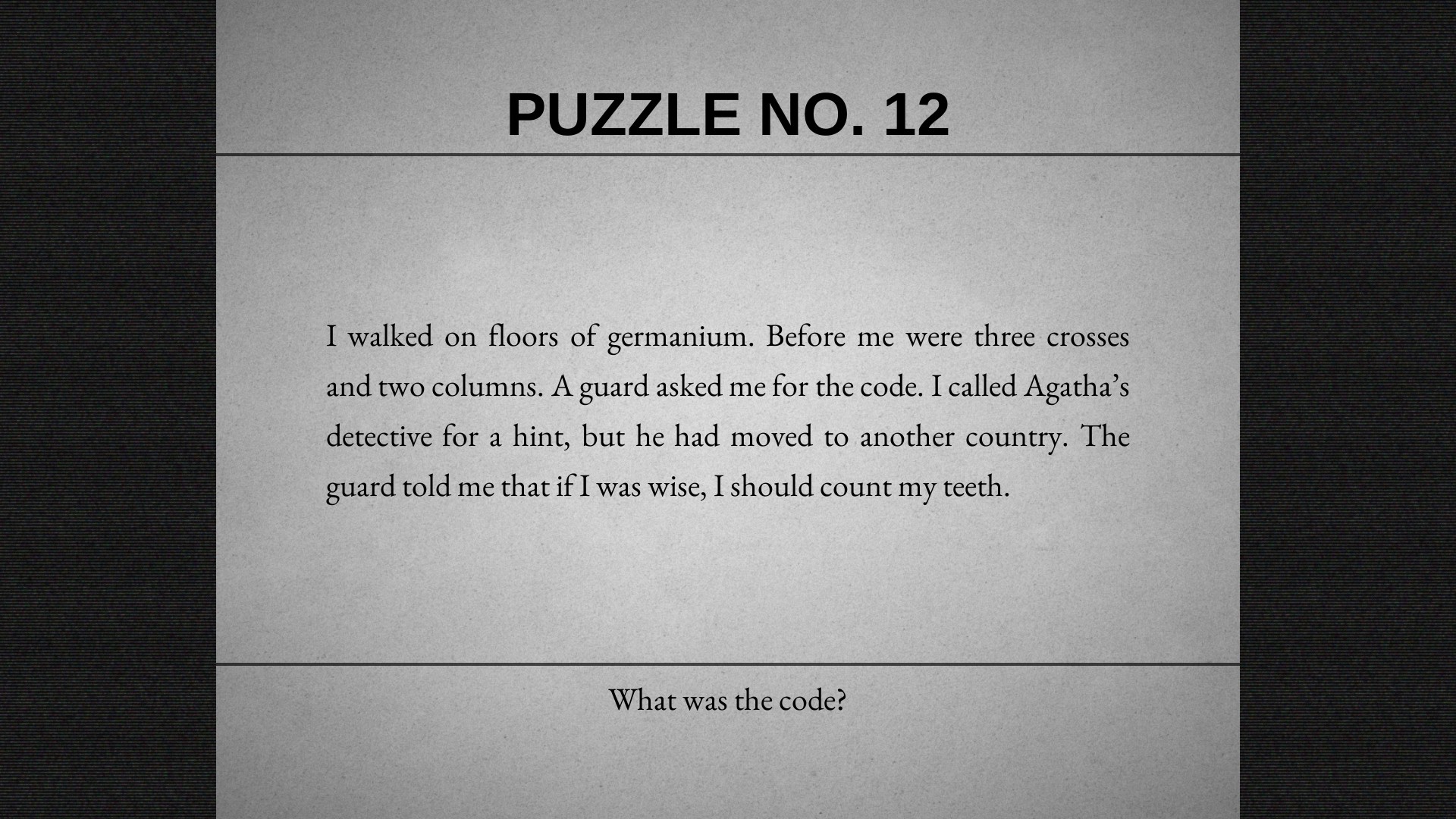
Oh! I know this one. It's actually that you don't bury the survivors. Had to learn that one the hard way.
Lorelei and the Laser Eyes has an unnamed woman roll up to a hotel somewhere deep in the woods of continental Europe with a enigmatic note and a single objective: to meet "him". "He" eventually appears shortly after you enter the hotel for the first time, splattered with a dubious liquid and leaving a trail of footprints behind, as he instructs the woman to recover pages of a lost script and deliver them to his room. The hotel is anything but amenable to this fetch quest, however, as most of its doors are locked with numerical padlocks or are one-way shortcuts and those that are accessible usually have some sort of puzzle attached to their contents or clues pertaining to riddles found elsewhere. Fortunately, the silent heroine has an eidetic memory, which conveniently saves any notes, journals, visual clues, dates, number combinations, and information from reference books concerning Roman numerals or Greek letters or Zodiac symbols should they be of use (and they sure will be). The game ominously tracks your understanding of "the truth" as an ongoing percentage, while also explaining that 100% isn't strictly necessary to uncover the chief mystery behind the hotel and your presence there.
Given the survival horror affectation, there's a lot of corridors shot from static angles and disquieting sound design breaking the silence as you explore, with the game rendered in a monochrome and slightly artistically abstract style with only the occasional flash of reddish magenta from the glares of computer monitors (where you can save), broken glass, rose petals, and the footprints of your anonymous employer/partner to cut through the macabre gloom (though in some way adding to it as well). The stylishness extends to the UI as well, with the game's pause screen—called "introspection", as you rifle through your own memories for clues—filled with maze-like patterns as the heroine stares directly to the camera with eye-concealing shades and an unreadable expression. This isn't all strictly for show either: the game's themes include the importance of artistic endeavor, especially with its power to upset social mores and push human understanding to new heights, and much of the game's construction both in the mechanical and aesthetic sense seems to point to this being the goal here too to an extent, massaging the players' brains with these puzzles to make them more malleable to new and unconventional notions.
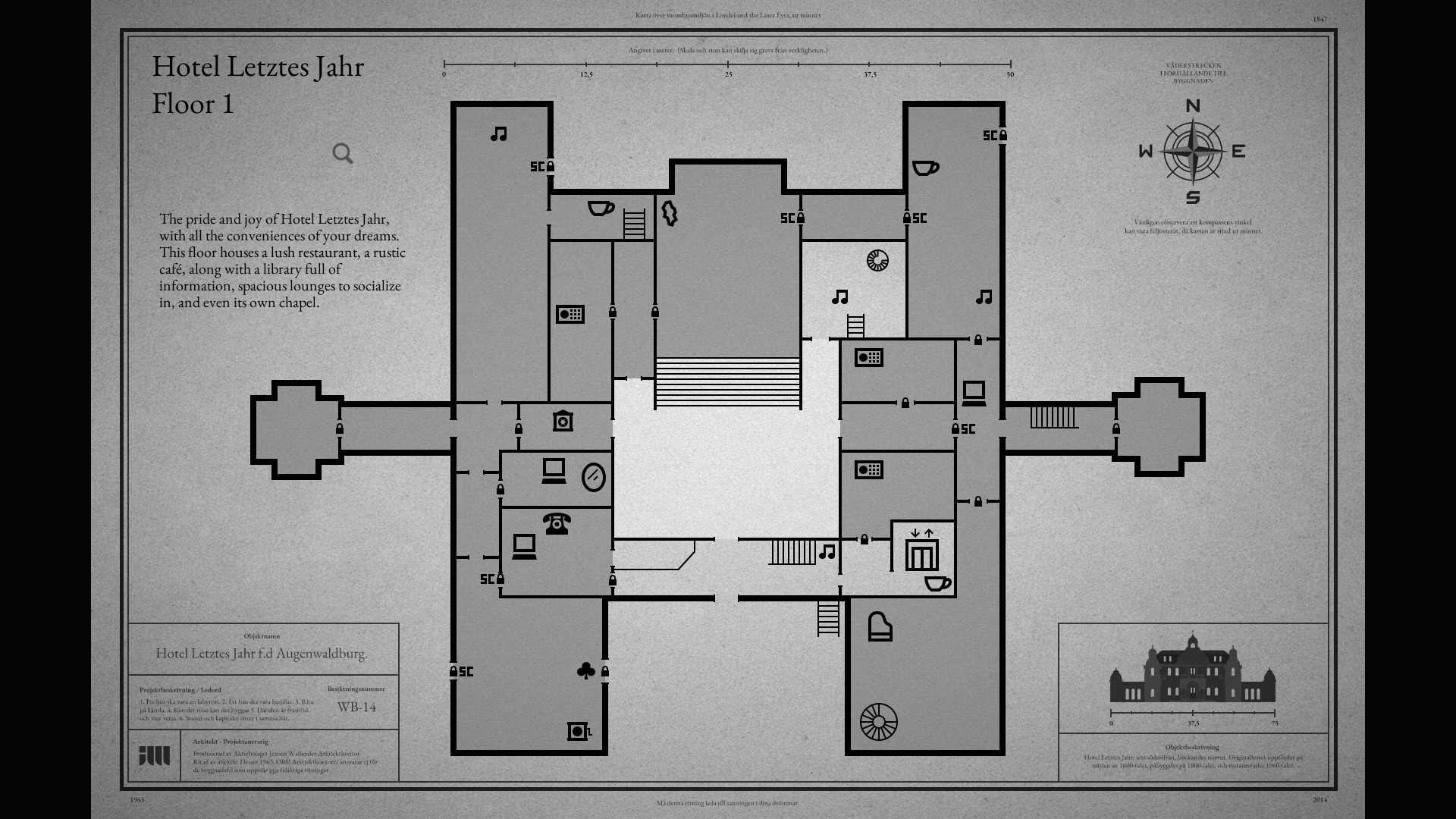
Lorelei and the Laser Eyes is one of those rare types where finding a normally helpful map just raises more questions instead.
While the game thrives on its obtuseness, it also feels like steps were taken to make the game as accessible as possible in spite of its puzzle design. For one, there's only a single action button: if nothing interactive is within range (and objects will glow to let you know if you can mess with them) it'll go into the introspection screen instead, which I can understand as a user experience consideration though it regularly can bring your investigations to a sudden if temporary halt as you click back out of the pause menu to get back to tapping around bookshelves to see if there's an item there you didn't see light up. The one-button-only approach also means that there's no quick way out of menus that I've found: you have to scroll up to wherever the "X to close" option is sitting, which if you're poring over your note library for the right clues might mean the exit is a dozen taps away on the D-pad or analog stick. Incidentally, there's a hidden collectible set of bank notes—the game always stresses that they're American dollars, despite you being somewhere in Europe—which can be spent on non-essential items like cosmetics. They're often small enough to elude notice and might tempt you to tap around a room with a lot of shelves to make sure you've found any that can be acquired, were it not for you being sent to the pause menu with every click.
On the whole, though, I'm greatly enjoying the puzzle challenge level here and the ways it'll toss reference books at you that will suddenly shine new light on a dozen locked doors with weird button combinations you passed by earlier with a shrug. It has that same research action vibe as a The Witness or a Fez, where whenever you feel like the game is about to stymie you there's some breakthrough that opens up another wing of the hotel or perhaps one of its handful of exterior locations like a nearby mausoleum. There's a main arc, of sorts, where you might wander through the lobby and activate a cutscene that puts you back on track for the enigmatic narrative the game is presenting, but just as often you'll decide to detour to check on a hunch you have about some other locked door elsewhere. It can feel a little directed, in contrast to its initially open format, though it's probably for the best when a game risks losing the player with too many threads to revisit. Discovering a series of safes with disks inside which contained a mini-series of point-and-click adventure games that happened to double as flashbacks to the events that led to the start of the game was one such instance where I was probably meant to do all that for the sake of the game's narrative impetus but at the same time felt incidental to that same critical path in a way that made it exciting to discover. Given that "100% truth isn't necessary" warning, I anticipate (and look forward to) plenty more ancillary puzzling.
(As with many of these reviews for in-progress playthroughs, I'll pop by later with a post-script in the comments below if anything changes significantly towards its endgame. I'm locked in for now though, that's for sure.)
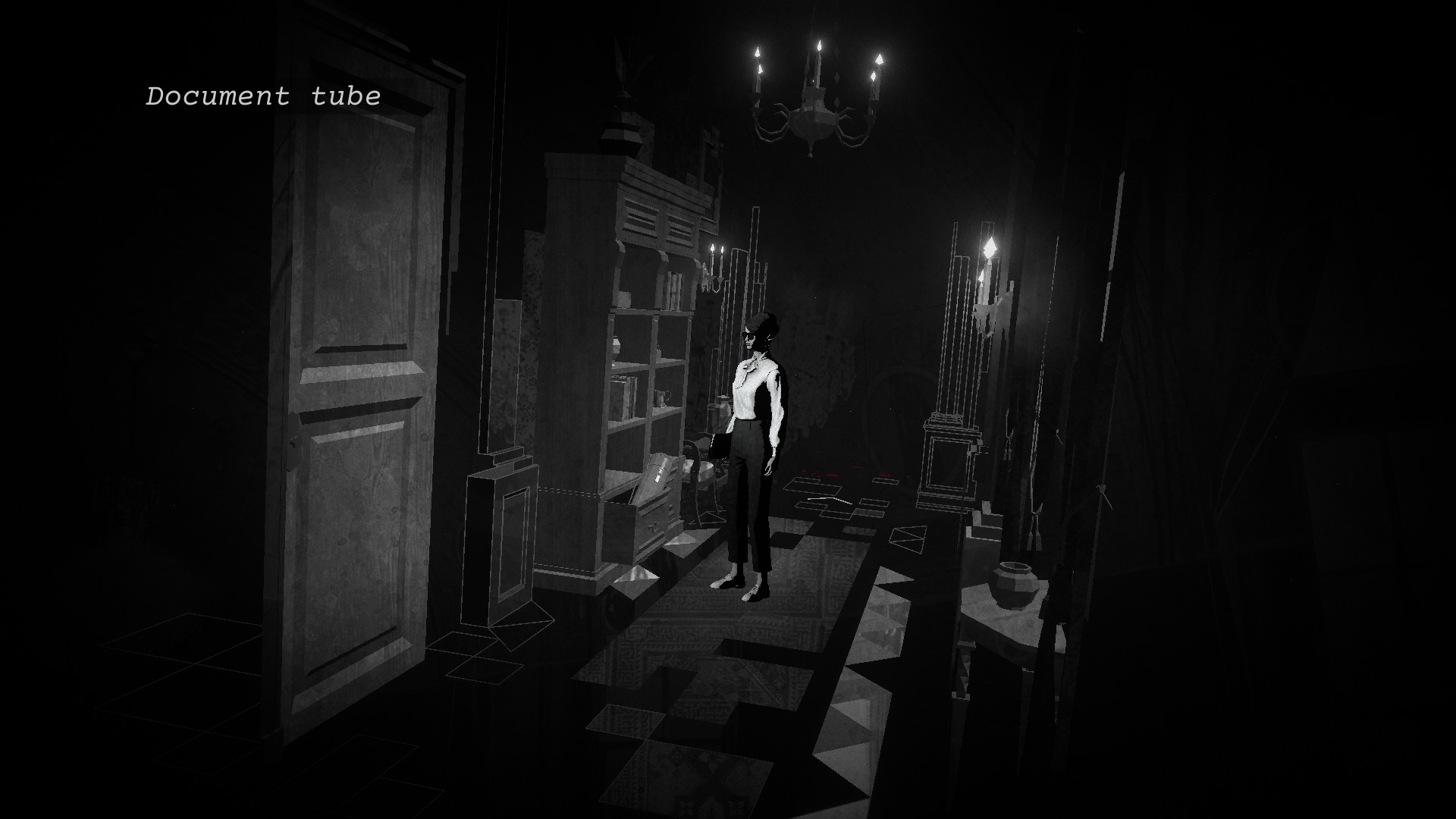
There are maps to help you get around the hotel floors, but they're all inside these document tubes that each need a puzzle to open. And even then, the maps themselves are covered with arcane symbols with no key to explain them. It's less a game about holding the player's hand and more the type to put a mousetrap in that hand's path.
Rating: 5 out of 5. (So far.)