
Indie Game of the Week 441: 8Doors: Arum's Afterlife Adventure
by mento
It's the spookiest time of the year which also means it's time to get out of our comfort zones and into our discomfort zones, which is why I'm playing a game about exploring the Korean underworld and fighting all manner of specters and spirits that refuse to participate in the great cycle of purification and reincarnation that this spin on the afterlife is apparently built around. Sure, yes, th...
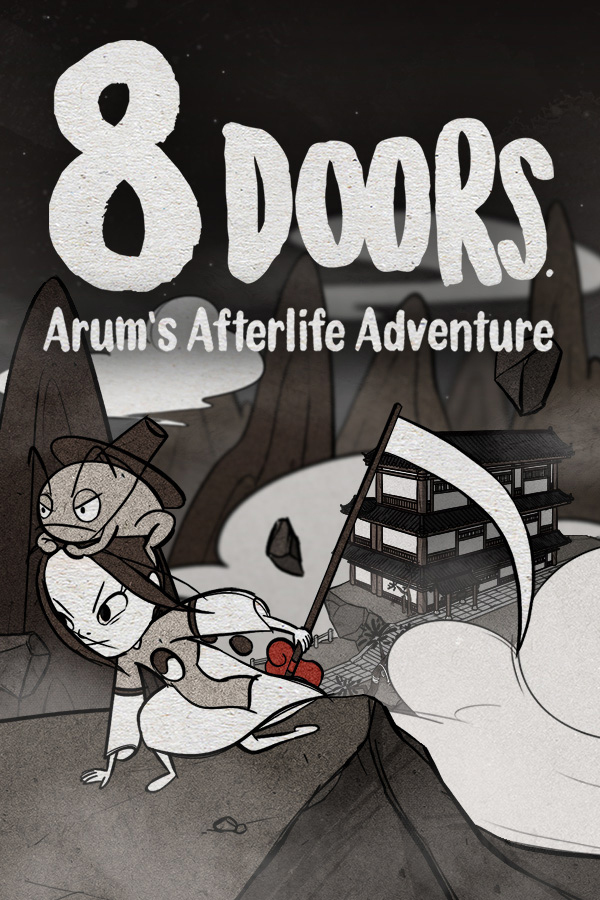
It's the spookiest time of the year which also means it's time to get out of our comfort zones and into our discomfort zones, which is why I'm playing a game about exploring the Korean underworld and fighting all manner of specters and spirits that refuse to participate in the great cycle of purification and reincarnation that this spin on the afterlife is apparently built around. Sure, yes, this is also a 2D exploraction game with some familiar mechanics and a moderately high challenge rating but when I said all that stuff about Octobers being ideal for getting out of our comfort zones I was employing the age-old media criticism trick called "being a hypocrite". The story here is that you play the titular Arum, the single survivor of a destroyed village who has sought out a means to travel to the underworld and petition King Yama directly for answers to this unexplained catastrophe, despite the underworld typically being a place living people shouldn't be strolling around in. Just ask Orpheus. Or any mid-level adventurer party with access to dimension travel that they perhaps shouldn't have been given.
With many games of this genre, because of the stupid name we've saddled it with, it's easy to make the assumption that they're either riffing on Nintendo's Metroid or Konami's Castlevania specifically. However, and as much as it pains me to admit this, neither of those two series have been making waves for quite some time. Castlevania's been on a semi-permanent vacation to the deepest recesses of rural Romania for a while, albeit with the occasional compilation put out by Konami as (I hope) feelers for an eventual series reboot, and while Metroid's been trucking along with Dread and the upcoming Prime 4 I think Nintendo still wants to hold Ms. Aran at an arm's length due to her series typically underperforming in their home country and aren't giving these things the budget or marketing attention they are owed. So, with that in mind, it's more likely any given Indie exploraction game is going to be based on... another one. But like a really popular one. Like, say, Hollow Knight. 8Doors: Arum's Afterlife Adventure has a similarly hand-drawn vibe to its well-animated character sprites and luxurious backdrops but the similarities are more than skin-deep. It's found in mechanics like the roundabout way they've chosen to make the auto-map work, which here has you filling in basic blank squares in any new region until you finally locate and buy a map from the map guy whereupon the auto-map suddenly becomes more detailed and starts tracking points of interest (like warp gates and save points) or collectibles you may have missed in rooms you've already passed through along with the always-welcome completion percentage to give you some idea of where to start looking for stragglers.
 Your one constant companion is this frog that hangs out on your head as you travel around. Occasionally, though, you can get him to do some grunt work. What am I, a free Uber?
Otherwise, 8Doors has some pretty typical platforming mechanics for the genre and a combat system that largely emphasizes planting yourself and getting in some standard three-hit combos whenever you're able to seize upon a gap in an enemy's attack pattern, since they'll do far more damage than the more cautious errant mid-air slashes. You also have the usual assortment of traversal upgrades including the wall-jump, double-jump, air-dash, and a means to break through walls and floors of an unstable nature. Arum's chief goal is to locate the spirit of her father but along the way is dragooned into becoming a "guardian of death" also tasked with hunting down particularly dangerous specters and "fugitive souls", the latter of which are benign souls that have escaped the bureaucratic nightmare that is this cycle of rebirth and have yet to be corrupted by the otherworldly energy of the underworld and become hostile specters, which the game asserts is an inevitability for any visitor not behaving themselves by joining the queue to the big whirly white portal for their ticket back to the dirtside. These fugitive souls are excellent hiders, unfortunately, so you're often spending a lot of time checking for false walls and ceilings. There's also the graves of fellow hunters of fugitive souls who confer a remainder of their power to you in a form that can be spent on upgrading your skill trees to make the combat easier to handle (and, in some cases, unlock new traversal skills) as well as some regular currency which can be traded for extensions to the gauges for health and "purified sin", the latter necessary for your highly damaging special attacks that you have various means of regenerating.
Given that Hollow Knight is evidently the chief source of inspiration here this game's going for that increasingly popular Soulsian edge with its approach to combat, and that also means some tough bosses to pacify as you search around each new region in pursuit of your wayward pops. Bosses typically have a few attacks that you need to identify from the preceding telegraph animations in order to elude them, and then you need to watch out when the boss hits the halfway point on its health bar because it'll keep those same attacks but start mixing them up a little. For instance, this one guy would rear his head back and bite forward, giving you the chance to use the dodge roll to move behind him and get in that ass with a quick combo as he bites at thin air; after his half-dead tantrum, though, that bite attack suddenly becomes a twofer and the second can be redirected to his blind side to catch you unawares. Compounding the difficulty, you have precious little in the way of healing potential: you start the game with three potions and can upgrade both their potency and number (to a max of five) but they recover a pretty minuscule amount of health even when fully charged up, with at least three needed to fill a maxed health bar, so it's paramount to avoid attacks whenever possible rather than trying to tank your way through fights internecine-style. I've been finding the combat tough but somewhat fair—it's not a complete parry-fest like Nine Sols (in fact, parry haters can rejoice in knowing this game eschews that mechanic entirely)—though at the same time it can be rough given the best damage output comes from those ground combos, and that means leaving yourself vulnerable to faster attacks. The combat upgrades can help a great deal, making the search for those bonus skill points paramount if you're struggling.
 This is my buddy the warp dragon. He just kinda hangs out in this creepy room talking about how cool he is. A nice touch is that this room is always dark until you go in, either through the door (right) or the warp gate (left), and then he's nice enough to reach over and turn the lights on for you.
While I do enjoy the game's striking art style, which like Hollow Knight has gone for a mostly dour monochrome look (fitting for the setting, at least) with splashes of red. That red typically highlights damaging areas but it's also explained in-universe as being a mineral of high value to the underworld denizens due to its distinctive properties, suggesting much of how this plane works is due to its reliance on this crimson substance. The soundtrack is a complement to the Korean aesthetic of the architecture and robed enemies, emphasizing the game's cultural roots from a lesser known part of the world (at least as far as South Korea pertains to games; you can't swing a dangpa without hitting a KPop Demon Hunters, BTS, or Squid Game fan these days). However, the game does suffer from a few technical snafus including a very overt and omnipresent screen-tearing problem which, due to the game mysteriously being absent a VSync option, is something you either have to tinker with your GPU settings to fix or simply deal with as it routinely screws with your peripheral vision. The translation is mostly fine but still runs into the occasional mistake, such as forgetting the genders of characters and using him/her interchangeably (from my limited time learning Japanese, I understand that Asian languages don't emphasize gender quite as often as European ones do). This game did get published by a third-party—Neowiz, who also published a certain Bloodborne Pinocchio game that I'm still meaning to conclude before the month is through, despite many distractions—but if it underwent any further polishing due to their involvement it's not evident. Certainly not of a game of poor quality or insufficient substance by any metric you care to apply, but it occasionally makes its smaller budget feel known with its myriad minor issues.
Overall, when it comes to highlighting Indie exploraction games I've begun to settle more on a combination of novelty value in addition to an overall high standard of quality as my main barometer for whether or not I can recommend it over the abundant amount of competition out there. 8Doors has a distinctive look and premise, with a solid combat core if one that doesn't offer a huge amount of variety (there are a bunch of different weapons you can find at least, each with their own combos and strength/weakness balances), but it's not super memorable outside of that and on a purely mechanical level doesn't offer anything you haven't already seen before. It's an entirely fine one of these, which is a sentence I feel like I type out far too often without anything really to expand upon for the sake of making these reviews a little more compelling to read, and if you're really jonesing for more games looking to take after Hollow Knight specifically after already completing Silksong (as well as something perhaps a little less intense) then it might be of some interest. Ditto for having a curiosity about Korean mythology and their own takes on the underworld and of the hostile spirits of the dead, in case you feel youkai have already been done to death. It's just... a VSync option really would've hit the spot here. My poor eyes.
Rating: 4 out of 5.
Post-Playthrough Edit: Well, the game did start to grate as I was sweeping up the final collectibles in part because there's three different endings depending on your completion % and none of them overlap. Sure was a fun idea to have the final boss be a four-part marathon with no rest stops given the aforementioned lack of healing (though thankfully the two last weapons you pick up are kinda busted at least, so that balanced things out). Then there's the horrible achievement set which separately demands a low-%, a no-deaths, and a speedrun on the harder mode which are all effectively mutually exclusive, suggesting they wanted you to take on this 10+ hour game centered around exploration and discovery four times in total. Despite all that nonsense though, the game still had the chops to stay a 4/5 due to its fluid controls, meticulous difficulty curve, and a remarkable and distinct presentation.
| < Back to 440: The Vagrant | 001-100 | 101-200 | 201-300 | 301-400 | > Forward to 442: Necrobarista |