
Anyway, Here's WonderSwan (Part Ten)
by mento
And here we are with the tenth and final part (yeah, right) of this furtive once-over of the Bandai WonderSwan: an also-Swan from an era just prior to the Game Boy Advance where there looked like, for just one brief shining moment, an opportunity for another company to get in on this whole lucrative portable market while Nintendo was distracted. Due to incorporating a randomizer aspect to this examination process I've played way more impenetrable anime tie-in games than I would've preferred but the system exists as this neat alternative reality Game Boy successor that never was. While there's definitely something about the WonderSwan that is very prototypical of what the GBA would later become given the similar tech levels, the system had a few innovative ideas all of its own: ideas like having certain games or certain levels within games be played vertically, a conceit Nintendo would only get around to exploring with its next portable, the Nintendo DS. Point being, I think it's easy to underappreciate a system that was only around for a couple years around the dawn of the millennium but there's plenty who could still argue it had left an important mark on the industry: I could be describing the WonderSwan or the Sega Dreamcast here, I recognize, and in my mind they inspire a similar sentiment of "what could've been with a little more third-party support and without an enormous and unsurpassable rival in the way".
That's enough retrospection; we have retro games to inspect. There are five final WonderSwan games to see this feature out and while most weren't quite what I was hoping for, I am glad to have used this final WonderSwan WonderSoapbox to slake my curiosity about them. And, as is the case for many other games I've covered on here too, I may just return to a few of them should a full fan translation ever transpire. As always, if you needed a firm idea of what's worth looking into on this misunderstood platform be sure to check the previous entries in the table just below and the ranking list all the way at the end down there.
| One | Two | Three | Four | Five |
| Six | Seven | Eight | Nine | Ten |
Anyway, for the final time, here's WonderSwan:
#46: Rhyme Rider Kerorican

- Developer: NanaOn-Sha
- Publisher: Bandai
- Release Date: 2000-12-09
- Inscrutability: Minor
- Selection Process: Curated. In fact, they all are for this episode. Guess I don't need this bulletpoint any more.
- Is This Anime?: ...I'll just go ahead and delete this one too.
Field Report: Rhyme Rider Kerorican is a rhythm game in which the titular character, an astronaut wearing a frog-shaped EVA suit, moves along a set path while avoiding obstacles and hitting enemies to the beat of the song. If the player correctly hits enough notes Kerorican will start flying, allowing her to skip several obstacles at once. There are four such courses, each based on a different track, and the player just needs to survive until the end. While not the only rhythm game on the platform (beatmania for WonderSwan is another, which we covered in Part Four) it's easily the most distinctive. Also, and this reference isn't going to play for most of you, but the game's titular character of a redheaded girl in a frog costume is super reminiscent of Hololive VTuber Kiara Takanashi (who frequently dresses as a frog) and I couldn't stop thinking about it. Had she played this before, somehow?
Probably didn't need me to tell you that NanaOn-Sha are the PaRappa the Rapper/Um Jammer Lammy/Vib Ribbon people going by that box art and the screenshots, with Rhyme Rider Kerorican being the company's fifth game after the three PS1 games above and their debut game Tunin'Glue for the Apple Pippin. Founded by musician and Psy.S co-founder Masaya Matsuura, NanaOn-Sha is popularly considered one of the first major video game developers to focus on music-based games in the home console space. Even if they're hard to go back to now (mostly due to emulation lag) PaRappa and Lammy were definitely favorites of mine as a new PlayStation owner towards the end of the 1990s in part because there really wasn't much out there that looked or played like them (I missed out on Vib Ribbon but I'd downloaded its soundtrack at some point in the early '00s; definitely a fixture on WinAmp for a while there).
Well, this is really just WonderSwan Vib Ribbon with a slightly more '60s funkadelic style. The most... well, saying "most distinctive feature" for a game like this might be hard to pin down, but what's perhaps noticeable enough right away is the slight isometric angle the game uses. That's not just a stylistic choice: the game is intended to be played while holding the WonderSwan diagonally (which is a first; usually it's horizontally or vertically) because the way the inputs work is that they rely on the upper left D-pad (the four "Y"s), the bottom left D-pad (the four "X"s), and the two face buttons on the bottom right (A and B): when the system is held diagonally in such a way that Kerorican's path is level, those clusters simply become left, down, and right respectively from the perspective of the screen. That configuration is normally intended to let you play vertically or horizontally but here each of those three clusters counts as a single button each: that is, every button in each cluster produces the same effect. Kerorican must defeat enemies in her way by pressing the appropriate button: early on, that's the A/B cluster for the blue armadillos that pop out of holes, the upper left Y cluster for the stacks of pointy fellahs, and the bottom left D-pad for the round guys with the whirling fists. Later courses start introducing foes where you have to hit two buttons simultaneously: Course 2, for example, has some sort of pot of rice on a playground roundabout that needs you to hit A and Y at the same time.
As always with NanaOn-Sha I run into an issue where I can't be sure if my sense of timing is off or the emulator introduces a tiny amount of lag that, while imperceptible in most games, makes all the difference in something like this where exact timing is crucial. Enemies are on the path in such an order where defeating them adds a musical sting to the track playing and you can usually judge by how the track is moving along when you need to add a note or two; yet the timing can be real tricky especially when there's two enemies in quick succession. You have a very generous health bar at least and you can even replenish it to some small degree by jumping up for candies flying overhead, yet the sheer volume of enemies in the third course (including a new dolphin-looking guy who needed an A + X combo) threw me off my timing too much for me to finish it. I think I would've had more fun with this game playing it on its native hardware where the question of whether or not I'm being screwed over by the emulation becomes moot, even for as short as it might end up being with only four courses. The music kinda slaps too.
Time Spent: 25 minutes.
#47: XI Little

- Developer: MBI
- Publisher: Bandai
- Release Date: 2001-12-20
- Inscrutability: Minor
Field Report: XI, or [Sái] as the box art and title screen styles it, is a puzzle game involving rolling dice that was first released on PlayStation in 1998, where it was localized overseas as "Devil Dice". The idea is to rotate dice a certain number of times by running on top of them, and if their upwards-facing side is the same as those sitting adjacent then they'll take each other out and score you points. The tough part is doing so around all the dice on the field as more continually spawn in and in creating sufficiently large chains, which might require setting up dice placements ahead of time before you remove them all in one big combo. XI was co-developed by Sony as a PlayStation exclusive but I guess Bandai hashed it out with them to port it over to their handheld, which was smart because abstract puzzle games like this almost always tend to do better on portable systems.
This is where I'd go into the developers MBI and their background but I've no idea who they are. I was curious if they had some relation to Sony or to the PS1 game's original developers Shift, but if I had to guess they were some Bandai label that was never used again.
Man, XI is still cool. I'm not sure I'd have the juice to play it for hours on end but the mechanics are simple yet rewarding when you get stuff arranged just right. To get a little deeper into those scoring mechanics: in order to create a chain the number of dice has to match the number on the top. So you could easily create a bunch of twos and threes but setting up the fives and sixes is a little tougher. As there's a little time before a set completely disappears, you can keep adding onto it by rolling other dice with the same number adjacent to the fading ones to boost the score bonus. One thing you want to avoid is falling into the pit area, since your ability to move the dice around is a lot more limited on the ground rather than on top of the dice themselves: all you can do is push the dice, not rotate them. There's probably even more mechanics that I'm forgetting about, like what the deal is with "1" sides—you obviously can't combo them but sometimes all the 1s on the field will mysteriously take themselves out. Clearly there's more to learn here.
I tried Endless mode, managed to stay alive for half an hour before the entire field was filled with dice, and then realized I'd had my fill rather than go on to check out the other modes (though Puzzle was definitely tempting). For as enjoyable as games like this can be I've always found that a little goes a long way, which is partly why I feel like they work so well on the portable platform where you're probably only likely to get thirty minutes max before something else requires your attention or the break is over and you need to go back to work/school (and why I've never understood why RPGs are so popular on that format, since long uninterrupted sessions serve their sense of immersion better). Even with all the PS1's fancy dice polygons, XI Little proves that the format works just as well in this less visually impressive form since the core is what matters. It's what I tell my Tinder dates that don't immediately bolt, after all.
Time Spent: 30 minutes.
#48: Namco Super Wars

- Developer: Gantan
- Publisher: Bandai
- Release Date: 2002-10-31
- Inscrutability: Major
Field Report: Ever since I first heard about it from browsing the internet in the mid-'00s, I've always been fascinated by the PS2 game Namco x Capcom: a company IP crossover game that—unlike Capcom's forays against SNK and Marvel—wasn't a fighter but rather a strategy RPG, which due to Final Fantasy Tactics, Vandal Hearts, and Disgaea had become extremely my thing at the time. Crossover strategy RPGs were nothing new of course—the WonderSwan alone has six Super Robot Wars games—but throwing together so many characters from both the long histories of Namco and Capcom felt like a great nerdy time of identifying who was from what while also getting in on all the fun tactical maneuvering and character development I attributed to the genre. It wasn't until the similarly-themed Project X Zone for 3DS and its localization many years later that I'd finally get a chance to play a game like that. Turns out Namco had been experimenting with the concept even before their Capcom mash-up: the first of their crossover strategy RPGs had been this one, Namco Super Wars, released about three years earlier.
Much like MBI, I have no idea who Gantan were but presumably they had some relationship with Namco if the latter were willing to give them the reins to this big celebration of the company's various IPs. The only other credits for them include Blaster Master: Enemy Below for GBC and The King of Fighters: Neowave for Arcade, in both cases as "programming support". Maybe they were a contractor with enough experience working on handhelds that Namco had faith in them to handle it, but I'm better off leaving it to the experts at GDRI (ideally those that can read Japanese far better than I) to figure out.
Unfortunately, there's not a whole lot to say about this game after playing through its first scenario. It's your standard square-grid map strategy RPG that's probably a little too similar to Fire Emblem for my liking, as you move your characters around and attack enemies within reach while also ensuring you don't leave anyone where they can get wombo-combo'd by the enemy forces. Most characters have a selection of abilities to use, though some were grayed out for the entire battle which either means they have some very specific conditions to meet or I just wasn't powerful enough to use them yet. My OC protagonist, some DBZ-looking person with long hair and indeterminate gender (plenty of that going around in anime games), could attack enemies at a distance with ki blasts that were much more powerful than their up-close fisticuffs but had a limited pool of "SP" which drained whenever they attacked remotely, suggesting he/she was a good character to soften enemies up before your melee guys got in range where they could be counterattacked—better instead to have them land the finishing blow and not suffer any retribution. My other character in this fight was a very Marth-esque dude called Amuru (who I believe might be the dragon from Dragon Spirit, albeit not currently in his dragon form) and then we were joined in the second turn by Valkyrie from Legend of Valkyrie and her pointy-headed lizardman companion Xandra, who also got his own SNES game (Whirlo) at some point. Amuru and Valkyrie were pure melee as far as I could tell while Xandra had a ranged attack where he threw his trident.
The enemy units were all generic monsters that included some flying baboons that threw... let's call them rocks, some giants, and some goblin-looking dudes. If I had to guess they were probably all Legend of Valkyrie monsters given she turned up to help us with them. However, since the fight was preceded by almost ten minutes of dialogue I didn't feel the need to stick around afterwards for any post-battle discussion since I wouldn't be able to follow it anyway. I'm sure I'll recruit other characters and get a whole posse together to fight whatever apocalyptic menace is threatening the many worlds of the NamcoVerse—I'm holding out for some sort of Pac-Man Galactus, i.e. Gapactus—but my interest level isn't all that high without a translation. The multiple character-specific abilities and higher-than-average level of challenge right off the bat made this a slightly more engaging SRPG than most that I've played so far on WonderSwan, but I'm not going to be here for the long run without understanding what's going on especially seeing how much darn text there is to click through.
Time Spent: 15 minutes.
#49: Chocobo no Fushigi na Dungeon for WonderSwan
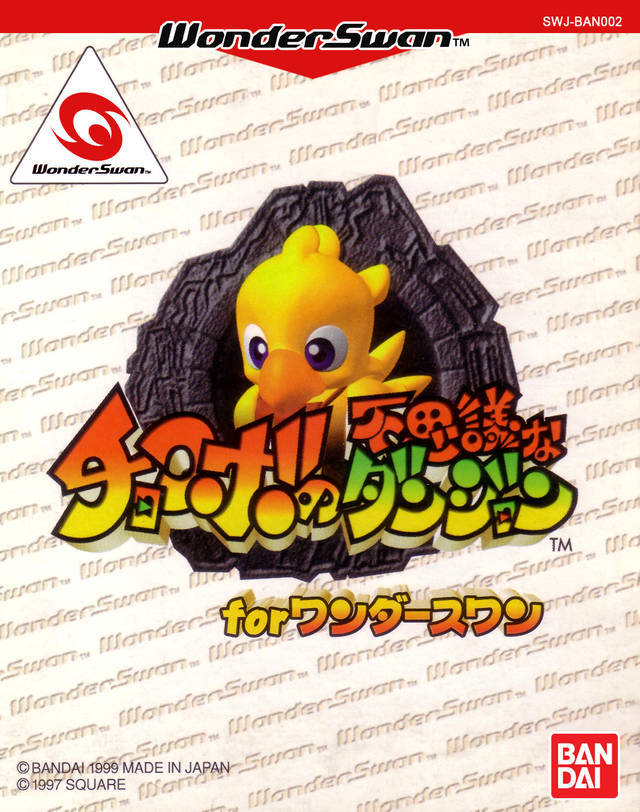
"Chocobo's Mystery Dungeon for WonderSwan"
- Developer: TOSE
- Publisher: Bandai
- Release Date: 1999-03-04
- Inscrutability: None (Translation)
Field Report: Chocobo no Fushigi na Dungeon for WonderSwan is a portable adaptation of the original Chocobo's Mystery Dungeon for PlayStation, which was first released in late 1997 and was the fourth game overall to carry Chunsoft's Mystery Dungeon label. The WonderSwan version retains most of the same mechanics but naturally downgrades the visuals and music; it otherwise offers the same near-endless procgen exploration as its console counterpart. The story sees a chocobo named Poulet and a moogle named Alta reach a new town that purports to have a dungeon filled with treasure. After getting tricked into entering it, the two set up shop in the town with Poulet doing most of the dungeoneering work: by finding certain items in the dungeon they can also help the townsfolk with their supply problems, which has them lending their support as well. Once entering a dungeon, Poulet cannot leave unless he defeats the boss or uses a Teleport Card (which become more common the deeper he goes). There's also some amount of progress retention if Poulet happens to get KOed while down there, giving him a better shot to reach the bottom on his next attempt.
I reserved slot 49 for a Square game for old time's sake, being that it's a square number and all, and this happens to be the first they ever licensed for the system (as well as their only non-Color game). It's also one of the four launch games I was able to determine, along with previous entries Gunpey, Densha de Go!, and Shin Nihon Pro Wrestling: Toukon Retsuden, so I'm glad I was able to check out all of them to see what sort of offerings early system adopters enjoyed (it's not a bad set in terms of variety at least). This would be the eighth Square game we've covered overall on here, which means I didn't get around to the last three: Final Fantasy II (no big loss), Romancing SaGa (ditto), and the original Front Mission. (Technically this isn't actually a Square release since it's a TOSE/Bandai joint but I imagine Square had to be involved on some level given all the chocobos and moogles involved.)
The Mystery Dungeon series tends to adopt new mechanics based on the IP universe they're currently inhabiting, such as the Pokémon Mystery Dungeon games and their Pokémon capturing feature. That's the case here too, with combat using ATB gauges instead of simultaneous movement and an emphasis on magic usage as one of the few statistics that are preserved after a dungeon run: by continuing to use magic (via single-use tomes) the player levels their affinity with that spell, allowing them to do even more damage on subsequent uses. Otherwise, most run-based dungeon-crawler rules still apply: there's a map you can check, though it only fills out places you've seen from a tile away; there's potions and other consumables, though some remain unidentified until you either use a different item to identify them or you take the risk and use them directly; there's equipment, but it's all chocobo-shaped by way of saddles, talon extensions, and a collar (the last of those is more of an accessory, providing fewer stat bonuses but often some special benefit instead); and the player is almost always at the mercy of RNG as they trigger traps, get cursed by unidentified gear, or bump into ever tougher monsters with nasty status effects as they explore and descend. However, the game is generally more forgiving owing to its more child-friendly cutesy vibe: you can save before descending a staircase (as well as back in the hub) and you hold onto anything you had equipped if you should die, with the option to store anything you don't want to lose back in town.
The last of these Mystery Dungeon games I played was Fushigi no Dungeon: Fuurai no Shiren 2 on N64 (for my 64 in 64 feature) and just like back then there is a certain amount of ambivalence that comes from hitting my head against procgen for who-knows-how-many hours. I do appreciate that both the games mentioned allow you to salvage some amount of inventory even after getting wiped out, but these games start to feel endless pretty quickly and more so if you've just run into a big progress-wiping streak of bad luck. The whole "two steps forward one step back" phenomenon made manifest via game design. The RetroAchievement support for Chocobo's Mystery Dungeon does make it a little more attractive a prospect to hack away at, since it seems like an entirely attainable (if occasionally grindy) set, and having combat be based around ATBs where you have seconds to maneuver into a better spot and prepare for fights before those gauges completely fill up is a nice change to the instantaneous movement and combat of most games of this genre; one that can quickly catch you unawares if you're zooming around on auto-pilot to reach a corridor you left behind. The monochrome visuals, limited resolution, and simplified mechanics does make it feel a bit antiquated though, even for a 1999 game, so I'm not sure if I'll ever feel a burning need to return when there are many modern run-based games with much more going on. But if I was still a schoolkid in 1999 with my ever-present aversion to socializing and this card in my WonderSwan? You'd better believe I'd be sneaking in a couple of floors every recess.
Time Spent: 45 minutes.
#50: Dicing Knight Period
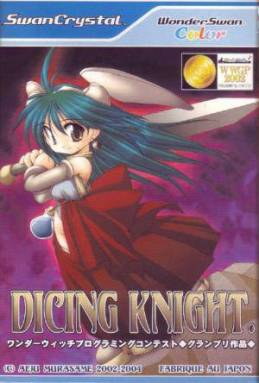
- Developer: Platine Dispositif
- Publisher: Qute
- Release Date: 2004-05-31
- Inscrutability: None (Translation)
Field Report: Dicing Knight Period, usually expressed as "Dicing Knight.", is an action-RPG with procgen dungeons (didn't quite mean to do two of these in a row, but oh well) in which a nameless heroine descends through monster-infested corridors slicing (and quite possibly dicing) through anything in her path. Think of it as Zelda or Ys top-down combat in a run-based dungeon-crawler model. Or I guess The Binding of Isaac, since that's basically what this is just with a more melee-focused bent and more anime girls.
So, he were are. Symbolically finishing this feature off with the very last licensed game ever released on the WonderSwan Color. Even if the GBA hadn't already killed the WonderSwan, the advent of the Nintendo DS—which released half a year after this game came out—would've done the trick, I'm sure. As with Judgement Silversword (the first game we ever covered on here), the publishers Qute are much more Indie tier than Bandai and the system's usual third-party contributors, having selected the WonderSwan to host a game development competition for which the prize was having your game become a professionally published product. Platine Dispositif is a one-person development studio that would later go on to make the Gundemonium series as well as several other low-budget doujins; I checked but I don't think any of them have been added to Steam yet (unless they're in their native Japanese; searching for something on there in kana isn't quite so easy).
Dicing Knight. is way weirder than I was anticipating but at the same time it's been relatively straightforward too. Every time you hit an enemy a die flies off them (another recurring theme this entry) and that determines the damage you did; there's a bit of a delay between the strike and the die rolling to a stop though, so I've found the best strategy is to go in for a couple hits, back off, and then approach again if it's still standing. You have both an attack and a defense button but there's nothing in the way of equipment changing that I've found yet: instead, most enemies drop single-use items that you can assign to the buttons on the Y-cluster. You can also simultaneously use an item while picking up another to replace it in the same slot. These items so far include floor keys (necessary to progress), drills (makes holes in walls for shortcuts), healing potions (self-explanatory), onigiri (ditto), some kind of dice predictor (lets you know what the next few rolls will be, I guess so you can hog all the high dice and let enemies hit you with the smaller ones), and a rabbit that supposedly makes me luckier. Since you have both health and hunger meters, with the latter constantly dropping unless you find the relatively rare onigiri, it seems the best policy here is to make a beeline to the stairs rather than stick around to explore the whole floor. The map is always fully revealed, so it's usually just a matter of finding the fastest route—or making your own.
A few other things I discovered while playing: the first dungeon ("Lindwurm") only has three floors while the next ("Shiningstar") has four, which also introduces tougher enemies, a blank map that now needs items to reveal, and "gate keys": additional keys needed to open gates between you and the exit. The reason for the last of those is to make the game harder by forcing you to sacrifice more of your item slots for these passive keys, since they're a pain to go farm if you just abandon them at first. You also acquire experience in dungeons that stays with you even if you get taken out, and by defeating bosses you earn lottery tickets which can then be exchanged for random orbs. These two features work in tandem: your level (aggregated across all dungeons, so you can go back and grind in earlier ones if you'd prefer) gives you orb slots that the lottery orbs then fit into. I got a purple one that increases my hunger meter, which I guess is better than nothing. The other notable feature of this game? This shit's hard, man. The first boss alone has three phases and is like a bullet hell match up (explicable, given the developer's later games and where the doujin scene was in general with the likes of Touhou) so I wasn't sure if it was something I could defeat this early on, especially as the next dungeon had already opened. If you die in a dungeon you can resume from the last floor you reached, so I was able to get in many attempts before it finally croaked.
Dicing Knight. is kinda neat for a small Indie thing, offering only a handful of gameplay options but balancing them in a way to make for a compelling grind towards the game's end-state. I can see a path to victory just by hacking away at these tough dungeons enough times, modifying my tactics between the right balance of offense and defense (definitely can't skimp on the latter, given how many enemies blast you on sight) while relying on some lucky item drops. Plus, if you keep resuming from your last floor you could probably brute force your way through the game eventually, though the downside to that is a lack of items: the floor is exactly as you left it, which might mean no enemies and no items to farm from them. After all, going into a boss fight with the single healing potion you always respawn with might not be enough. As I said before, though, I only have so much patience for procgen before the repetition gets too much, but Dicing Knight.'s little formula (and, again, having some degree of progress retention) does make it a better run-based game experience than most, for as rudimentary as it might be.
Time Spent: Just shy of an hour.
Final Ranking (For Now)
(* = Don't need fluent Japanese to enjoy this and/or it has a fan translation.)
- O-Chan no Oekaki Logic (Ep 4)*
- Rockman & Forte: Mirai kara no Chousensha (Ep 5)*
- Kaze no Klonoa: Moonlight Museum (Ep 3)*
- Puzzle Bobble (Ep 9)*
- Dicing Knight Period (Ep 10)*
- Chocobo no Fushigi na Dungeon for WonderSwan (Ep 10)*
- Final Fantasy IV (Ep 9)
- Final Fantasy (Ep 4)*
- XI Little (Ep 10)*
- Rhyme Rider Kerorican (Ep 10)*
- Rainbow Islands: Putty's Party (Ep 4)*
- Raku Jongg (Ep 9)*
- Flash Koibito-Kun (Ep 1)*
- Magical Drop for WonderSwan (Ep 1)*
- Mr. Driller (Ep 9)*
- Namco Super Wars (Ep 10)
- Hataraku Chocobo (Ep 7)*
- Wizardry Scenario 1: Proving Grounds of the Mad Overlord (Ep 6)*
- Slither Link (Ep 5)*
- Gunpey (Ep 2)*
- Judgement Silversword -Rebirth Edition- (Ep 1)*
- Neon Genesis Evangelion: Shito Ikusei (Ep 8)*
- Makaimura for WonderSwan (Ep 6)*
- Golden Axe (Ep 7)*
- Side Pocket for WonderSwan (Ep 5)*
- Battle Spirit: Digimon Frontier (Ep 8)*
- Final Lap Special (Ep 2)*
- Densha de Go! (Ep 2)
- Gomoku Narabe & Reversi Touryuumon (Ep 3)*
- Rockman EXE N1 Battle (Ep 8)
- Kurupara! (Ep 6)*
- Guilty Gear Petit (Ep 3)*
- Hanjuku Hero: Aa, Sekaiyo Hanjukunare...! (Ep 5)
- Blue Wing Blitz (Ep 3)
- Makai Toushi SaGa (Ep 8)*
- Wild Card (Ep 9)
- Beatmania for WonderSwan (Ep 4)*
- SD Gundam: Gashapon Senki -Episode One- (Ep 7)
- Super Robot Taisen Compact for WonderSwan Color (Ep 3)
- Inuyasha: Fuuun Emaki (Ep 1)
- Chou Denki Card Battle: Youfu Makai (Ep 5)
- Meitantei Conan: Nishi No Meitantei Saidai No Kiki!? (Ep 2)
- Shaman King: Mirai e no Ishi (Ep 6)
- Shin Nihon Pro Wrestling: Toukon Retsuden (Ep 4)
- Inuyasha: Kagome no Sengoku Nikki (Ep 7)
- Sangokushi II (Ep 6)
- Kyousouba Ikusei Simulation: Keiba (Ep 7)
- Metakomi Therapy: Nee Kiite! (Ep 2)
- SD Gundam Eiyuuden: Musha Densetsu (Ep 1)
- SD Gundam Eiyuuden: Kishi Densetsu (Ep 8)