
My Other Open-World Sim is a Portia
by mento
Hey folks. I have a nasty habit of getting really invested in open-world games that offer many different gameplay modes and activities to potter around with, chiefly those of a more simulation-heavy bent like farming and construction sims. I'm talking games like Terraria where you can spend whole weeks building your own village of NPCs or Stardew Valley where you can get wrapped up in gathering...
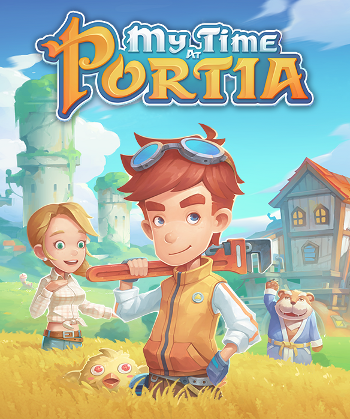
Hey folks. I have a nasty habit of getting really invested in open-world games that offer many different gameplay modes and activities to potter around with, chiefly those of a more simulation-heavy bent like farming and construction sims. I'm talking games like Terraria where you can spend whole weeks building your own village of NPCs or Stardew Valley where you can get wrapped up in gathering all the resources to fix the community center that you don't even realize it's four in the morning.
My latest one of these is Pathea's My Time at Portia: a rare 3D variant of this kind of open-world, do-whatever life sim that I reviewed back at the tail end of last year for Indie Game of the Week. After a busy January trying to squeeze in as much 2021 gaming as possible before the site's GOTY coverage I got back into Portia in a big way this month. As I continue to play, more and more of the game's extracurricular features have become unlocked, and with it more indecision about how I want to spend what little free time you get on an (in-game) daily basis. It's been a little surreal seeing how many more layers deep this game can get: the benefit of being one of very few games like Terraria or No Man's Sky to see major post-release content updates despite not being a F2P or service game.
Since that original IGotW review stopped way before a lot of the game's more engaging content showed up, I want to do a little addendum to cover what My Time at Portia offers would-be builders in this relatively late stage of the playthrough. It's definitely made me curious how much more ambitious their follow-up, My Time at Sandrock, is going to be when it releases sometime later this year or next.
Construction
The game's bread and butter. The goal of the game, on the surface, is to take commissions and build the doodads people want. This eventually segues into developing infrastructure, helping to construct things like bridges and new buildings that have marked effects on the world (the former, for instance, open up new areas of the world map). Most of the time you're balancing looking at progress markers on your many resource-crafting machines while going out to gather said resources, such as making trips to the forest for lumber or the local ruins for metal ores.
The huge variety of items and constructs to build, some of which are assembled piecemeal on a special platform while others are created instantly at a workbench, make this progress-bar-watching aspect of the game a little more palatable than it might be otherwise. It is the cornerstone around which everything else is anchored after all, as both your chief source of income and the impetus for story progression, so it's important to make it somewhat full-featured and compelling. These long development times also have a silver lining in that they're an excuse to leave components to generate at your workshop on their own while you head out and busy yourself with any number of other pursuits. You can set up your constructors early in the morning, head out to do any of the below, then come back at the end of the day to assemble whatever finished products you can with all the materials that have transpired in the meantime.
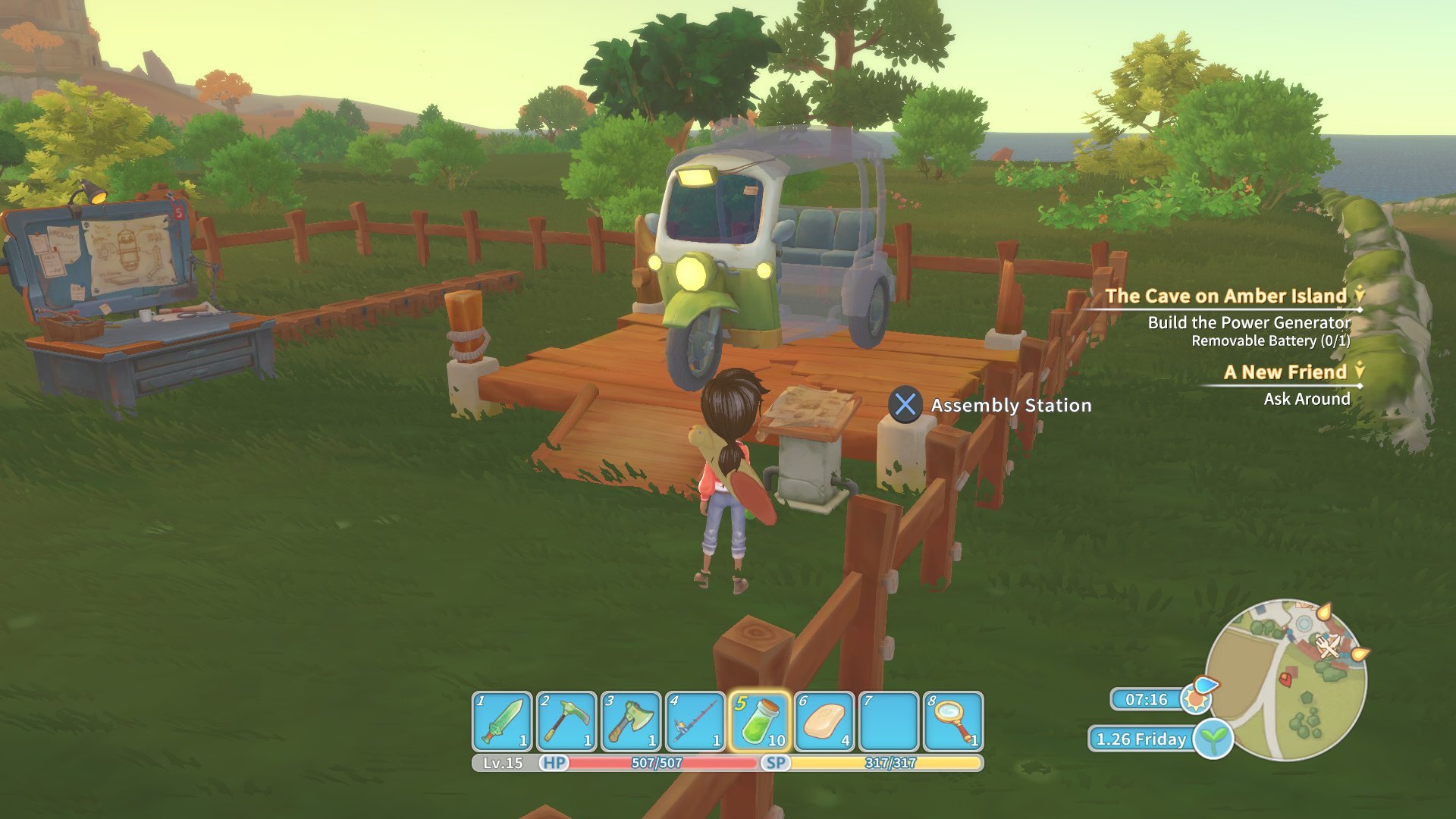 I'm longing for the day when I can turn all this greenery into smoke-belching factories. This world's already had one technological apocalypse, it probably won't have another for a while yet.
 Socializing
Most of these life sims also have a heavy social element, where you're encouraged to talk to the townspeople, give them presents, and sometimes play mini-games with them. In no game I've encounter has that aspect been more pronounced than in My Time at Portia (excepting, perhaps, multiplayer games where you make your own fun with actual human beings). Not only does every townsperson - and there are over fifty, not including pets - have their own likes and dislikes and personalities, but most have side-quests attached to them that become unlocked as you become better acquainted with them.
I've been digging into the social aspect more after I accumulated so much crap that has no other use than as gifts, and there's some surprisingly complex business involved. Like how if you upgrade your friendship with a character to the next level - everyone has ten "levels," a bit like social links - you earn bonus friendship points with every character in that person's clique. That might mean family members, best friends, co-workers, or pets. For instance, there's a group of septuplets and it's possible to upgrade your friendship with one of them, hit the next level with a different one from the bonus points, get another round of bonus points for every brother, and possibly hit even more level-ups from these crazy long chains. It's rad when it happens.
The side-quests you get as friendship rewards are worth it just to learn more about the characters they relate to, even if none of them are particularly memorable, and each one has a set of perks related to their friendship level: discounts at their store if they're vendors, stat increases, befriending the mayor makes it cheaper to buy land around your home, they come to live with you (in the case of stray animals), and others. Some characters can, of course, become your partner (and later spouse): it wouldn't be a Harvest Moon type of game without getting hitched and exploiting your beloved as free labor.
Fishing
You can tell a lot about an open-world game from the quality of their fishing mini-game. That sounds like an aphorism restructured for video games, but it's actually true: a developer will usually include a fishing mini-game because they're so often expected, same as lockpicking, and based on whether or not it's something perfunctory slipped in mid-development for the sake of more features or a case where the developer really considered its inclusion and tried to make their particular spin on the idea distinct is often a clue to the level of attention provided to many other value-add features.
I say all that, but Portia's fishing mini-game is mostly just OK. It does a fine job representing that balance inherent to angling where reeling in too quickly can overwhelm the tensile strength of the line while reeling too slow can risk losing the fish by drawing out the "battle" too long, but that's mostly hitting the bare minimum. It also moves quick, which is more what I'm looking for in a fishing mini-game: hooking a dozen fish in a couple of minutes is ideal if I have other tasks on my plate that day. However, I will point out a notable and extremely handy feature - one that I've not seen any other fishing mini-game do - is an upgrade that actually tells you what type of fish is biting on the line before you press the button to start reeling them in. If you have plans for a specific variety of fish, sitting there until the name of it appears makes catching one that much quicker.
Ruin-Diving
Like the Rune Factories (and, indeed, Stardew) Portia has a weird selection of monsters to fight and dungeons in which they can be fought. Half the dungeons are actually devoid of enemies, however: the game separates the two sets as "Abandoned" ruins and "Hazardous" ruins. When entering the former, the player digs through solid rock to find ore deposits and treasures for as long as their stamina lasts. These ruins have a "relic scanner" device that points out buried treasure and lets you dig towards them, though you need to upgrade it before you can know in advance what you're digging towards. Of course, you can ignore the relics entirely and look for the ore, since you'll be needing a lot of it (like in No Man's Sky, ore just looks like different-colored rock making it easy to find and identify).
The Hazardous ruins are just randomized dungeons with a standard selection of enemies and traps and treasure chests; this part of the game isn't super in-depth, with only a handful of pre-generated level design variations to encounter. Still, though, the rewards - lots of ancient mechanical crap needed for some constructions - are often worth it, and the game does you a solid of freezing the timer whenever you enter one: instead, it simply subtracts a certain amount of hours from the day once you emerge.
I'll admit to not spending a lot of my character building points on the combat because it's the weakest aspect of the game, but dedicated monster-bashers can find some really valuable stuff down there. The game, almost as if recognizing its own weakness, also includes a feature where you can just pay the local guards to go dungeon-delving on your behalf.
 The wall coloration tells you what sort of ore to expect. The lights, meanwhile, could be anything from scrap to relic pieces. Relics are a menace to assemble but they're sure worth a lot.
Events
After almost an entire in-game year, I've seen almost every event Portia has to offer. Most are opportunities to earn event-specific currency in a special mini-game that you can exchange for unique prizes. For instance, winter has a snowball fight (it's a bit like whack-a-mole), autumn has horse races, summer has a martial arts tournament and Halloween ghost-hunting for some reason, and spring has a fishing competition. More valuable to know is that all gifts count for double on holidays (birthday gifts count for triple), so it's worth hauling a chest's worth of junk around and meeting as many townspeople as possible before and after these events happen. They're great for having the whole town come together for some fun, including NPCs who have weird schedules where you never see them, and they help break up the usual routine... even if you're probably trying to finish up a bunch of commissions on the day they happen regardless.
Photography
I'm a sucker for a good photography side-quest, though sadly Portia's seems a little undercooked. There's albums for storing photos you take for fun, either selfies or group photos with other citizens, but the actual collection part only applies to different enemy types. There also doesn't seem to be any rewards for completing the collection? It feels like something the game threw in as a bonus though there are still a few side-quests that require the camera, so it does see some use. Mostly, however, it just exists as a photo mode, similar to those in various other open-world games. I could see this being something Sandrock expands on: I'd love a photography mode akin to Dark Cloud 2's, where objects can serve as inspirations for new gadgets.
Museum
I just unlocked this place and it lets you earn rewards by donating relics found in the digging mini-game and assembled constructs you can build in your workshop if there's nothing else you need it for that moment. Since you only need to build most things once, it's an excuse to take another swing at them if so desired. There's also an aquarium in the museum, so that's another reason to go fishing and be grateful the game tells you when something rare is biting. I look forward to filling it with crap, provided I ever get a moment free from all these main quest commissions...
More so than all these bulletpoints can express though is how Portia is constantly changing with each new major construction, and not just in the sense that the amount of traversable geography in the world keeps expanding outwards. The people you've come to know continue to live their lives - there are potential partners that will eventually hook up with each other if you're not actively pursuing them - and new faces show up in town all the time. I've helped create new mini-games (including my favorite, where you have to find differences between two flawed products), opened up new dungeons to explore, improved the lives of my neighbors in meaningful ways, and now there's a dozen different things I could be doing at any moment and yet somehow never find myself overwhelmed with indecision. Hell, I haven't even tried raising livestock or visited the desert yet.
I figured this flow of new content will slow to a trickle once I hit the second year, but since so many of them are predicated on the player's involvement with story quests and major construction jobs I'm guessing it'll only dry up once the main series of quests are done, and I happen to know that I've got several more projects to develop including a whole new extension of the town closer to the local desert. It's rare I get through a full year of a game of this sort and still find myself with so much to do, especially since each of its 112 days are about fifteen minutes long (or longer, since the player can change the in-game clock to half-speed, and it pauses when menus are open).
There's a certain unmistakably shoddy quality to the game's visuals and UI that goes hand in hand with its remarkable ambition as a 3D open-world life-sim made on an Indie studio's budget, yet spending all this time with its many quirks and glitches and largely unattractive Klasky-Tsupo-ass NPCs have lent the game an endearing personality of its own that I've come to appreciate. Planning to be done with the game before the end of February as I've so much else on the docket, but who can say if I run out of reasons to keep playing by then.