
Innovation of the Week: Overworlds & Hub Maps
by alianger
In the early days of game development, those who wanted to create large scale, open-ended adventures spanning whole worlds or even multiple ones were likely asking themselves one or more of these questions: a. How am I going to render all of the detail of an entire world on screen without the game slowing to a crawl, b. How do I keep the game from losing focus from the player getting lost in th...
In the early days of game development, those who wanted to create large scale, open-ended adventures spanning whole worlds or even multiple ones were likely asking themselves one or more of these questions: a. How am I going to render all of the detail of an entire world on screen without the game slowing to a crawl, b. How do I keep the game from losing focus from the player getting lost in the minutiae of searching through every nook and cranny of the world? and c. How do I efficiently convey a sense of place where smaller areas connect into a cohesive whole? Let's have a look at how developers answered these questions at different points in time in this week's topic: Overworlds & Hub Maps!

The first example of an overworld can be found in Akalabeth (AII, 1979), the first commercial RPG. In this game, the player creates a character and then starts in the overworld, in which there are several entrances to one big dungeon, where most gameplay takes place. Graphically the overworld consists of simple patterns of lines on top of a black background - collections of five squares are towns, the large square with a smaller crossed-over one inside it is Lord British's castle, Xs are dungeons (going into them changes the perspective to first person view), squares are forests, and the lines are mountains. The last two are impassable, serving only as landmarks. The player's avatar is a crosshair positioned in the middle of the screen and can be moved in the cardinal directions via keyboard shortcuts, and the size of the world is 20x20 screens. While this is all impressive for the time and platform, it should be noted that there are a couple of heavy limitations here in that towns are identical and dungeons are non-persistent when it comes to loot and monsters, so you really only need to find one dungeon entrance.
The game's manual also provides a bit of a backstory for why the game world is structured as it is. One of two sons of the lands of Akalabeth's king, Mondain, wasn't chosen to become the next king. He became jealous and used his great powers for evil, traveling the land for many years while spreading "evil and death". During these travels, he created all the dungeons of the game's world and filled them with monsters. Why he did the latter isn't actually written, but one can assume it was to leave a permanent scar on the lands to spite his father. We also know from interviews that an influence on creator Richard Garriot to structure the game world like this came from D&D.
Some More Notable Retro Game Examples:
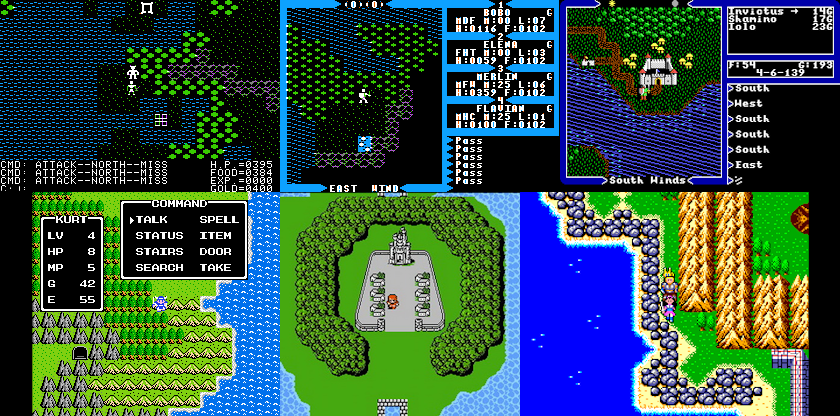
The Ultima series until Ultima VI (and Dragon Quest, Final Fantasy, Phantasy Star series; 1980-1988) - Starting with Ultima II, the early Ultima games seem to use the same game engine for the overworld as for the town segments but while in the overworld, the terrain and towns are downsized, making the player avatar appear as a giant. Or as a board game piece, a feeling that is intensified by the tile-based movement which lasted up until the NES ports of Ultima III-IV and until Ultima VII on PC. The visuals are sparse even compared to mid-'80s console games but a positive is that every type of tile can be easily identified such as water, forest, field, mountain, town and so on. Ultima II (1982) introduced avoidable enemy encounters (non-random encounters) in the overworld, which didn't trigger a separate battle screen when touched. By Ultima V, a day/night cycle is introduced which makes the player avatar's field of vision shrink as it becomes night and vice versa. This way of structuring game worlds in RPGs also shaped JRPGs for many years to come, with a few exceptions.
AD&D: Cloudy Mountain (1982) - It didn't take that long for official D&D games to appear, though they weren't always what we'd now call proper RPGs. This proto Zelda-like Action Adventure game with rogue-like elements... is also one of the first games to feature a hub map, letting the player quickly move between points of interest. Which in this case are the different dungeons, some of which have a boss (dragon enemy) and a tool item in them. Tool items? Well, while the game is mostly non-linear, you do need to use acquired inventory tools to progress at certain parts of the hub map - the boat is used to cross rivers and the axe is used to get past trees. For a pre-NES game, the map is also pretty detailed, with a bit of animation as well as color coding to show where the player has recently moved.
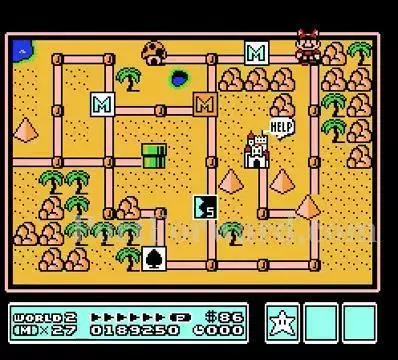
Super Mario Bros. 3 (1988) - While SMB2 (U/E ver.) had some semblance of a hub map in-between levels, Nintendo went all the way here with detailed, distinct hub maps for each area. These maps span more than a single screen and have the visual design and content on par with a good board game without the annoyance of bad dice rolls or the rollover effect at the end of a course. They feature branching paths between levels, fortress levels with an exploration/puzzle element and a mini-boss at the end, wandering monsters, mini-game and NPC encounter locations, locked doors, interactive elements and even some secrets. One example: by scoring 80k points, a memory mini-game panel appears somewhere on the map, and if it appears over an unfinished level its panel can be used to skip the level, as when the game is finished the level tile will transform into a finished state. One final interesting mechanic is how when the fortress level of an area is beaten, a locked door on the map is removed (and a bridge lowered), opening up either a shortcut or a path towards a mini-game, which stays open after a game over.
Clash at Demonhead (1989) - In a fairly unique twist on the by-then-established hub map concept, this comedic Platform Adventure/Metroidvania game makes it so that the player can generally only travel between points that are connected on the hub map, and the routes themselves make up the game's levels/sub areas. This idea might be from Cube Quest (1983), but it is more fleshed out here with many branching paths, and you can (and should) move back and forth between visited areas. Other than that, there isn't that much to the hub map, it's not very detailed and shops and NPCs are encountered while en route.
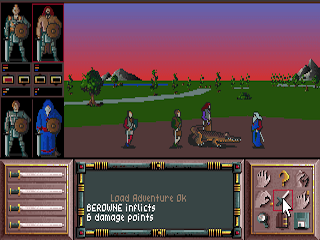
Drakkhen (1989) - This unconventional RPG had a unique for the time way of portraying its overworld that's very reminiscent of the Mode 7 effect in SNES games - a 2D ground plane is skewed so as to mimic a 3D perspective where the player can move in the cardinal directions as well as rotate in FP view, while most objects and characters are 2D sprites laid on top of it and scaled in/out as the player moves, and a 2D background makes out the horizon landscape and sky. There are also a few basic polygonal shapes mapped onto the ground, representing roads, dirt patches, fast travel points and lakes. When dungeons are entered, the engine changes to a flip screen, tilted view one sort of like in a beat 'em up, except during combat, your party of heroes move onto the screen and act on their own (the same happens when monsters or NPCs are encountered in the overworld). Other locations are portrayed with single screen artwork, like in a graphic adventure game. Like in Ultima V, there's also a day/night cycle and here you can even see the sun rising and setting in real-time as you're moving around in the overworld.
Claymates (SNES, 1993) - In this platformer, the overworld while fairly detailed and helping provide some additional context to where the player is going on their adventure, doesn't drastically change between areas and isn't the best looking one we've seen up to this point. At first glance, it probably looks like an average hub map. What's more interesting about it is the gameplay - the player can move around freely and each screen of each area was turned into a mini-game reminiscent of ChuChu Rocket or Lemmings. In case you haven't played those either, each completed level gives the player two robots, automatically moving forward. These can then be manipulated by moving different objects on the screen to make them move up to and clear obstacles, unlocking the next level.
What are some of your favorite overworlds or hub maps in retro games? Do you prefer for games to use them, or to provide a more seamless experience? Let's discuss and reminisce!