5 ★ (0)
4 ★ (0)
3 ★ (0)
2 ★ (0)
1 ★ (0)
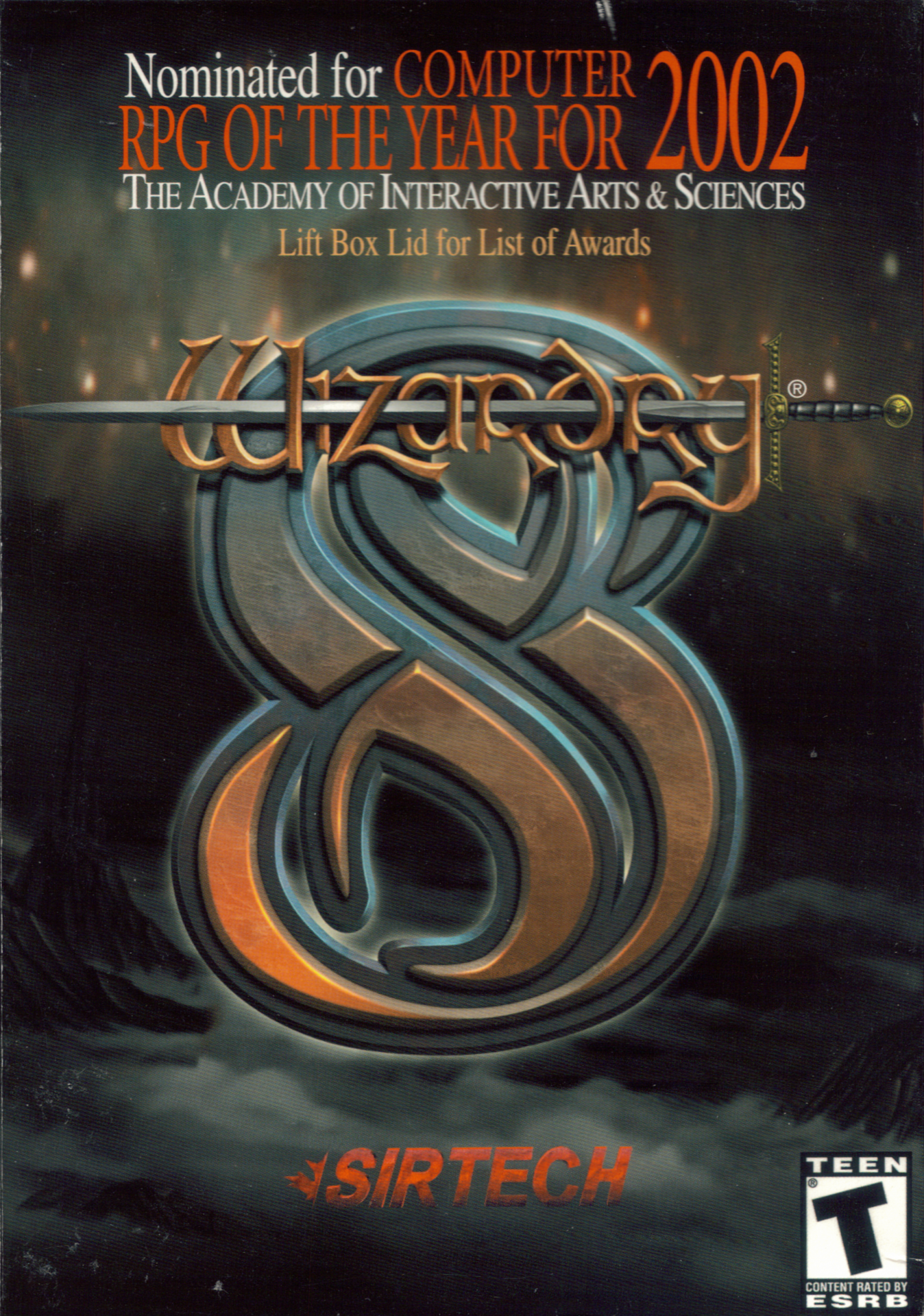
Wizardry 8 is a first-person RPG that pits an initial party of six adventurers against an otherworldly being known only as the Dark Savant (Character). After assembling their party of adventurers, the player will confront many challenges and puzzles as they attempt to find a means to stop him and his army of automatons. This would also be the last game in the series by Sir-tech. It should not be confused with the Japanese version of the series which had long since spun off from the main franchise.
It was completed and published by Sir-tech Canada when the publishing arm of the company in New York had closed its doors in 1998. Unfortunately, soon after Wizardry 8 was finally published, Sir-tech Canada would follow suit in 2003. One result of the financial difficulties that the company had been under was the sale of ad space within the game itself, something that appears when exiting the North American version of the game. The European version did not have any such advertisement.
The game is notable for being considered to be one of the last of the "old school" RPGs on the PC for both its detailed combat mechanics and the exceedingly deep character development system of classes, skills, personalization, and atmosphere. Although it utilizes both elements of sci-fi and fantasy within its story, the game manages to balance both of these against the backdrop of an epic quest that easily crosses between both genres due to its vast scope. The game also utilized extensive 3D graphics to represent its world and aside from the interface, everything was rendered in this way making it the first, and only Wizardry title to do so.
The game was also, according to Charles Miles (Person) who was a member of the team behind it, "unapologetically hard" in order to make "surviving each level to feel like an achievement.". Unfortunately, some of the mechanics that had been introduced within its gameplay (monsters with line of sight detection, using the 3D landscape to actually hide and sneak by enemy patrols) had been overlooked by players unused to having such conventions within an RPG like this one. The first section of the game that takes the player from their starting point from a Monastery to the city of Arnika, Arnika Road, had been called by RPG-reviewer Scorpia "The Terrible Road' for its incredibly tough encounters.
The game was also notable for featuring an import mechanism that allowed veteran players to bring in their saved parties from Wizardry VII which had been released approximately nine years earlier. Parties could also be imported from Wizardry Gold, a remake of Wizardry VII that had been released in 1996. Depending on what choices were made, the starting point for the player could be determined by their save. Also notable were the multiple endings that could be experienced depending on the player's choices at the end of the game.
Among the other features of the game were:
Wizardry 8 also features spoken lines for nearly every character in the game from the NPCs that the player encounters to the reactions spoken aloud by the personalities chosen for their party members.
The manual was also notable for presenting the credits of everyone that had worked on the game within the first few pages.
Wizardy 8's quest arc is notable for being fluid in how the player handles certain situations when confronted with a decision. As there is no alignment to worry about in the game only the consequences of the player's actions mattered. For example, an important NPC may have an important artifact in their possession for sale at an exorbitant price. The player can opt to sell equipment and slowly earn the monies needed to buy it. Or, they can opt to kill the owner (if they are strong enough) and take the artifact anyway, but earn the wrath of their faction for the rest of the game.
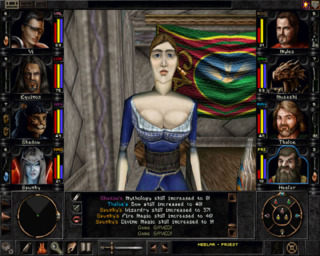
The story of Wizardry 8 completes the "Dark Savant" arc that had started with Wizardry VI: Bane of the Cosmic Forge. In that adventure, the party had to recover the Cosmic Forge, a relic created by the Cosmic Lords that could make anything that it wrote literally true. At the end of that adventure, the Cosmic Forge had been taken away by Aletheides, a servant of the Cosmic Lords. It was later revealed that the Cosmic Forge had been used to hide another powerful artifact, the Astral Dominae, and with the theft of the Forge, the planet where it was hidden was revealed. In Wizardry VII: Crusaders of the Dark Savant, the Astral Dominae is found, but the Dark Savant steals it away and the party go off in pursuit of him.
Depending on what kind of ending the player may have experienced at the end of Wizardry VII, their save state will determine where they begin in Wizardry 8. If the player did not play through Crusaders of the Dark Savant, they would start off as bodyguards to a Mook named Grimpak who takes them on his starship to pursue the Dark Savant to the world of Dominus where the final clues lead. Unfortunately for Grimpak, the Dark Savant had already beaten everyone there and has set up defenses to ensure that no one should interfere with his own quest. The ship is shot down over the Higardi Monastery. Grimpak dies, but the party survive to continue their quest.
For veterans that had finished Wizardry VII, there were other ways that the game could start for them depending on what they did at the end of that game:
Upon arriving on the world of Dominus, the party eventually discover that many other races are there from the last game, all of which have their own reasons for following the Dark Savant. In exploring the Higardi Monastery, they discover that Aletheides had been waiting for them and he tells them why the Dark Savant is so interested in Dominus. He is there for the Ascension, the rite of passage that would enable him to ascend to the Cosmic Circle and become a Cosmic Lord himself. But to do so, he needs three relics: the Astral Dominae which is the key to Life, the Chaos Moliri which represents Change, and the Destinae Dominus which represents infinite Knowledge.
The Dark Savant already has the Astral Dominae, so he is feverishly searching for the other two relics that he knows are on Dominus. The Chaos Moliri is held by the scientifically minded Mook who had discovered it and was brought to Dominus in order to continue their studies of the artifact. As for the Destinae Dominus, it was held at the Higardi Temple until it was stolen by a Higardi called Maarten who consequently went mad after using it on himself, his mind unable to grasp the knowledge that had flowed into it. Much of the quest will involve trying to track down Maarten's last location as it had been many decades since that he had disappeared with the relic as well as dealing with several other problems.
For one thing, there is a titanic bomb on Dominus, built by the Dark Savant and protected by traps and an army of automated soldiers. If the Dark Savant event suspects that anyone is approaching Ascension at Ascension Peak, he has threatened to destroy the planet with it. That becomes one of the party's more pressing quests, but there is no way inside the bomb and it is impervious to any attack.

The second problem is that the Dark Savant's ship is somewhere in orbit, busily shooting down anyone that either tries to arrive as the party had or leave. Destroying his ship becomes another quest that they must succeed at, if only to trap the Dark Savant on Dominus and to keep him from escaping when the time comes for them to mete out justice. This will require some way to track his cloaked vessel as well as feeding those coordinates, once found, into an appropriate weapon powerful enough to blast it from the sky.
As the party explores the world of Dominus for clues, the Dark Savant appears before them and mocks them with his power, threatening to destroy them if they dare to reach Ascension. He brandishes the Astral Dominae in front of them, but then realizes that it is actually fake and hurls it to the ground before leaving to find out just what happened. The party picks up the fake Astral Dominae and keeps it in their inventory. It's a convincing fake with just enough magic to make it appear real, but upon closer inspection, it is merely a pretty bauble. Still, it can be useful in the right hands.
As for who made it, the answer becomes obvious when the party discover that the Rattkin had followed the Dark Savant to Dominus by stowing away on the T'rang ship when it had come to the planet from Guardia. The Rattkin had a deal with the Dark Savant on Guardia to help locate the Astral Dominae, but the Dark Savant had welched on the deal leaving them empty handed. In revenge, they manage to steal the Astral Dominae from him and replace it with the fake that the party now has in their possession. They offer to sell the real Astral Dominae to them for the price of what the Dark Savant had owed them which is an astronomical number.
During the course of their adventures, the party discover that the warlike Umpani have also arrived on Dominus. They are busy gathering their military strength on Dominus not only to deal with the Dark Savant when the time comes as the evildoer has betrayed them as well, but to deal with their insectoid rivals, the T'rang. The T'rang, the party later discovers, are holed up in an old fortress that used to belong to Maarten and his followers before he had disappeared in the battle to arrest him. The fortress still holds many secrets and the party eventually discover his old journal that leaves several clues behind for those to follow.

However, both the Umpani and the T'rang, while they have many things to offer the party and freely allow them to explore their respective bases, also want to send the party as emissaries to the mysterious Mook who have also arrived on Dominus. Making them an ally could tip the odds in either of their favors, something that they want in order to deal with their hated rivals. With another ally, they could do what is needed to finally put an end to the meddling of the other side. However, the party sees the mission as an invitation to get into the highly secured Mook base in Arnika and upon doing so, discover that they have the Chaos Moliri in the vault.
All three races are concerned about the "Ascension", although none of them are sure what it really means on Dominus and dismiss it as something of a local legend. What matters, however, is that the Dark Savant thinks it important enough for him to risk everything, so they are also doing what they feel is needed to find out as much about it first. As a result, one of the requirements for the "treaty" between one of these races and the Mook is to take a look at the Chaos Moliri. The Mook, of course, are happy to oblige.
Within an anti-magic vault where none of their spells will work, the party enter to find the Chaos Moliri hovering in a beam of light. It's obviously trapped if they attempt to leave with it, the technology of the vault immediately detecting any such theft, but with the fake Astral Dominae in hand, they easily make the switch and leave without the Mook ever suspecting a thing. With the Chaos Moliri in hand, and a possible ally of their own, they finally pursue the clues to Maarten's final resting place deep within the Sea Caves far beyond a treacherous island filled with brutal sea men and an underwater network of caverns, tunnels, and Nessie.
They meet Maarten who warns them of the power of insanity that it holds and only the character armed with a special helmet may grasp the Destinae Dominus without going mad. If anyone else holds it, its power flows out and turns the party into a pack of raving goons as long as it is in their possession. Once it is safely kept with the responsible party member, the party then return to the Rattkin at this point with enough money to buy the final relic. After several other adventures, they are finally ready to make their way to Ascension Peak and complete the ceremony themselves before the Dark Savant can even guess at their intentions.

Unfortunately, the way to the Peak is protected by the Rapax...a race of horned and and highly violent warriors...who have been convinced by the Dark Savant that they would be the ones to inherit the world of Dominus once he ascends. The only way through the castle is in battle, and the only way to Ascension Peak and the colossal bomb that the Dark Savant still has under his thumb is in becoming Rapax Templars. Little do they know is that one of the requirements for becoming a chosen Templar is to lie with the Rapax' demon queen, leaving the choice up to the player as to which character they want to send in alone.
After becoming Templars, the party eventually discover a portal that ties the castle directly to the inner mechanism of the titanic bomb sitting outside Arnika. Making their way inside and defeating the Savant's servants, they manage to disable the weapon by solving a puzzle requiring them to withdraw a set of rods from the central shaft allowing them to leave. Several other adventures see them rescuing the Rapax Queen from captivity, stopping the Rapax King and his plans for conquest, and making their way to Ascension Peak. Veterans of the previous game will also discover that Bela is also there and is ready to help them.
Amid the many dangers on Ascension Peak, they face three gates and three temples; each one protected by deadly challenges including one very angry Rapax Prince and his host of spellcasting minions and soldiers. The dangers protecting each temple are unique to their nature and once the party is able to defeat each one and enter them, they replace the relics where they belong, opening the way to Ascension. Aletheides also appears at each temple to greet the party and to tell them that they are drawing close to the end.
Once all of the artifacts are in place, the party make their way to the top of the mountain only to see the Dark Savant already waiting for them. He laughs at them and enters the Cosmic Circle through the glowing doorway at the top of a hewn staircase and the party quickly follow after him. They find themselves on a floating pathway, surrounded on all sides by the universe, a single way forward into what appears to be a hovering structure. Inside, they find the Dark Savant confronting Aletheides and asking him where the Cosmic Lords are. Aletheides gives him an answer that he was never expecting: the Cosmic Lords are gone. There is no one there for him to exact his revenge on.
In fury, the Dark Savant vents his frustration at the android servant, destroying him and then quickly disappearing afterwards to find any trace of the Cosmic Lords. However, they also discover that the Cosmic Forge is back where it should be, atop the book in which is written the destiny of all things, and with an ally who urges them to act quickly, they decide to use it to write their own ending. At that moment, the Dark Savant appears behind them and tells them to stop, revealing the truth of who he is.

It turns out that the Dark Savant is actually Phoonzang, the legendary Cosmic Lord that had dared to share the gift of knowledge with the races of the universe in the hopes that one day, they may rise up and become Cosmic Lords themselves. For what they saw as an abuse of his power, the Cosmic Lords banished Phoonzang from the Cosmic Circle and stripped him of his power...but not his knowledge. Thus began his thirst for revenge, but it would not arrive in his lifetime. Over the many centuries of his preparation, he eventually replaced most of himself with machinery in order to live past what his now-mortal frame was capable of doing in order to achieve his goals. Now that he almost has, he turns to the party and offers them a deal: to join him instead and become Cosmic Lords together.
Depending on what the player chooses to do, three different endings will play out:

Wizardry 8 is a free-roaming, first-person RPG set on the world of Dominus. The player must stop the Dark Savant from achieving Ascension by recovering three powerful relics, but in order to do, must negotiate the many side quests and explore nearly every dungeon to find what they need as well as gain the power to survive the final confrontation.
Saves could be made anywhere and at anytime in the game, except when playing in Iron Man mode.
Wizardry 8 was notable for giving players an active parser in which they could type in words or phrases for NPCs to provide answers for. An active list of topics was added to when required by the game, but the player could also add to the list themselves for later reference with other NPCs. In doing so, this interactivity allowed the player to simulate having a conversation with an NPC on a very basic level (such as that found in text only adventures or adventure games with similar parser driven mechanics) as opposed to simply selecting from a preset list of possible responses.
Several easter eggs were also included in the response list for veterans of the series. Entering in words related to the previous Wizardry (such as referring to certain races or worlds) would sometimes elicit a response that added to the collected lore of its backstory.
For an RPG, Wizardry 8 was also notable for the many puzzles scattered throughout its gameplay. They would range from simple tasks such as finding the correct item to riddles, fixing broken machines or in finding and then using certain items to repair bridges, and in piecing together scattered clues in order to generate the appropriate response to another puzzle much later on. Some quests, or important pieces of knowledge pertaining to them such as where the party should investigate next, were hidden within item descriptions or conversation phrases, making it easy to overlook them.
Wizardry 8 came with three different difficulty levels which could be adjusted at any time during the course of the game:
Aside from determining how hard monsters hit you, the difficulty levels also affected several other aspects of the gameplay such as the hints that you might receive on your next quest or the difficulty of lock picking in general. It also determines just how many monsters decide to show up for your party's impending funeral.
The game also used difficulty scaling to ramp up the toughness of its encounters, although only up to a certain limit. For example, the rats that you might have stomped all over at the Monastery may be just as tough five levels later. Weapons, skill sets, and spell choices among other development options largely determined how effective your party was in a fight other than the raw level.
Iron Man Games
One notable feature of the game was the Iron Man Game setting. This is the ultimate challenge for players that want that sense of realism that an impending character death could smash their world with. In this mode:
However, the difficulty levels could be freely adjusted during an Iron Man session to help tilt the odds in your favor if only for a little while. The manual even came with a disclaimer saying that the developer and the publisher will, under no circumstances including but not limited to "acts of the Cosmic Lords", restore a lost Iron Man save.

The inventory system was divided into two parts: that belonging to a character and the general pool of items belonging to the party. There are limits to both in terms of how much the party can carry as a load. In addition to the load directly carried by a particular character, the party's shared inventory has a weight that is split among everyone. Load determines how much the party can carry before they either have to sell what they have or, if they can find a safe place, dump the items and come back for them later.
Wizardry 8 had the advantage of being able to "remember" where dropped items and loot would be allowing the player to literally thrown anything they didn't need on the ground and it would still be there for them to pick up later. However, load limits would only be increased depending on how strong a character was and even though there were no lockers or chests to store items in, it could be a challenge to safely drop certain items where you were certain to be able to return for them later once you hit the limit.
Moving around the world of Dominus was as easy as using the keyboard to move the party. The 3D rendered world of Dominus was also filled with a variety of hot spots to interact with whether it was a lever or a locked chest that required a little lockpicking. Players could tilt the camera up and down and examine things with the mouse. Anything that wasn't nailed down could be added to the inventory of a character or to the shared inventory that had no limit.
Thieves and others with the ability to pick locks will first need to set a series of tumblers in place. Making a mistake causes either one, two, or all of the tumblers to fall and this is predicted by the character's inherent skill.
As for disarming traps, when one is suspected, the thief is presented with a series of tiles upon which are inscribed a rough estimation of part of the trap's mechanism. If it is highlighted in green dashes, it likely means that clicking on it would disarm the trap. However, many traps range in complexity and several of these tiles may have to be clicked on, one after another, as the trap is disarmed.
Depending on how well the character's skill for detecting traps is, the highlighted tiles that they believe to be the 'correct' ones are usually what the player will need to look for. However, one or all of them can just be as bad a guess as any, resulting in the trap going off.
Dominus is inhabited by several native races in addition to the otherworldly visitors that have come on ships, such as the Dark Savant. All of them have their own reasons for either making the party's life difficult or in giving them an unexpected helping hand during their quest.
The Natives
The Visitors
The player can opt to start with the batch of pre-made character provided for them by the game or create their own. As noted earlier, they could also import their party from Wizardy VII or Wizardry Gold, but if they picked the bad ending where they were simply floating in darkness, they might as well start over.

Fifteen classes awaited the player. The player was also allowed to change professions during the game at which point they start out at first level for that class, but earn levels based on the total number of experience that the character is at. Each class is also an expert at certain skills and come with bonuses in those skills for when they start out.
There are eleven races to pick from in Wizardry 8, each with their own strengths and weaknesses.

Attribute scores ranged from 0 - 100 and determined a variety of effects and class eligibility requirements. Many of these attributes were particularly important across many classes across a variety of skills. Characters can improve their attributes thanks to the investment of points earned with every level.
When an attribute hits 100, it bestows an additional bonus skill that can also be improved during the course the game, such as a skill that can improve a character's ability to empower their spells with additional strength making them even deadlier in battle.
Upon finishing the process, the player had several options to toy with.
The next step was in picking a personality for your character. Wizardry did not use an alignment system and picking a personality did not mean that a particular character followed a specific ethos. It was simply used to represent their attitudes to the world around them, whether it was as a jaded cynic or an open minded explorer.
But more importantly, it would also determine the voice set used with any particular character (two voice sets per personality). None of these were set in stone, either, as the game allowed the player to change the voice and portrait of their characters. Character voices would also react to many other things, such as if a party member's spell fizzled and hit a friend in the face, someone's death, or in coming back to life and complaining that there wasn't anything there to get excited about. The humor in Wizardry 8 was decidedly cheeky.
The personalities available were:
As with many RPGs, character development was driven by experience points which translated levels. When a character gains a level:
Although the player was required to spend earned points on their attributes and skills, they could save the number of spells that they could select for later if they are waiting for a particular spell to unlock during the course of the character's growth.

Wizardry 8's skill system allowed the player to customize each character's strengths depending on how they wanted them to develop. Skill points were earned during each level and it was up to the player to distribute them as they saw fit. There were also unique skills that belonged to specific classes and would have considerable bonuses to their starting condition because of that, but for the most part, it was up to the player to decide what they should specialize in. If the player wanted to invest points in another skill other than Dual Weapons for their Samurai, they were free to do so.
The maximum score for any skill, as with attributes, was 100, although special bonuses could push it above that level. Additionally, as noted above, when an attribute hits 100, a special bonus skill was unlocked for the character that had reached it. Skills were divided into several groupings:
Weapons:
Physical Skills:
Academic Skills:
Expert Skills
These skills were unlocked once a character had become an expert. This was accomplished by mastering one of their main attributes by raising it to 100 which would unlock its associated skill.

Combat in Wizardry 8 was handled from the FPS window and can run in one of two modes: phased combat or continuous combat. In phased combat, orders are given to each party member and are executed on a turn-by-turn basis in the next round. In continuous combat, characters will continue to attack and follow their previous orders until interrupted by the player to execute something else in their queue. Movement was handled with a movement bar that would come up onscreen and measure how much "movement" the party had left as they maneuvered onscreen. The party could either run, which ate the movement bar at a much faster rate, or walk, which consumed the bar at a predictably slower rate.
Party formation also played a part in combat as the player could arrange their characters to protect their flanks, place their mages in the back, or in stick them in the center surrounded by fighters. Direction facing was also important since, because it was a 3D game, attacks could come in any direction and easily expose less well defended characters to a surprise from behind or from the sides.
Characters with ranged weapons, such as lances, could sit in the "middle" of the party and be able to strike enemies. Gadgeteers with their musket-like weapon could fire from the rear, and Rangers could also pelt enemies with arrows from the safety offered by a row of formidable fighters in the front row.