Game Pass Gambols 2: Olija
by bigsocrates
The Game Pass Gambols is my chronicle of attempting to at least sample every game released on Game Pass in 2022. Game: Olija Game Type: Puzzle/Action Platformer Time Played: Approximately 5 hours. Completion level: Rolled credits Approachability: Medium. It is fairly intuitive and very easy but its graphic violence and dire tone might be unpleasant for many. Should You Try It? : If you read a r...
The Game Pass Gambols is my chronicle of attempting to at least sample every game released on Game Pass in 2022.
Game: Olija
Game Type: Puzzle/Action Platformer
Time Played: Approximately 5 hours.
Completion level: Rolled credits
Approachability: Medium. It is fairly intuitive and very easy but its graphic violence and dire tone might be unpleasant for many.
Should You Try It?: If you read a review and think it sounds appealing you’ll probably like it. I think most people won’t get much out of it.
Olija is one of the weirdest games I’ve ever played that doesn’t seem to be intentionally weird. At its heart it’s a 2D action platformer built around the use of a cursed harpoon that you can throw into certain targets and then teleport to them. Its main gameplay focuses are puzzles and combat. There’s a little bit of reflex testing platforming here and there, but most of what you do is hit switches or plot out routes through a given room and then use the basic move set of jumping and harpooning to work your way through them, and fight enemies using the harpoon and a suite of secondary weapons you pick up along the way, including a rapier, a short range musket, and a repeater crossbow. Neither the puzzles nor the combat are particularly challenging or interesting, which leaves the focus on the presentation.
It is in that presentation that Olija’s weirdness really blossoms. You play Lord Faraday, a lord and captain from a poor village who is on the sea seeking food when his ship goes down in the ocean and is washed ashore on an island in an archipelago whose inhabitants have seen better days. You quickly stumble upon a cursed harpoon and set about helping your castaway crewmen assemble at a makeshift town on one of the islands. In order to do this you must take on the Rottenwood clan, a group of people who seem to have made some kind of deal with an eldritch horror of some sort in exchange for the power to dominate the rest of the people in the land. It is from them that you rescue your crewmen, and also Olija, the queen of the kingdom that held power before the Clan took over, a woman with whom Faraday is immediately smitten.
If this plot seems fairly straightforward that’s because it is, but it’s told in an unusual way. There’s some narration, a few conversations with NPCs you encounter, and some cut scenes that take place away from Faraday whether other characters talk to one another. There’s no real voice acting in the game with the exception of a few names (the game loves to ominously say “Faraday”) but instead you get English-subtitled gibberish (or possibly some language I could not identify), all spoken in low and threatening tones that sound like the whispers of madness. The story itself is full of allusions to ancient legends and curses, full of poetic proclamations of doom and half-stated threats. The game also does some visual storytelling, having Faraday travel through areas where there is no combat (and where he distractingly walks like he very much has to go to the bathroom) and showing gruesome sights like piles of bodies or desecrated shrines. Sometimes Faraday will walk past some people who chat with him and then return back after accomplishing some objective only to find them slaughtered.
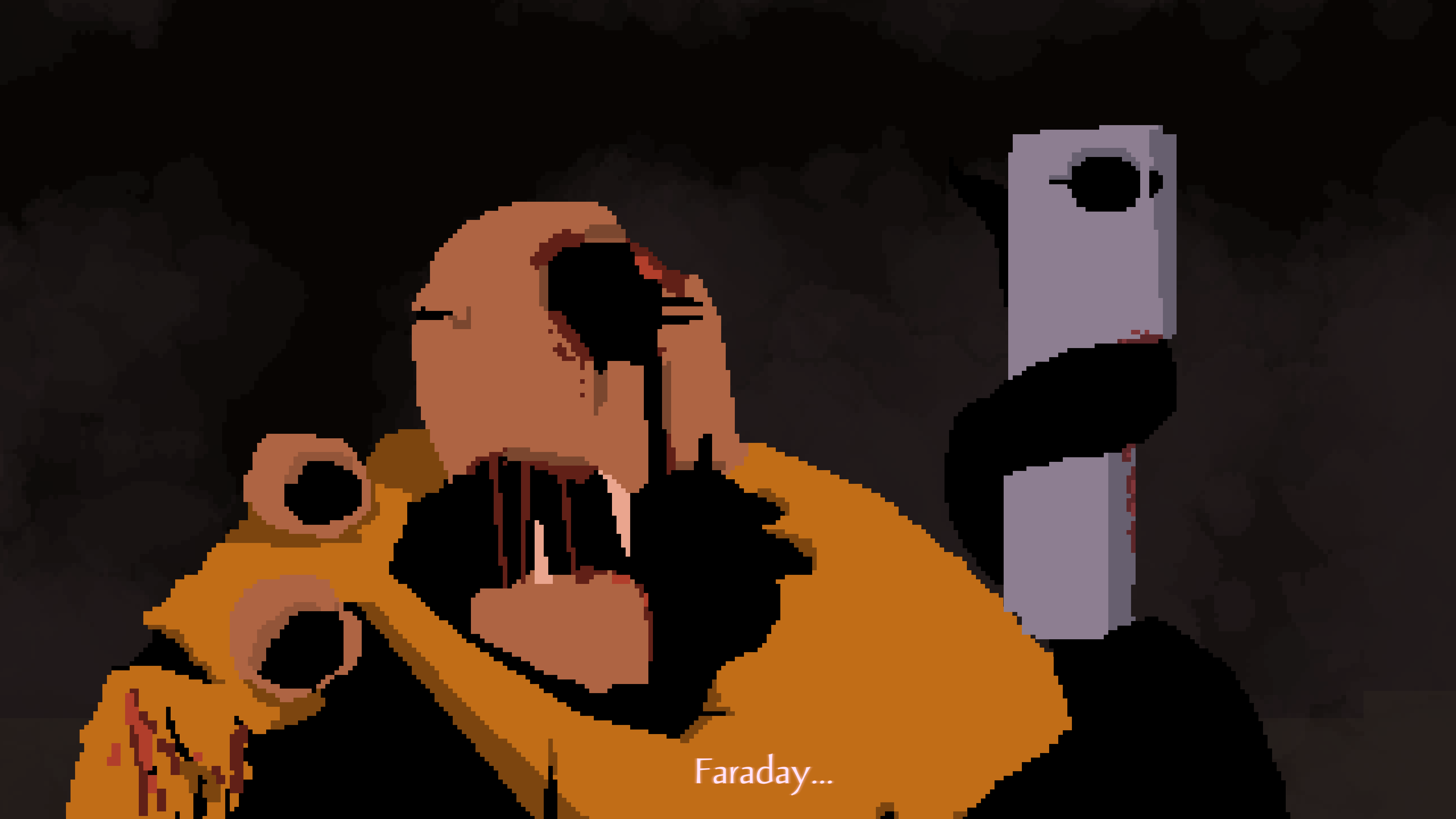 The game loves to say "Faraday" which is one of the few words you can clearly make out. Cut scenes are done in a style that intentionally recalls older games like Another World.
 All of this serves to generate a powerful tone of foreboding without developing much in the way of characters or plot. There's a boatman who has much of the game's dialog but his main character description would be "spooky." You rescue your crewmen from cages but don't get to know any of them in any meaningful way. Olija is clearly intended to be unsettling. The graphics are clearly modeled, in part, after the classic game Another World, which came out 30 years before Olija did and featured thin, faceless, characters against alien landscapes. Olija’s art style seems to reflect the same aesthetic but in a world of Lovecraftian horror. Enemies are either all mouths and writhing tentacles (not totally unlike the leeches in Another World) or humans who explode in viscera and body parts. I was surprised that the game is rated teen, probably because of its throwback graphics that don’t have the realism of something like Mortal Kombat, because it is extremely violent. Enemies spray blood and lose heads. There are mindless slaves, halfway between starved refugees and zombies, who wander around and often follow Faraday, dying brutally as they stumble into pits that he jumps over. The hints about what the queendom was like prior to the rise of the Rottenwood clan imply that it was always a brutally unjust place and what has changed is more who happens to be the master than the fundamental unfairness of life there. Olija does successfully manage to impart this tone to the point where I felt a little uncomfortable while playing it, like I had stumbled upon the half-rotted corpse of an animal in the woods and just wanted to get away from the sight of it, while also having a bit of perverse fascination in the way the bone breaks through rotted skin and the sight of organs being devoured by fungi.
Probably the most unusual aspect of Olija is that for the most part it’s a non-scrolling platformer. The camera pans a little bit but mostly you move between static screens, like you did in pre-Mario Brothers games like Pitfall. The game’s state is persistent from screen to screen (you can hurl an enemy off the screen you’re in and follow them, and you can leave the harpoon in one screen and travel to another) but you only get camera cuts when you reach the boundary. This is very unusual in a modern platformer, and Olija does abandon this choice in certain areas like boss fights in favor of a more normal scrolling playfield, but it gives the game a decidedly old school feel that matches its otherworldly aesthetic of ancient rot. It also allows the game to surprise you by hiding enemies or hazards at the beginning of a new screen, and to hide secrets by making what seem like bottomless pits actual transitions to new screens. There are some hidden items like ships in bottles and music boxes concealed behind walls you can pass through or pits that seem bottomless that aren’t, and there is little in the way of hints to tell you which these are. The health cost of falling into a bottomless pit is low and healing relatively plentiful, though, so experimentation isn’t too painful.
 Combat shows damage numbers for some reason even though you can't see enemy health. The aesthetic of the enemies is very much "tentacles and bone," at least for the less humanoid foes.
Olija’s strong aesthetic is unusual but not in and of itself weird. What’s weird is how little it is reflected in the gameplay. Olija is, as I previously said, something of a cakewalk. I can’t think of one even remotely challenging sequence in the game except maybe the final boss, and I beat him on the third try. I’ve complained in the past about games being too difficult but I think Olija goes too hard in the other direction. The puzzles are all simple and straightforward, the combat amounts to slashing guys with your rapier until they explode (or whatever your weapon of choice is, I guess) and…that’s really it. The platforming doesn’t even try to be difficult. It’s just kind of there. Olija’s entire aesthetic seems to suggest it’s going to be this brutal unforgiving game and it’s just…not. That in itself is not a problem.
The problem is that it’s boring. Olija just isn’t very mechanically interesting or engaging, it has only the barest bones of a narrative to drive it forward, and the graphics are fine but they’re sparse and don’t change much so you won’t be pulled forward wanting to see what’s around the corner. It’s more scrub brush and weird pulsating eyes. It lacks momentum. It’s a short game, around 5 hours, but I played it over the course of 6 or so days in short sessions that still felt a little bit like slogs. It’s not unpleasant to play; everything works reasonably well and it mostly feels fine to control but it’s too repetitive for its own good. It introduces new equipment and mechanics over time and it has a basic upgrade system that lets you buy new hats that come with abilities, so it’s clear that the developers meant it to have a normal progression, but the extremely low difficulty makes everything feel too samey. You’ll never be agonizing over which hat you should equip; the one that lets you heal is almost always the right one and you’ll never be puzzled about how to work with the new mechanics because their uses are obvious and straightforward.
I’m mostly done with the review and I haven’t even discussed the game’s biggest gameplay ‘hook,’ the cursed harpoon that you can throw into certain targets and then warp yourself to. You use this for much of the platforming and puzzle solving and can also use it during combat to impale enemies and warp to them. Many of the games puzzles are built around this mechanic and it can be useful in combat but it doesn’t feel like anything new or innovative. Aiming the harpoon doesn’t feel great with a controller and the game moves so fast that using it effectively in combat is both chaotic and unnecessary given the difficulty curve. Like the rest of the game it isn’t bad per se but it’s not an exciting or particularly fun mechanic. Even when the game introduces another way to warp to certain points it really only provides 2 or 3 puzzles that require you use the combination of abilities, and they’re all incredibly obvious. Compared to games like Flinthook or Bionic Commando Rearmed the Olija harpoon grappling mechanic is pretty ‘meh.’
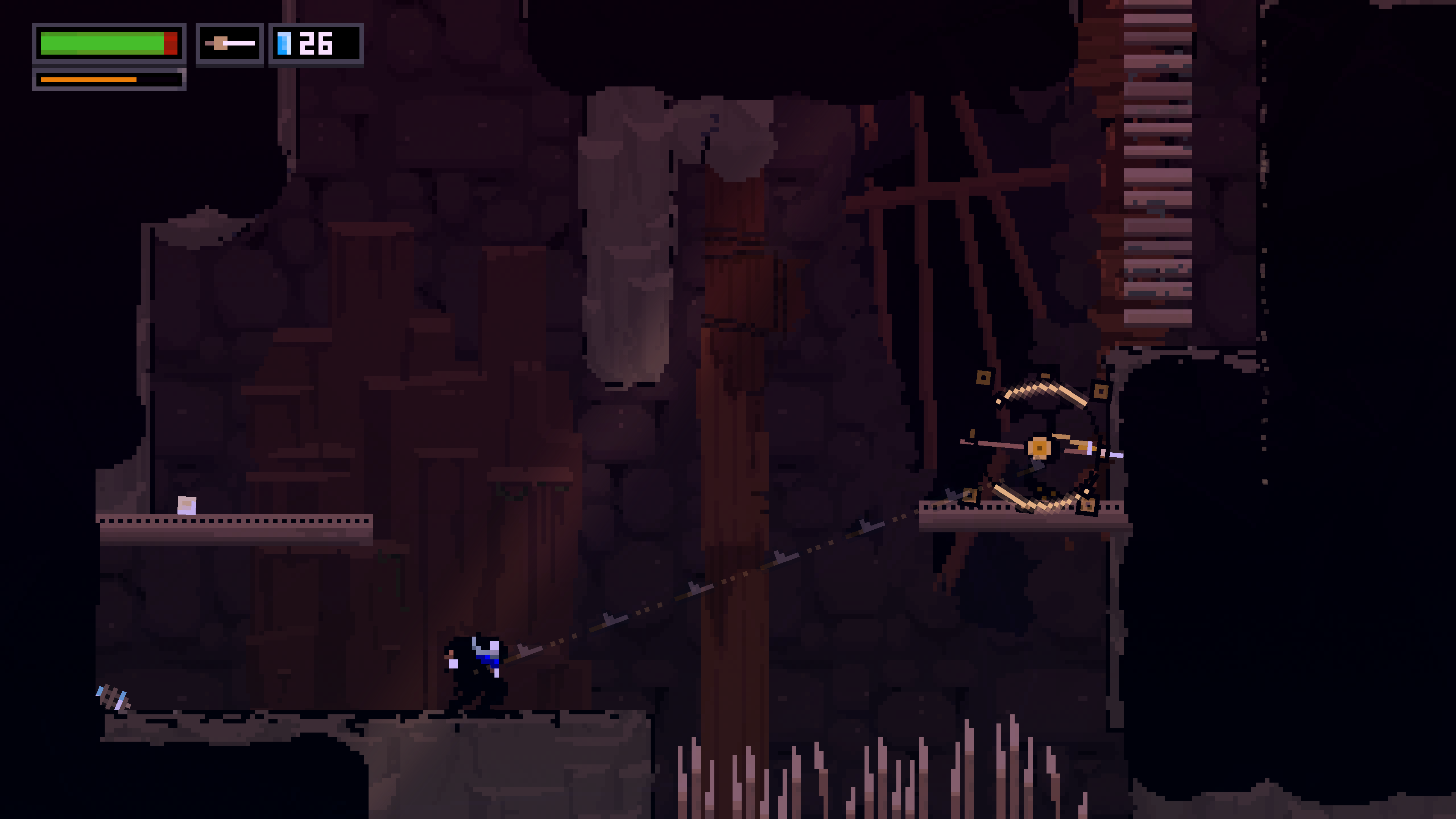 You can throw the harpoon to these anchor points and transport to it. You can also stick it in enemies. As a mechanic it's...okay.
I played through Olija because it was short and I wanted to be as fair to it as possible because I knew I was going to write about it. I really wanted to like it because I feel like the developers were trying something different and they had a vision and that they executed reasonably well. My problem with the game is that the vision isn’t compelling to me. It’s atmospheric and inoffensive to play, but that’s only enough to get you to “not actively unpleasant” not enough to make it something that’s actually worth someone’s time unless they really vibe with the particular atmosphere the game is presenting. There are long “story” segments in the game where you’re just slowly walking from one screen to another while something silent happens to in the background and I found them excruciatingly boring, as I did most of the long dialog sequences. It’s impossible to care about these people because you don’t know anything about them, and there’s so much suffering in the game that Faraday’s particular troubles aren’t of great import. It feels like you’re supposed to care about Faraday and his crewmen and Olija and think they’re trying to accomplish something important by defeating the Rottenwood clan and their eldritch sponsor but the game also implies that you’re not actually changing anything.
Olija did relatively well critically, with a metacritic over 70, and I think that’s in part because critics also wanted the game to be more successful than it actually is. I think there are a select group of people who will really like it and a much larger group who will find it offputting, baffling, or just unpleasant. Does that make it a good fit for Game Pass? Maybe? On the one hand you’d think that Game Pass is best serving up games that can be enjoyed by all of its nearly 20 million subscribers. On the other hand you can imagine that if even 5% of the players are people who would like Olija then that’s nearly a million people who could get value from the game, and by providing diverse offerings that please the various subgroups in the subscriber base you can provide something for everyone even if not everything would be for everyone. I think that anyone who looks at the game or reads a review and thinks it’s for them will probably enjoy it, and the rest of us can find other things to play on the service. I like that Game Pass takes chances and offers up weird projects even if they’re not to my personal tastes.
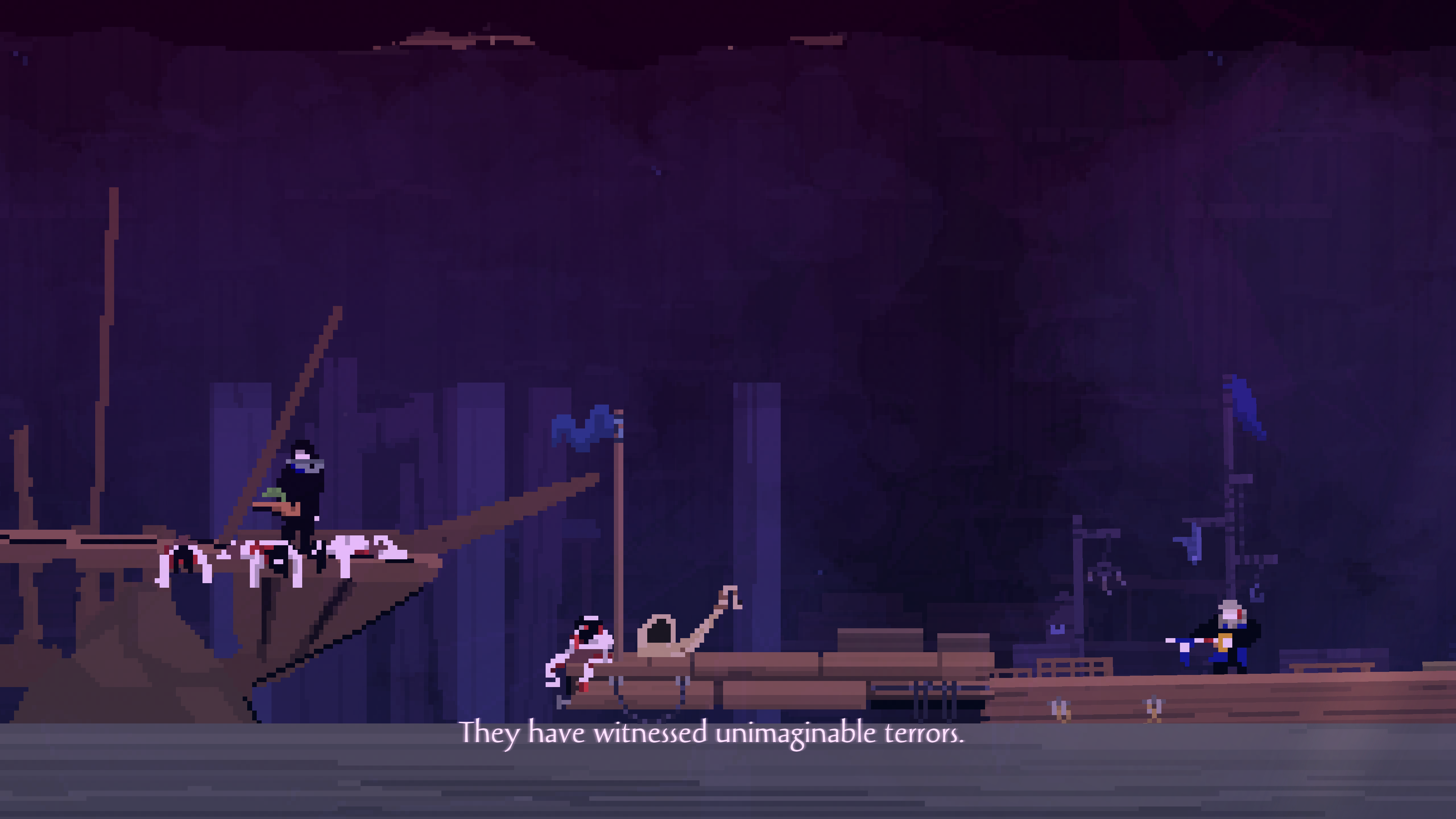 I too have played Balan Wonderworld.
 I struggled rating Olija, swinging between 2 and 3 stars depending on what part of my playthrough I was in. I thought it was interesting at the beginning, annoying towards the middle, and a little better again towards the end once it had fully developed its ideas and focused its narrative a bit more as it came to its conclusion. In the end I split the difference. One thing I learned from Olija is that I need to take more seriously the fact that I only promised to play 1 hour of each game. I don’t need to finish them. I didn’t need to finish this game. It wasn’t for me. That’s okay. It might just be for you. I hope it is.
GAME PASS GAMBOLS RATING (out of 5):