
Assassin's Creed Freedom Cry is good DLC that could have been an even better full sized game.
by bigsocrates
Assassin’s Creed Freedom Cry is something relatively rare. A piece of DLC that was released as DLC first but later released as a standalone game. Ubisoft’s decision to make this piece of content its own separate title shows their confidence in the add-on and their justifiable belief that, unlike a lot of DLC, Freedom Cry represents a substantial story and chunk of gameplay that expands the Assa...
Assassin’s Creed Freedom Cry is something relatively rare. A piece of DLC that was released as DLC first but later released as a standalone game. Ubisoft’s decision to make this piece of content its own separate title shows their confidence in the add-on and their justifiable belief that, unlike a lot of DLC, Freedom Cry represents a substantial story and chunk of gameplay that expands the Assassin’s Creed franchise.
I played Freedom Cry as a piece of DLC and I ultimately think that's the context where it makes the most sense. Freedom Cry stars Adéwalé; Edward’s quartermaster from AC IV, and picks up over a decade after the events of that title. Adéwalé is now a full blown member of the Assassins and has sailed to Saint-Domingue and what is now Haiti to intercept a Templar courier. He ends up shipwrecked near Port-Au-Prince with most of his equipment gone and quickly finds himself in a slaver’s dystopia, where a small black resistance fights for freedom in a colony that is dominated by plantations and the slave trade. Adéwalé decides to help the best way he can, which is, of course, by doing what every Assassin does best. Trailing missions! Okay, there’s also some ship battles, plantation raids, and smaller side activities like killing jailers. But there's a lot of trailing missions. It’s a trimmed down AC IV experience on a much smaller map but almost everything from the main game is present and there are a couple new pieces of equipment to mess with, as well as the return of a mechanic from AC III where you can run through a building to lose pursuers, though I only found one place it actually worked during my time with the game.
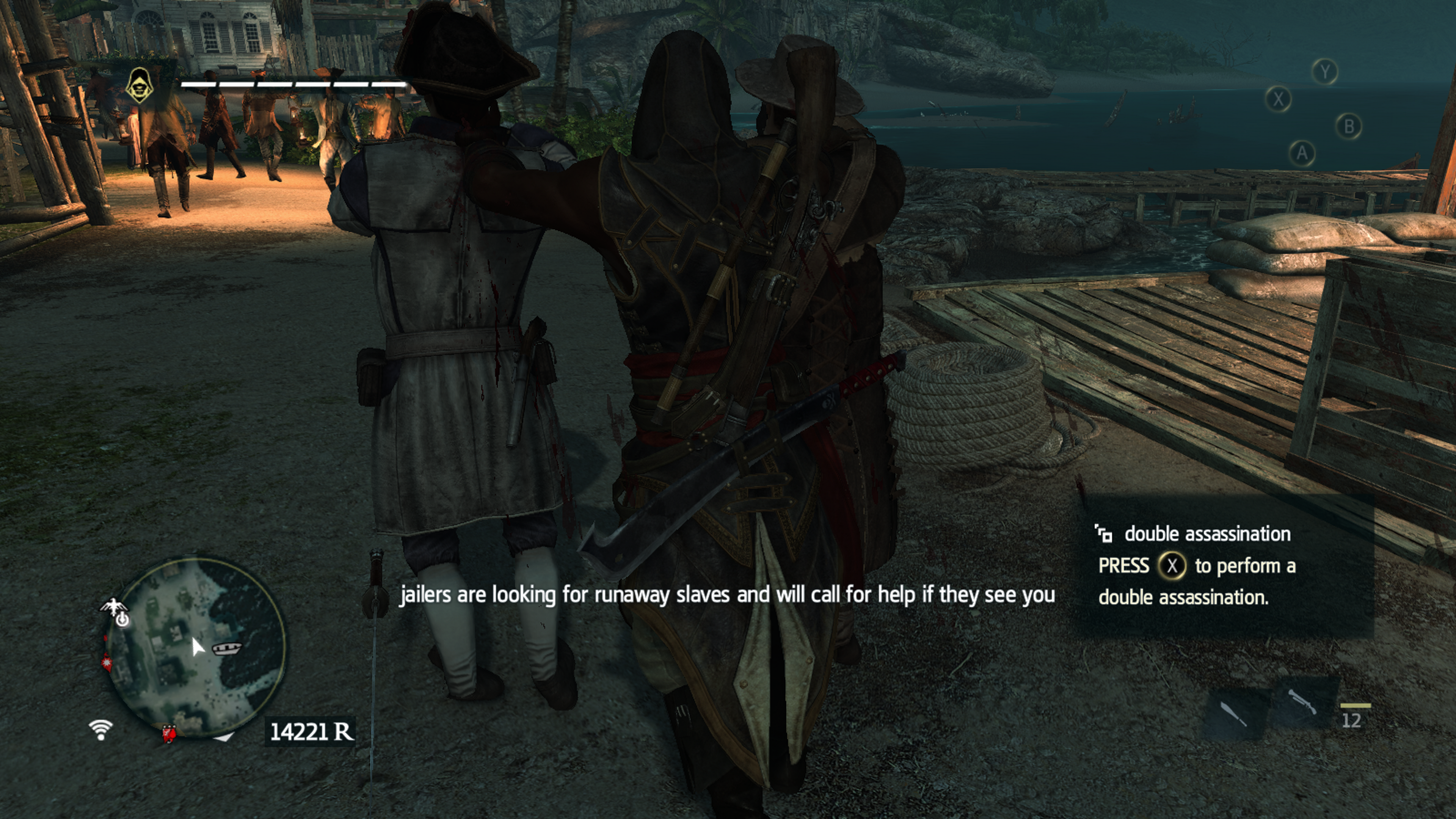 Double assassinations are back, as are almost all the mechanics from AC IV, for better and for worse.
Despite the triviality of the gameplay additions (Your pistols are replaced by a blunderbuss that fires like a shotgun and you get firecrackers to distract the baddies) Freedom Cry plays like more Assassin’s Creed IV. Adéwalé moves just like Edward did. Adéwalé's ship controls just like the Jackdaw. The combat and stealth and everything else are virtually unchanged. A lot of minor mechanics are gone from the main game (there’s no trading minigame or taverns; upgrading and equipment are massively stripped down) but they aren’t really missed and it makes you wonder why they had to be there in the first place. The main side activities are now all focused on freeing slaves and building a force of Maroon freedom fighters, and it is pretty satisfying to take down a slave ship and her escorts to free the human cargo within and make your numbers go up, unlocking gameplay benefits like better equipment and more crew for your vessel as you increase the free population.
The reason I think that this game is better as DLC than standalone is because despite having a decently long story (about 3 hours if you take your time with it) and a lot of mechanics, it doesn’t spend a lot of time on set up or teaching you how to play. Adéwalé does briefly summarize experiences from AC IV a few times, but it’s hard to get a real sense of his character from this game alone without having spent time with him when he served with Edward. Instead Freedom Cry’s story is really focused on two NPCs; Augustin Dieufort, the head of the Maroon freedom fighters, and Bastienne Josèphe, a local madam associated with the Templars who also helps the Maroon cause. Dieufort is a pretty typical Assassin’s Creed NPC, which is to say that he’s undercooked and not very memorable, but Josèphe is an actually interesting character, and probably the best NPC in either the DLC or the main game with the possible exception of Adéwalé himself. She’s a complex character and she’s given a decent amount of screen time to threaten, seduce, and ultimately work alongside Adéwalé in pursuit of her own ends.
 What's this? An Assassin's Creed character being perceptive and thoughtful rather than just dumping exposition on you? How did she get into this series?
Freedom Cry got a lot of credit for being a mainstream big budget game that actually focuses on a painful historical issue like the slave trade, and to its credit it really does let that historical atrocity take center stage. The Templars and Assassins are mere background to what’s going on in Port-Au-Prince, and the choice to have Adéwalé more caught up in real human suffering and rebellion than supernatural conspiracy theories means the game has real stakes and the bite that the main game is lacking. But while what’s there is mostly good, a lot is glossed over and there was the opportunity for so much more.
Much has been written recently about how so much of even well-meaning presentation of the black experience in media is essentially suffering porn, and Freedom Cry falls into this trap. The open world is absolutely full of black people in distress, whether it’s slaves being chased through the streets or slave punishment detail or slaves in cages or injured slaves who need you to carry them to safety, this is a game that traffics a lot in black suffering. That doesn’t mean it’s bad, and I am not black so I will defer to writers like Evan Narcisse, who has Haitian ancestry, to talk about their own feelings on the game (he liked it a lot but also felt like it was shallow in places), but because it’s a 3 hour DLC it really only has time to get through a one arc story and a few side missions before its running time is over. Normally I am not a proponent of the modern day parts of Assassin’s Creed, but this game could have done so much there, in tying the experiences of descendants of slaves to the horrible institution of slavery. That’s probably beyond what Ubisoft is comfortable with (in 2013 it was non-controversial to portray historical slavers as terrible villains, but the echoes in modern society were more controversial) but it would have given the game even more relevance. It also would have been nice to see characters fleshed out, and maybe see some happier moments among the freed Maroons and other ex-slaves as they get to enjoy their hard won freedom. I would have loved to see Dieufort fleshed out, and even Adéwalé himself. This is a much more interesting setting than any other Assassin’s Creed game, but it’s over in a flash, unlike the endless repetition of AC III or the forgettable pirate drama in the main AC IV. I haven’t played Assassin’s Creed: Rogue, and maybe it’s spectacular, but I can’t help but wish that instead of being a short little DLC this were developed into a whole game that built on AC IV’s systems even further while giving us more time with these characters and this place.
I was also rendered somewhat uncomfortable by the way the game used slaves and black bodies as literal game mechanics, where if you free more slaves you get access to more stuff. In general the slaves in the game are dehumanized and turned mostly into collectables, which was unintentional but still kind of icky. There’s also a big moment where a large number of slaves die to set up the dramatic apex, and while this makes sense from a dramatic perspective it again feels like using real black historical pain for cheap narrative manipulation. More time with some of the slaves as actual people would do a lot to contextualize this stuff and humanize them. There’s just so much nuance and complexity that has to be glossed over because of the length. I would have loved to help free slaves and then have them become full blown NPCs and be given agency in their own right within the story. Instead Dieufort has to stand in for all of this, and his underwritten character is not up to the task.
 Dieufort isn't a bad character but he just doesn't get enough focus to make a significant impact.
Despite these criticisms of Freedom Cry, I understand why it’s so beloved and I do give Ubisoft credit for tackling difficult subject matter in a way that mostly works. The fact that I wanted more Adéwalé and more of the setting shows that they were on to something. I definitely connected more to this than to Edward and AC IV’s main story, and it’s a much better fit for Assassin’s Creed overly self-serious tone. In terms of gameplay…all my criticisms of the main game apply, but I won’t rehash them. This DLC also clearly had a much lower budget, meaning that cut scenes basically take place in two locations and involve a lot of seated conversations rather than big action set pieces, but that adds a sense of intimacy and works well with the storyline of these being conspirators in a hostile city with very few spaces they can safely congregate. There’s also the soundtrack, which features pieces with vocal tracks that draw from the tradition of slave songs and are both excellent and atmospheric. Assassin’s Creed games often have decent theme music but mostly allow the soundtrack to blend in to the background. Freedom Cry’s soundtrack is good, memorable, and unusual within video games, while also being appropriate to the setting and themes of the game. High marks.
Freedom Cry is good, but not great, DLC. It shows glimpses of a game that I’d really love to play that never got made. The fact that the black stories in Assassin’s Creed were shunted off to this and AC III: Liberation (a game with similar themes that I didn’t like as much) is not a great look, nor is the fact that neither game features a modern day component playing as the descendants of these black characters, though clearly they did eventually get around to adding a modern day POC perspective with Layla.
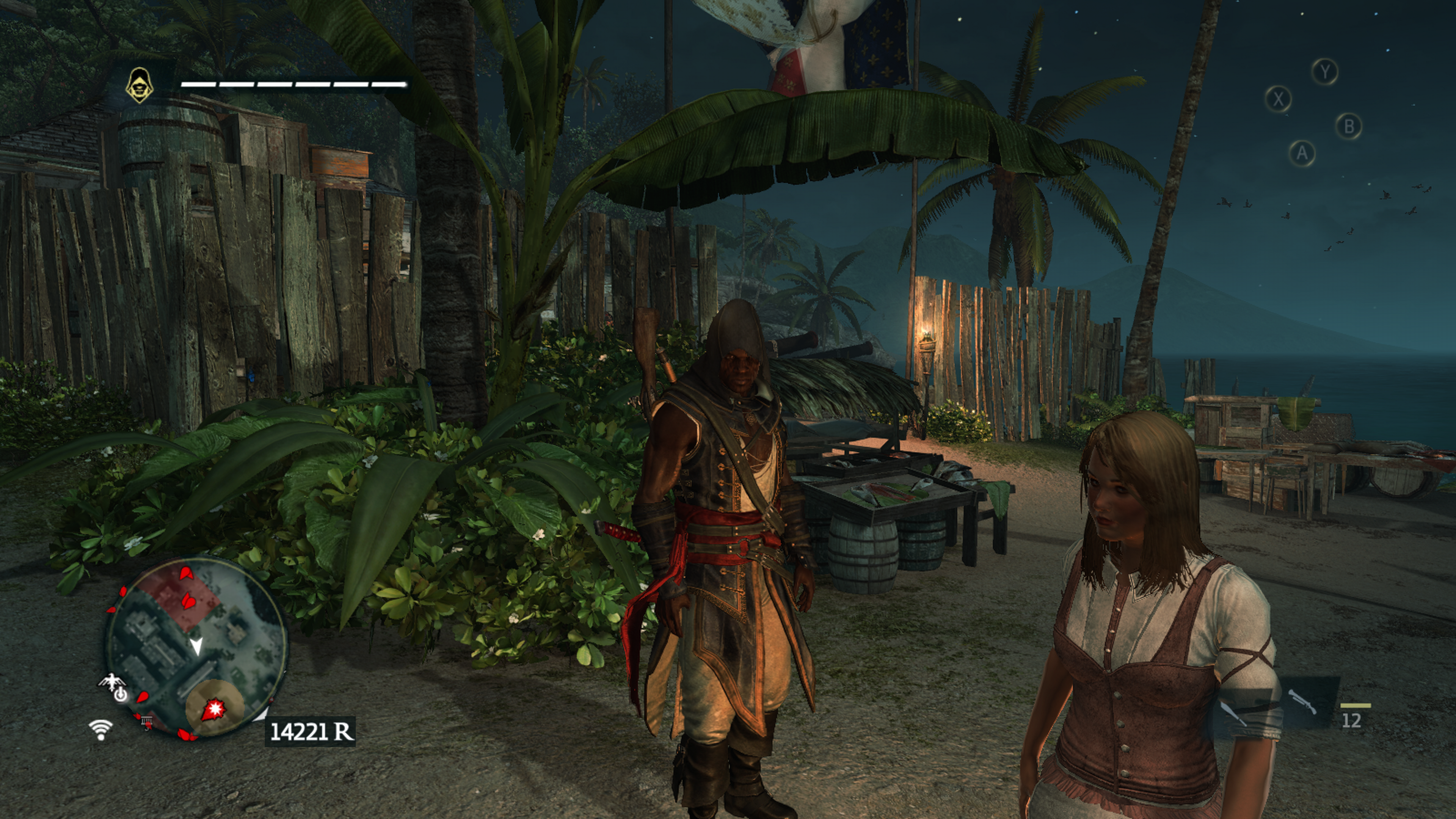 The game adds a few details like jailers who will try to capture you and a few random comments about slaves from passing NPCs but most characters just ignore you even though you're a black man openly carrying weapons in a slave colony. This is a DLC add on and it is bolted on to a main game where it doesn't really fit, rather than being its own unique title built from the ground up to tell this story.
My biggest recommendation for anyone thinking about Freedom Cry is not to play it back to back with AC IV proper. Play AC IV first, then take some time before getting back to Freedom Cry. I had mechanical fatigue with these games by the end, and even though I only played 45 minutes to an hour per day of Freedom Cry over the course of a few sessions, my patience with the actual game parts was pretty thin. I think I would have been better served by waiting until I wanted to dive back into this shallow gameplay pool again. Give it a month or at least a couple weeks so that you miss the sailing and aren’t quite so annoyed at all the trailing missions and another mechanical annoyances like how finnicky the human shield mechanics can be (love to be shot by watch tower guards when I’m wrestling with the finnicky parkour controls that won’t let me use the damn lifts, too.) For those interested in this as a stand alone experience I’d give it a firm maybe. It’s short and a little bare bones, and the fun mechanical parts are much less fleshed out than in the main game, while the story itself leaves Adéwalé as something of a cipher if you aren’t already acquainted with him. But I’m glad I took the time to play through this thing and I ultimately came away with a positive impression from it, which seems like more than I’m going to be able to say about Unity when I make my way through that.
 Ultimately this is a compelling story with arguably the best protagonist in the series. You're actually doing heroic things that matter, instead of chasing silly magical artifacts. I just wish the story had more room to breathe.