
2024: Change, Continuity
Hello from Vancouver Island! Since last I wrote too many words on this website, my family sold a house in the greater Seattle area and moved our lives up to Canada for the next few years. It's been great! Except for the parts where it hasn't been! The good news is we are safe, the graphs with lines moving downward are starting to move upward, and school (the nominal reason we're here in the first place) is going fantastically.
As for gaming, well, one of the big trades that has happened is I've excised about 20-30 hours a week of commuting to a handful of hours, some of which happen on an e-bike. If anything, I've lost more podcast time than gaming time. My venerable fleet of handhelds has seen less action, my PC has seen more. I scratched off 26 games in total last year, in line with my prediction from the last such post. Let's get through a few preliminary awards before jumping to the lowlights and highlights. As last year, there are several Final Fantasy games appearing below. As to where they appear, well...
Games I Didn't Finish But Will Finish Soon
Super Video Golf
I won't pretend that any of you are reading this for purchasing advice. But if that is in fact the case, and if you have any affection for 32-bit vibes and/or simulations of golf, open Steam right now and purchase Super Video Golf. It is the best golf game I have played in a very, very long time. There is a community playing this game right now that is so friendly and welcoming. The developer has talked to me directly about sideloading "other" music into this game... music one may associate with certain outings to Pebble Beach, perchance, with a certain walrus-like man, let's just say.
Golf games live and die by the swing mechanic, and then their courses. Super Video Golf has a fine spin on a three-click golf swing, and twelve courses with enough variation to keep things fresh across its career mode. The only reason I didn't finish said career is because I spent a lot of time doing online leaderboard stuff last year instead of the campaign. And I don't really do leaderboard shit, so this game really did something to me.
Runner-Up: Vampire Survivors
You know what other game is doing something to me? The one where I'm about 20 items away from completing the inventory. This is a game that has gotten its flowers elsewhere for a few years now so I won't linger here too long, but suffice to say I got infected pretty bad over the last two months with some vampirism. This is a game stripped down to crystalized player agency; everything feels immediate, responsive, gratifying, animalistic to a point. I do think there are builds that just flat out work better than others, which has led to some "end game" repetition for me, but if I keep doing the same things over and over again because they feel *so* good, is that really a problem?
Games That Finished But Just Kinda Underwhelmed?
Metal Gear Solid IV: Guns of the Patriots
Man, when MGS4 is good, it is a remarkable thing. When MGS4 is bad, it makes me wonder if I actually liked any of these goddamn games in the first place. Kojima's oeuvre certainly has a lot of sexual content for everybody, with its cavalcade of hot people, but as this game vacillated between being a satisfying third person action story about (again) grief and loss, and a clumsy peepeepoopoo mess with a literal diaper monkey stealing my soda, MGS4 basically edged me for its entire runtime.
This site in particular has had lively debates on the merits of MGS4 since it was founded, and in that spirit I'm just going to talk directly about the last half hour of this game that is approaching 20 years of age soon (by the way). I think the introduction of Big Boss was clever. I think the additional half an hour of explaining shit runs into the Star Trek: Enterprise issue where actually it's not necessary to tell me everything about your world because it doesn't fucking matter, doesn't make any sense, and I don't care. I think the last words out of Big Boss' mouth, the manner in which they are delivered, and the response to them, are a moment so perfect that it takes a game that I instinctively want to punish and instead makes it a 3 on 5 experience.
The frustrating thing is, I don't even think Kojima knows why that moment was so good. I don't know what is in that man's heart, or what his goals are, or if we've got much in common philosophically. But I hope that if he does make more games, that are mechanically sound and at least functional melodramas, and not games where we've somehow regressed to where, instead of the villains soliloquizing themselves, the guy who owns the diaper monkey calls me after I've killed the villians to tell me that they were just fucked up traumatized women who I spent ten minutes shooting in the face. Yeah. Less of that.
Runner-Up: Touch My Katamari
I'm selling my Vita soon. The thing is just a sadness factory, and I'm not commuting enough anymore to even sorta justify holding onto this thing when perverts collectors will buy it for near retail price used. Touch My Katamari is the sort of game the Vita deserved, which makes sense as this was basically a Japanese launch title. The game is just some warmed over levels and a handful of new stages with a half-baked back touch gimmick and some meta-level garbage around collecting randomly spawning items in levels to unlock new challenges. It feels like some of the worst mobile game trends of the early 2010s crammed into my actual favorite video game ever made, and buddy, fuck that in particular.
Most Perverse RetroAchievements of 2024
Beating a single level of Ikari Warriors on the NES
Yo this port is mega ass and you already know that. I'll just point out that RetroAchievements is a self-selecting group of deviant people, that people who choose to play Ikari Warriors on the NES despite knowing of its inherent badness are also sickos, that Hardcore Mode RA users are ultra-sickos, and of the 931 people who have started Ikari Warriors only 50 have unlocked the RetroAchievement for beating the first level on hardcore mode.
Runner-Up: Beating 27 consecutive rounds of Urban Champion
I am not a proud man. Urban Champion is not a hard game.
The Five Least Good Games
5. Final Fantasy: Mystic Quest
One of the first things I did in 2024 was dogsit for a professional quarterback. I was recovering from COVID, and wasn't entirely sure what was going to become of the rest of my year. What better time to complete the RetroAchievements set for Mystic Quest, Jeff Gerstmann's favorite Final Fantasy. Now, make no mistake (or mystake), this is not a great game. But that is more to do with just how simplistic and limited it is than any pure badness. It's about 15 hours of basic JRPG combat with an all-too-brief selection of standout music. Between the extremely bare bones game on offer, and the paternalistic line of thinking that led to this design - in short, Square released this game with the goal of teaching fool gaijin how to play games with math - Mystic Quest is a rudimentary and patronizing experience.
4. Psychonauts
Psychonauts is an ugly game. Not just visually, either. I think its lazy use of basic pop psychology terminology belies that a lot of its much-ballyhooed depictions of mental health issues play into some damaging stereotypes. Just the existence of a dilapidated asylum as a platforming hub world alone is kinda gross. There is a difference between saying something, and having something to say, and Psychonauts has nothing of note to say about the human mind. And that's before I've touched on the game much. I found the platforming here to be tolerable in doses, but held against its generational peers (I'm thinking of Jak and Daxter specifically) it feels slippery. I don't love how the abilities are implemented, or how improving skills are tied to the tedious act of hunting down figments. The game feels very much like the product of a tortured development cycle with its rushed, sequel hook ending and uneven levels. Crucially, most of the time it just isn't that funny.
3. Knack
I have not had a good year financially. Yes, I sold a house and made a profit, but that profit is not going to be liquid cash for a very long time. So there have been some cuts to the budget, and PlayStation Plus was one of those. Knack, being a launch PS4 title, was one of the last games I played through that service, and good golly did I not find much to like in Knack. So much of it just hinges on its gross, plasticine art style. The game looks very much like cheaply produced children's program, which could have worked, if not for its rizz-less protagonist. You won't hear a bad word about Polygon Man out of my mouth, but the main character being just a heap of endlessly fluctuating shapes just doesn't work. There's no nice Team Fortress 2-esque sillhouette here, just a bunch of shit whirling around a glowy sphere. As to playing the game, it's a case of spreading a simple loop too thinly across too much game. It was odd to see the arena-esque level designs of the game in light of another one I'm about to discuss very soon, but the simple combat and repetition brought on by frequent deaths - there are portions of some levels I wound up repeating a lot due to how quickly I got ganked - added up to a game I was quite happy to put down. It's not hard, but it is tedious. Tedious enough to be down in the bottom quintile of games I've played, along with incidentally everything else in this dubious set.
And speaking of combat arenas...
2. God of War (2005)
As much as I will happily dunk on the sad dad, faux-Hollywood aspirations of contemporary Sony games, at least they've managed to do something with this pathetic warmed over DMC edgelord bullshit. I played a little God of War in its day, yes. The game is fine, "successful", insofar as it is in fact a competent third person action thing. I enjoyed bopping around in little millennial combat arena style levels, the Dollarama Zelda environmental puzzles, hell I even enjoyed the fallow square-square-triangle exercise of its fighting for a whille.
The issue here is Kratos, a middle school boy's vision of ideal masculinity. I find him unlikeable to a shocking degree. He's a screaming misanthrope whose soul depth stems from going about covered in the ashes of the wife and child he murdered in a whoopsie. It's farcical, just silly and gross. I did a little digging around and have determined David Jaffe really dislikes what they've done to Kratos in the more recent God of War games since he stopped having any authorial input on the character. To that I say, make Jaffe howl. Have Kratos with a baby carrier in the next game. Have him teach a lesson on pronouns. Put a pride flag tattoo tramp stamp on the lad in God of War: Hlidskjalf or whatever it winds up being called. It wasn't the "light light heavy" that wore me out of the first game in the series, it was everything to do with its protagonist.
Incidentally, this was also the worst game about death and grief that I played all year. These are themes that come up some more, later!
1. Final Fantasy: All The Bravest
Behold, the single worst Final Fantasy thing. All The Bravest is about as shallow and cynical game as has ever been conceived, amounting to a collection of images the player can swipe on between trips to a slot machine.
Gameplay at first consists of tapping on sprite renditions of Final Fantasy classes, until your party grows to a point where the winning move is to just fat finger your entire hand across the right hand of the screen as quickly as possible. These pokes and swipes activate your party members, making them attack enemy sprites at random. These encounters occur on linear world maps, with some dozen included in the base game and others on sale for a few bucks a pop. At the end of each world, which again are comprised of swiping your screen to make some pictures go away, ends with swiping your screen against a big picture of a boss until it disappears or your party is all knocked out.
Each encounter thus feels exactly the same; the only real variables are your parties, which are randomly assembled at the start of encounters. Given that some classes have far more damage potential, this is not ideal. And that's before you address the idea of buying characters from the in-game store, some of which have very useful properties like resurrecting fallen party members mid-battle. At full strength you have 32 party members on the field so the odds of pulling any unlocked character from your pool aren't horrible, but on the other hand I certainly had full parties of thieves pop up from time to time.
I've mentioned knocked out party members because it's one of three real interesting choices or mechanics in All The Bravest. Enemies are fighting back, you see, and your party members will steadily fall over time if they are losing the little damage races you run throughout the game. Once your party is wiped, your choices are:
1) Wait until your party slowly resurrects, over the course of a dozen or more hours;
2) Leave the level, and return with a full party but all enemy damage reset;
3) Use a Golden Hourglass item, available direct from Square Enix to you in a generous 20 pack for a few dollars.
So, that's one of the game's mechanics. Sounds fun, right? The other mechanics include repeating levels dozens of times to obtain gear drops that incrementally improve your characters, and engaging with the in-game shop to buy pulls for named Final Fantasy characters and additional levels.
In short, ATB's verbs in this game are: Swipe, Wait, and Spend Money.
Those involved with this little abomination have sought to launder their reputations by describing it as something other than a game. That's pretty weird because most lore codex apps don't have level select screens or require me to engage in rudimentary RPG battles to unlock more content. It's hard to know which is more insulting, the game itself or the excuses around it. Regardless, this title has been delisted for a long time now and thankfully these gacha style games are well dead at this point. The notion that people would pay any amount of money for random drops from a game, which to me sounds like gambling, is an absurd one. I'm glad we live in a world where this sort of software has been relegated to the past.
You fuckers.
The Ten Most Good Games
10. Gris
Yeah, yeah, move to a country with French as an official language and suddenly I start playing a bunch of games with Francophone names (I am aware this game was made in Spain). But Gris was a nice time, a not overly long 2D puzzle platformer with fantastic visuals and strong grief and loss themes. Its five chapter structure adheres a bit too closely to the Kubler-Ross stages framework, perhaps, but then again it was Kubler-Ross that paved the way for dozens of other grief specialists to find that there is fact no perfect, lineal bereavement process for all people. Been studying a lot of grief, folks.
Anyway, Gris is nice and it is nice to jump around with some block logic puzzles in pretty spaces.
9. Baldur's Gate 3
You can sex a vampire and see his weiner. You can also set exploding barrels to specific places on a map, kick enemies toward the barrels, and make them die in neat ways. My wife did the relationship-em-up parts of this game, which seem just fine I guess. That left me with the work of BG3: the combat, the abililty management, the gear, the shopping, etc. I came to appreciate this moderate crunchy crunch. I also have to tip my hat to just how big the "diamond" of this game is. Case and point, my wife never found Karlach. I imagine a lot changes with her around! That, and her desire to play as a certain Sinister Urge-type character, mean I'll inevitably be back to Faerun at some point. That will be nice.
8. RiME
Behold, the champion of my brief race through games made available to me through PlayStation Plus. It's an Ico-like!
Despite all the words here, the hundreds (?) of hours of podcasting, and the way I show up in classrooms, I'm a pretty quiet person by nature. I have come to accept, over time, that I have some neurodivergence. I struggle with overstimulation; if there's too much going on, I have these freeze responses. I'm already introverted in my soul, but when I start to feel sensory overwhelm my deepest desire becomes to turtle and avoid. If I know you and you're reading this, I promise that a) I like you, and b) I will avoid the shit out of you if I'm feeling swarmed.
RiME, and games in this sort of Ueda-inflected mode, appeal to me by just not talking a whole hell of a lot. Or at all, in fact. It's another game exploring an individual's grief process, but is more bittersweet than Gris. I enjoyed the saturated primary colours and the faux coastal Greek aesthetic of the world, and the reveal of the true nature of that world was affecting. Doesn't reach into the hallowed heights of the games that inspired it, but a fine time all the same.
7. Super Kiwi 64
If you've three dollars burning a hole in your pocket and like bite-sized games, Super Kiwi 64 is right there. This little love letter to N64 platformers of yore is about as good a nostalgia snack as you could want: it focuses on vibrant worlds full of collectible bibbles and bobbles, and each of those worlds takes at most ten minutes of your time to complete. This manages to focus on the strengths of good N64 platformers (collecting stars and coins in early Super Mario 64 levels) with none of the bullshit of bad N64 platforms (literally every metagame thing in every Rare N64 platformer, holy shit).
I imagine there are some people loading revolvers and sharpening bayonets over me placing an hour long collect-em-up over Baldur's Gate 3. My response is that a lot of things dictate how I rate games, and one of them is what my experience with the game was. I couldn't look you in the eye and say Baldur's Gate 3 is "worse" than Super Kiwi 64. My experiences, however, do count. My experience with BG3 was largely looking at menus and fighting some unoptimized combat encounters that my wife initiated. My experience with Super Kiwi 64 was being presented with a few platforming challenges that reminded me of being young, and finishing those challenges on a couch, dog by my side, while in a state of blissful inebriation. That's a stronger memory for me. I hope you have meaningful memories of games I don't appreciate as well.
6. Myst
It makes me angry how much I like Myst, it really does. How am I supposed to slap ZombiePie around with this game now that I've seen it to its conclusion (which I guess I have opinions about?) and had a good time getting there? And with minimal help! Hell, one of the helps I used was only because he gave it to me!
Honestly, the single hardest part of Myst is getting the damn thing rolling. Being thorough, I was presented with a lot of different switches, levers, knobs, doors, etc. to bang on and not a lot of direction as to what I should be doing. Everything about the hidden video and the two brothers is fine, but it's the leap to knowing to manipulate the tower that throws me. I don't think the game does a great job of highlighting that in its Masterpiece release; maybe they do some work to further indicate that this is what is needed to get to the rest of the Hypercards in further releases, I don't know.
But I can say that once that was out of the way, the only things that really threw me for a loop involved timing some elevators and navigating a minecart. It was the latter that ZP just sent me a map to accomplish; I would have probably managed this through brute force or noticing the little associated environmental tell in time. The maze nature of that puzzle felt contrary to a lot of the otherwise logical puzzles throughout the rest of the game.
In fact, hey ZP, rank the Myst puzzles. I'm already planning on playing Riven (gods help me), so you can do us all a solid and let us know how you feel about the nastier hidden pages in Myst.
Game's pretty good. Anyway here's five games that I think are better.
5. Parking Garage Rally Circuit
Filling in my traditional "game of the calendar year" spot on this list is Parking Garage Rally Circuit, a game which has nothing to do with death and grief, but everything to do with the Sega Saturn and ska music. PGRC tasks the player with driving Dollarama versions of Group B rally monsters through the fabled parking garages of the Seattle-Tacoma International Airport, the Minneapolis International Airport, and magical translucent roads through the sky. Drifting is the name of the game here: drift to boost, which increases the top speed of your car, which is conducive to ever more risky yet rewarding drifts across the eight courses in the game.
The core gameplay of this game is so goddamn tight. Hell, everything about PGRC's execution is tight. The game launches by default into an incredibly Saturn-esque display mode, but the player can toggle through higher resolution displays; this is funny because they loosely correspond to different releases of Sega Rally games over the years in how they are arranged. Coupled with the blue skies and tasteful music selections, the entire thing just drips of 90s nostalgia in a way that I suppose resonated with me over the last year quite a bit. The vibes are absolutely fantastic. I kept coming back to this game, shaving off a few hundredths of a second here and there and managing to get a few times in the global 90th percentiles on some tracks. Again, when a game gets my introverted ass engaging with its leaderboards, it has done something truly impressive.
4. Adios
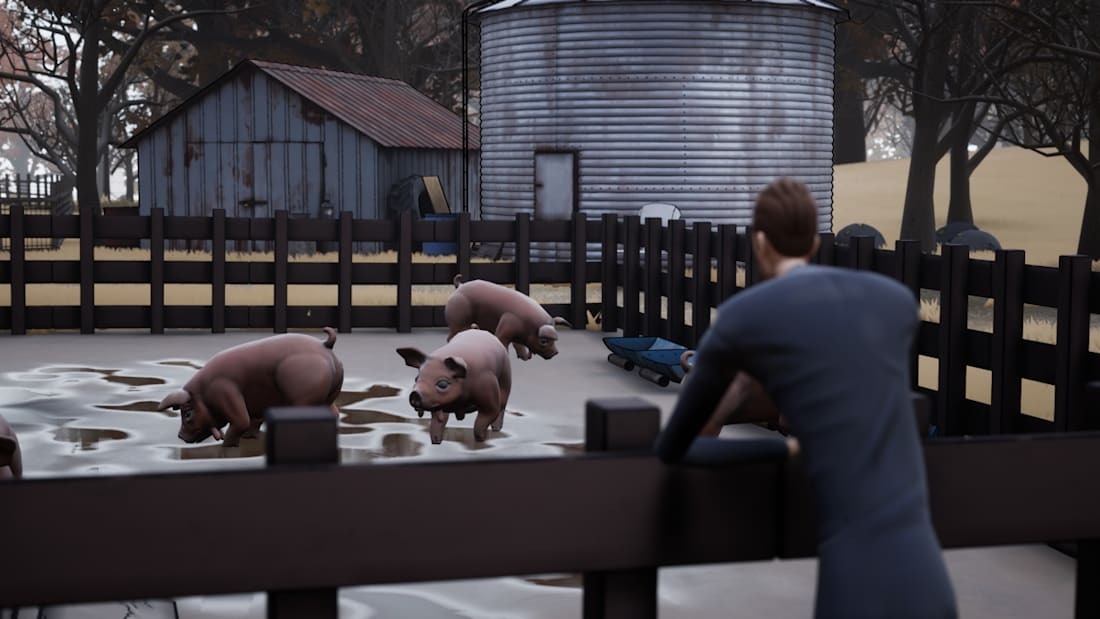
Adios is the game that most directly dealt with the subject of death that I played this year. Being the work of the artist known as @docseuss or @docsquiddy on various platforms, he of Paratopic and Hardspace: Shipbreaker fame, Adios is another tight short experience which tells the story of a man who has grown tired of his job. As it happens, that job was in helping the mob dispose of bodies by feeding them to the pigs on his isolated farm. The game's text is the unfolding of the conversation wherein the protagonist informs his contact that he is done.
I don't even want to talk in too much specific detail about this game. I have enjoyed the creator's approach to environmental storytelling stuff so much over his previous games, but this is just on another level. I loved the bits of humor throughout the game, and how well they were used thematically to reveal things about the small cast of characters. I love the game's depiction of male relatonships, between two close business associates/friends and between a parent and his child. It all builds to a final act that manages to be humorous, unnerving, heartbreaking, and deeply contemplative.
If you are an Xbox Gold Plus Plus Game Pass Ultimate whatever subscriber, odds are this is already in your library. You have nothing to lose. Play it.
3. The Legend of Zelda
I don't know exactly when I played Zelda for the first time, but my guess is it was emulated on my first personal PC in Hawaii. It wasn't among the NES games I had as a kid. I definitely had this in the GBA iteration, but didn't wind up beating it there. Nor did I finish this on any of the Virtual Console platforms where I wind up owning it over the years. It took the siren song of RetroAchievements to drive me to killing the silly pig monster at the end of this game at long last.
Overall I think this game holds up wonderfully. The truly cryptic parts of this game ultimately stem from trying to do "everything" there is to do, what with collecting every last rupee and arrow in the world by finding every last hidden cave. There is zero need for that, though it will behoove you to farm up on bombs and arrows on occasion. The real thorough exploration should be focused in the dungeons, which I found to be tremendous fun to explore and master. I even found the boss fights to hold up nearly forty years later.
That all said, I don't feel the need to write much about this game. It's been a pillar of the industry for decades and has been cloned hundreds of times, including many sequels which used most of the same formula over a quarter century. The real note is that now the only console Zelda games I've not taken down are Zelda II and Tears of the Kingdom, both of which are two-thirds done.
2. Rock Band 3
Rock Band 3 was perfectly timed for me to miss it. The first two Rock Band games, plus The Beatles iteration, came out when I was in college dormitory settings and my first off-campus house. I played so goddamn much of those games, loved them dearly. Bought a full 360 instrument set for my roommate's Xbox, then when we moved and he traded that in for a PS3 I happily bought another set of instruments. Did the song exports (on a sadly lost Xbox account), bought a lot of delisted songs (furious my Spinal Tap songs are tied to an Xbox account I can't access anymore, and yes I've spent a lot of time with Microsoft trying to rectify this), spent countless hours with those games.
By the time Rock Band 3, I was entering into the most serious stretch of academic effort in my life. This period lined up with me studying abroad in China for a semester, getting into grad school, moving into a studio by myself, spending time on New York learning about nuclear materials management, and basically not spending time playing video games beyond Skyrim. I knew Rock Band 3 had come out, but didn't even have a console that could play it. And honestly, by the time it was released the broad sense was people had gotten tired of the whole plastic instrument phenomenon. Beyond a new selection of songs and the addition of a keyboard, what could Rock Band 3 meaningfully offer over its sequels?
Well, first off, that library is pretty damn good. I actually bought a used copy of RB3 and used somebody's 360 to export the RB3 tracks into RB4 before that was made unavailable, so these songs live on inside my Series X. The setlist has something for just about everybody, from "Bohemian Rhapsody" and "I Love Rock n' Roll" to more deviant shit like Primus and At the Drive-In. I also appreciate some contemporary Spanish language rock was included, suggesting that not just white monolingual families buy video games. I'll forever miss not having "Maps" and "Feel the Pain" in my Xbox library, but "In a Big Country" suits me just fine.
As for the keyboard, I think it's neat. I still have mine rattling around, in theory I could MIDI out of that thing and use it to tinker around. I imagine for piano and keyboard inclined people it was great.
For me the real appeal of Rock Band 3 was how it implemented all of its meta challenge stuff within the game. There's a surprising amount of discrete little rewards to ding for finishing tasks across different instruments, difficulty levels, and game modes. In another world I could see myself spending a lot of time checking off the lists in Rock Band 3, really digging into mastering some of the guitar solos that remain locked in this game.
As it was, I think the moment that will stick with me the most from finally checking this one off my stupid mental list was watching the end credits. The included photos of most of the Harmonix staff circa 2011 was surprisingly moving; these people are responsible for some of the happiest memories I am ever going to have, video games or otherwise. I'd love to see a Rock Band 5 someday, if the will exists within Harmonix to make it. But goddamn, if they're happy making music content for the Fortnite mill, I wish them all the best. Between Rock Band and their in-house Guitar Hero games, they are a god-tier studio with a consistency of quality that others would commit high crimes to have sniffed.
1. Final Fantasy IV
Final Fantasy IV is a game about crystals, space whales, twin magic, and a kitchen knife that is the most powerful weapon in the universe. But it's also a game about truth and reconciliation, which is why it has to top this list.
In 2015, the Truth and Reconciliation Commission of Canada published its Calls to Action, a document which outlined 94 recommendations to the government of Canada to address the legacy of the residential school system. The document touches on nearly every aspect of Canadian society.
In my experience most of the Canadians I have met are grappling with the Calls to Action. I am in a college setting studying social work at present; let me tell you, the TRC is taken deathly seriously among social workers and therapists in my life. The twin tasks of accepting the truth of atrocities committed, and taking active steps to reconcile the victims and perpetrators of those atrocities as well as the children on both sides, requires some radical steps on both sides to fully reestablish trust. The First Nations, Inuit, and Métis people of Canada have completed the monumental task of laying out what they would like to see happen to establish that trust; it is incumbent upon settlers to do the ultimately anti-colonial work of implementing those Calls.
A key element in this process, tied to the Truth construct, is embedded in being able to perform an apology. Conservative Prime Minister Stephen Harper, in the highlight of his government, did an admirable job of this when he placed the full responsibility for the residential school system and assimilationist approach to Indigenous persons on the Canadian government. He did this without qualification, without rationalization beyond what was needed for bare context. He identified the harm that had been done in an unambiguous way. He then laid out concrete steps that the Government of Canada would take going forward, one of the fruits of which was the Calls to Action.

What do you do when you have wronged somebody? What if that wrong amounts to a war crime? How can people move forward after atrocity? Is it possible to see the people who have sought to destroy your entire way of life as anything other than monsters?
Christopher Browning, a former professor at UNC Chapel Hill (and, incidentally, Pacific Lutheran University) wrote a book in the early 1990s called Ordinary Men. The book follows a group of middle aged men from Germany who formed Reserve Police Battalion 101, a group whose duties shifted from being peace officers of the Third Reich to being active participants in the rounding up and shooting of thousands of Jewish persons across Poland and eastern Europe. What Browning sought to demonstrate with this book was that these men were not cartoon villians from the jump; most of them were men with families, interior lives, anxieties, fears, and other deeply human traits. They also ultimately chose, whether by peer pressure or fear of being seen as derelict in their duties, to become the machinery of genocide. I think Ordinary Men is one of the most horrifying books ever written.
Final Fantasy IV is, once again, the game where a whale flies you to the moon where you wade through caves full of jellyfish.
At the outset of Final Fantasy IV, the game opens with a man torn over his actions. Cecil Harvey is struggling with a classical sociological and ontological problem of agency versus structure; he is an officer, commanding the Red Wings of Baron, and has been sent on what seems like another smash-and-grab mission to Mysidia to pilfer the Water Crystal. The structure of his life, his obligations and his sense of duty to his king, compel him to follow through with these orders unflinchingly. His own agency, first voiced by the chorus of enlisted men on his airship, drives him to question the king directly as to why he is being used as an instrument of robbery and murder. The consequences are immediate: demotion, and a crummy delivery mission with some monster hunting for good measure.
Cecil and Kain slay the Mist Dragon, enter the Valley of Mist, and suddenly their little package explodes. Everybody in the town is vaporized, spare a young girl who explains her mother was bound to the Mist Dragon, and killing that dragon killed her mother.
Is Cecil a monster? Are you, the player, a monster?
As the game progresses, Cecil winds up back in Mysidia. There he encounters the Elder of Mysidia, who recognizes Cecil as the guy who stole their Water Crystal. Cecil is in need of help, and has guilt over what he did while under orders. And you know what the Elder of Mysidia says?
"Apologizing won't bring back those who have already died."
Instead, to demonstrate his commitment to changing who he is and how he will be, the Elder instructs Cecil to climb Mt. Ordeals, transform his sword from one of darkness to one of light, and become a paladin. This, in spite of Cecil's desire to aid his friends before undergoing such a quest of self-transformation.

Cecil's apology is not enough to undo his crimes. It is not his words alone that can make good on the harm that was done. Cecil must choose to actively change himself and his orientation to the world. By choosing to live in harmony with his neighbors, walking with them in their quest to create a world different from the one envision by Baron and a host of other fantasy villain type folks, Cecil rejects fatalism and becomes a more whole person.
Final Fantasy IV is a game about the truth of historical trauma, and the hard but necessary work of reconciliation for the restoration of the world.
Now, friends, I'm not going to lie, this interpretation of the game starts to take a back seat almost the instant you leave Mt. Ordeals. We get our classic Final Fantasy dwarves attaching drills to wooden airships, melodramatic death scenes undercut by the deceased miraculously returning for the endgame, a little Star Wars relational tease, and have I mentioned the moon whale? The game doesn't suddenly become worse; it just becomes one of the most mechanically influential JRPGs of all time in its second half. The character beats, monster designs, and music of Final Fantasy IV loom large over Square's output over the next three decades; I think their choice to reissue this game as frequently as they have speaks for itself in terms of how important the game was to Square.
It's also far from a perfect game. I think the static classes of the game are limiting compared to even the barebones implementation of FFIII's jobs, and the game is neither as flexible as FFV nor as thunderously good as FFVI. I think the last dungeon could have used another save point. Some of the grinds required to "complete" the game in terms of obtaining all of the summons and weapons are grade A fucking bullshit.
But as somebody who is currently trying to train into a new career in caring for people, in a country which is wrestling with the impacts of cultural genocide and colonial policies towards Indigenous people, the first of half of Final Fantasy IV really landed for me. And that's why it was my 2024 Game of the Year.
