
Mento's Month: January '24
by mento
Hey all, trying out a not-particularly-novel new feature where I wrap up a month of gaming, blogging, and other miscellaneous activities of a mostly lawful nature. This'll give me all the excuse I need to deep dive on some of the non-Indie stuff I've played this month as well as sprinkle in a few other surprises. Game of the Month: The Legend of Heroes: Trails from Zero Oh look it's Falcom Boy...
Hey all, trying out a not-particularly-novel new feature where I wrap up a month of gaming, blogging, and other miscellaneous activities of a mostly lawful nature. This'll give me all the excuse I need to deep dive on some of the non-Indie stuff I've played this month as well as sprinkle in a few other surprises.
Game of the Month: The Legend of Heroes: Trails from Zero

Oh look it's Falcom Boy over here ready to gush some more about his favorite (increasingly less) obscure Japanese RPG developer. I am about to get unpleasantly effusive, so be forewarned. The Legend of Heroes: Trails from Zero constitutes the first half of what we Trails types call the "Crossbell Arc": moving the action from the southern kingdom of Liberl that was the setting of the whole Trails in the Sky trilogy to the Switzerland-esque city state of Crossbell, sat between the antagonistic Erebonian Empire (the setting for the Trails of Cold Steel series) and the Calvard Republic (the setting for the most recent Trails through Daybreak series). Crossbell is a demilitarized state with only a self-defense force for protection: it largely depends on Erebonia and Calvard remaining peaceful to continue surviving in its current form. It is, however, one of the richest nations in the world due to its status as a trade hub and various major corporations making it their headquarters and so its citizens enjoy a relatively high quality of life with many modern advancements found only sparingly in other countries, like the internet-equivalent Orbal Network and orbal-powered automobiles. The game follows a newly-minted division in Crossbell's mostly ineffectual police force: the Special Support Section, a squad of younger agents who are able to serve the community through odd jobs and other miscellaneous assignments in much the same way as the Bracer Guilds from previous games. The squad comprises four members: Lloyd, the only qualified detective in the group who joined the force to investigate his fellow cop brother's mysterious death; Elie, a VIP's granddaughter tired of how little Crossbell is able to deal with its rampant political corruption; Tio, a middle-schooler magical prodigy with exceptional senses and a whole heap of trauma to process; and the incredibly-named Randy Orlando, a redheaded laid-back party dude and womanizer looking to escape his dark past (and, like all redheads in Falcom games, is an exceptional warrior).
The thing I kept in the back of my mind throughout my playthrough of Trails from Zero was just how damn smartly designed it is, from its foundations on up. Any random encounter can be instantly dispatched with a stealth approach: attacking an enemy to stun them briefly, attacking them from behind them to knock them senseless, and then walk into them to trigger a fight where you get two full rounds of attacks (the first of which is all criticals, and might even contain an "all-out attack" team assault) which is usually enough to crush any normal encounter milling around. Far from being cheap, it helps minimize and mitigate the amount of grinding and pointless filler battles while still demanding a bit of finesse from the player and, obviously, is not a strategy you can rely on against pre-set encounters like bosses and the perilous monster trap chests (though, mercifully, monster chests have their own distinct appearance to give you a moment to prepare). All the carried over Trails in the Sky mechanics like the Orbment grids and learning when to use S-Breaks and S-Crafts felt like they were rolled out on fast-forward: you're starting from square one again, since it's a new group of characters in a new series, but by the end you're as buff as around the mid-point of Trails in the Sky Second Chapter (everyone has their second S-Craft by then). Speaking of fast-forward, I realize it's a common sight in most older RPGs getting remasters but being able to ramp up the overall game speed in a turn-based RPG is still darn appreciated. But, as I've already intimated, there's very little dead air in a game this sharply compact.
 Even if it's a little graphically dated (it was originally a 2010 PSP game) it's still capable of some really pretty environments.
 The sassy chest messages are back! I heard the original fan translation group Geofront painstakingly added them back in after the original game left them out. Impressive, since the game still had plenty of other text left in it to translate.
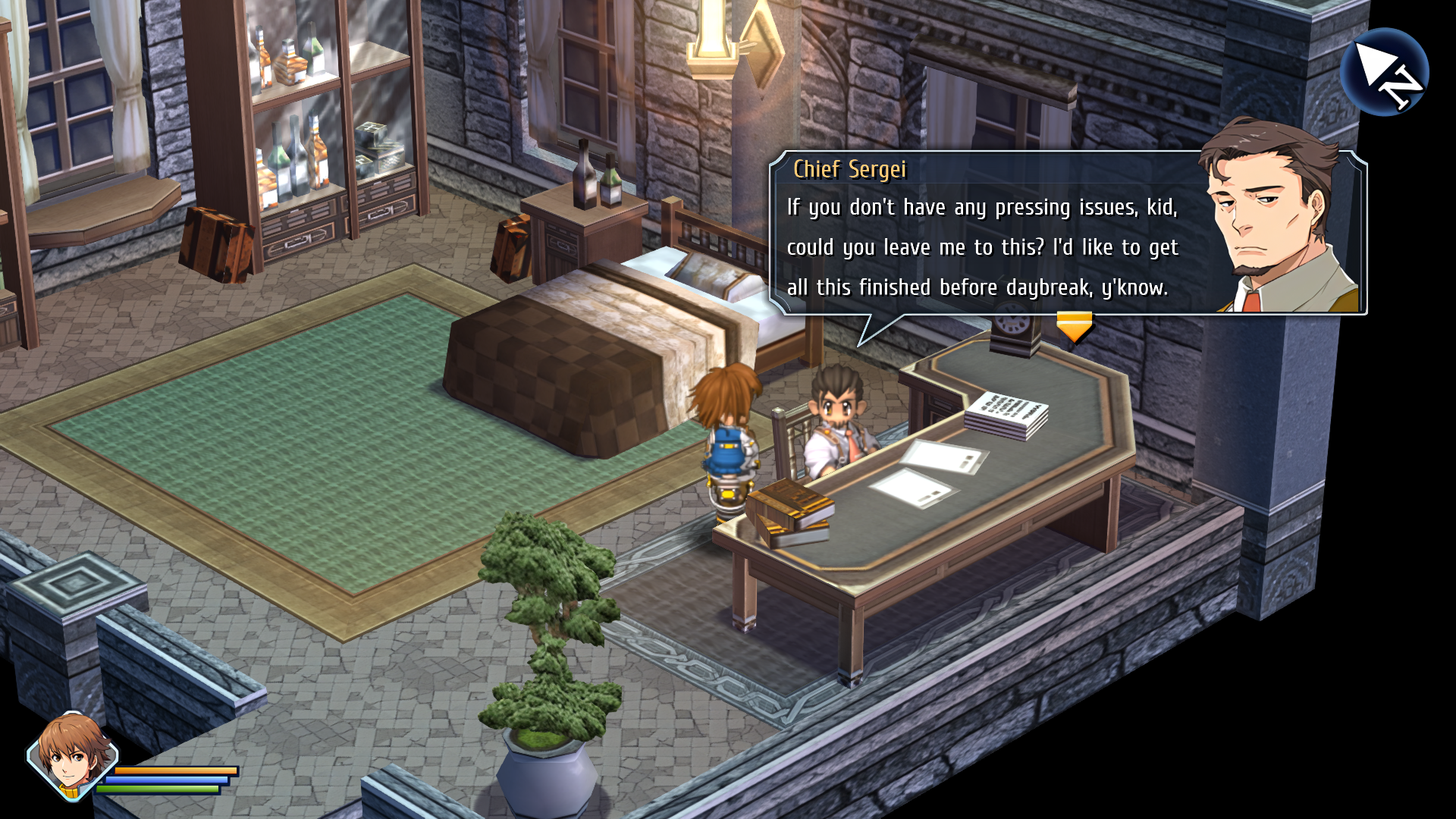 Don't worry Chief, Daybreak is still seven whole games away. (Did they know when they wrote this? Probably, knowing this series.)
The old Trails charm is still here and accounted for as well. Not just in the characterization of its major characters, but in how it populates its towns and central city with named NPCs that have all these little incidental stories of their own happening in the background and frequently have new responses for you after major events or could have a word to say to any guest characters that might be tagging along. One such minor sideline involves meeting a crew of delinquents and quashing a beef with a rival gang before it erupts into street violence. You're then tasked with visiting the local hospital which is some ways out of the city of Crossbell. At some point after these two introductions, you learn (again, just by talking to a random NPC at the right time) that one of the hospital's doctors has a son that's part of that delinquent gang. Talking to the doc reveals how stressed he is about his wayward kid, while the kid in question is stifled by his respectable father's authority and has chosen to rebel. Much later in the game while at the hospital, you see the delinquent delivering his father's lunchbox, embarrassingly insisting to the receptionist that it was purely a favor he was doing for his mom: just another little detail that builds up this dysfunctional but perhaps not doomed relationship that you might not even notice existed if you hadn't been paying attention to the seeds being planted. That I know I'll be seeing almost all of these characters again and learning what's been going on in their lives since I last saw them once I eventually play Trails to Azure is just one of many reasons I keep coming back to this franchise.
I'm not exaggerating when I say that the Trails series is still the peak of the turn-based RPG genre as it stands today, albeit with close competition from a rapidly-improving Tales (which isn't turn-based, but hey), the Xenoblades with their huge scopes and tons of QoL features (which I guess is not really turn-based either), and some of the more promising recent Indie throwbacks like Chained Echoes. The worldbuilding and characterization of Trails is so much denser than you'd expect from first impressions and the combat system can be real demanding when it gets to the important fights: some of the battles in Sky SC were downright diabolical without first gleaning the right strategies, and though Trails from Zero was more gentle overall there were definitely some hairy moments. It's going to take some time to get caught up to where The Legend of Heroes sits presently, but I'm more motivated than ever to keep chasing after it.
Also the soundtrack is amazing. This is just the basic-ass battle music and it's so good. The arranged tracks are even better.
Darling Indies and Other Gaming Tomfoolery
The Legend of Zelda: Ocarina of Time: The Cursed Randomizer Run
That's right, I've been chipping away at that horrible Ocarina of Time randomizer run I began around the start of the year. The one I blogged about here.
As a reminder, here's what was randomized:
- All inventory items
- All heart pieces and containers
- All keys and dungeon items
- All vendors and their stocks, including the Deku Scrubs
- All golden skulltulas and their tokens
- All crates
- All pots
- All beehives
- All cow milk
- All entrances and exits
- All boss fights
- All silver rupees needed for certain puzzle rooms
- All Ocarina songs and their notes
- All warp song destinations (except Shadow Temple, since it can't be reached any other way)
- Dungeons are randomly either their normal or Master Quest variant
I won't go into the full horrors of the playthrough warts and all, but I'll highlight a few of the more messed up moments this randomizer put me through:
- The whole time I was Child Link I did not have the Kokiri sword. I eventually found it deep inside the Fire Temple while an adult, which was also the most awkward dungeon to access (it involved going through Gerudo's Fortress to reach Sacred Forest Meadow and the Forest Temple entrance).
- Since I didn't have the Kokiri sword in most of the run, I couldn't get past Mido in Kokiri Forest for the first dungeon for the longest time. I only finally managed to sneak past him using a warp song: the Prelude of Light warped me directly to the Deku Tree.
- Speaking of Gerudo's Fortress, I cleared out all those sword-wielding prison wardens as a kid with nothing but a slingshot. Took like 20 hits each. Of course, I didn't get all the jail keys until the end of the game so it was kinda pointless (my reward for freeing them all, normally the Gerudo Pass, was instead one rupee. Wooooorth it?).
- I showed it in a screenshot in the original blog, but I spent some time in the Master Quest Water Temple as Child Link. Couldn't do a thing in there without the iron boots or hookshot though.
- It took a while to get the bow or boomerang, so to clear out the beehives for their items I had to throw explosives at them. There are probably grainy educational films out there expressly advising against that.
- I once defeated a Stalfos with nothing but deku nuts and bombchus. Again, a sword would've been nice.
- I reached the end of Dodongo's Cavern early in my run as Adult Link with six hearts, but the warp took me to the Twinrova fight instead. Fighting her on just six hearts was... rough. (At least I had the Mirror Shield though; would've been even tougher without it.)
- So I randomized the Ocarina notes, which meant having to find all four C-buttons and the A-button in random places before I could play all the songs. The last of those was C-left, which I found in the Spirit Temple at least halfway through the run. It was a big moment, since I couldn't use Epona's Song, Saria's Song, or Zelda's Lullaby without it.
- The Queen Gohma fight showed up right at the end of the run (she replaced Phantom Ganon). By then I had the Biggoron sword, almost full hearts with the defense boost, and every item. She didn't know what hit her.
- The absolute last item I found were the Ice Arrows, in a pot right before the Spirit Temple boss door. They are, as far as I know, the only item that isn't related to progress at all. You never need to freeze a thing, even in the Master Quest dungeons.
 'God, you wouldn't believe the month I've had, Zelda.'
Speaking of the N64 I had the fortune and misfortune, respectively, of playing an hour-plus of Doom 64 and Heiwa Pachinko World 64 as part of my ongoing 64 in 64 feature, enjoying its final season this year. My therapist gave me a special cushion to punch whenever I think about the latter so let's not dwell on that but the former was one of those rare occasions on 64 in 64 where the hour flew by way too quickly. If you've read this far you deserve a small hint on next month's duo: they're both Midway games. Really doesn't narrow it down much though, huh? Here's another: neither of them are sports games, mercifully.
The "Indie Game of the Week" of the Month: Tower of Time (Event Horizon, 2018)

I've played a great deal of CRPGs, many of which hail from the Infinity Engine period (and those of a more modern vintage that have taken after them such as your Pillars of Eternity and whatnot) and yet in all my travels I've only found two that picked up the "real-time with pausing" dynamic from the IE-style combat system and took it a whole different direction. The first was Aarklash: Legacy, a thematically-odd Cyanide RPG from about ten years back, and the other was this game, Tower of Time (IGotW #351). If I had to narrow down exactly what was revolutionary about their approach it's that the player's situational awareness is frequently pressed to react quickly to any and all manner of perils and opportunities, frequently micromanaging the placement of their units. In that sense, it can feel more like a real-time strategy or war game; sort of like a 4X type but focused on a much smaller hyper-specialized group, all the while pulling off more complex evasive maneuvers and making full use of AoEs and other crowd control tactics. The strength of the combat would be enough to carry the game on its own, but I also appreciated how tabletop-like the exploration was too: so much dungeon dressing had flavor text and each floor presented its own challenges and puzzles to overcome, while the tower as a whole had a certain logic to its construction rather than feeling like an arbitrarily thrown-together monster-nest-slash-treasure-vault. Speaking of Arbitrary, I still owe that guy one for recommending (and gifting) this game to me: I wish him luck with the terrible CRPGs he has planned as subjects for his streaming and blogging this year.
Our runners-up this month were Itorah (#352), The Spirit and the Mouse (#353), and Ary and the Secret of Seasons (#354). Itorah had some overt flaws and was far too linear to really qualify as an explormer but at least graphically it was a serious contender; a similar statement could be made for Ary and the Secret of Seasons too, which swung for the fences with its take on a Skyward Sword-era Zelda with a fraction of the budget but even with some impressive Chinese-influenced visuals (the Winter Temple was especially gorgeous) its world overall felt empty and barely held together, like a half-finished house; finally, the Spirit and the Mouse was a much more confident 3D platformer with a fetching Gallic aesthetic with some neat puzzles and clever vertical level design, if a bit on the (understandably) short side. Still, given that their larger scopes didn't do Itorah or Ary any favors, I suppose brevity can be a virtue.
Bonus Indie: Fossil Echo (Awaceb, 2016)
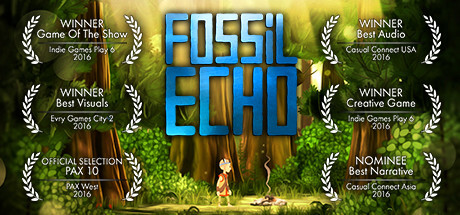
I have a whole stack of Indies about which I don't think I could easily turn out a ~1,000 word review via the usual weekly series but am still interested enough to delve into, so I'm going to try to toss one or two in at the end of the month and review them here. In January's case, it's an early game from the same studio that would later produce Tchia (a Zeldersatz I've been keeping my eye on): Awaceb, hailing from the French overseas territory of New Caledonia, an island some ways out from the eastern coast of Australia. The game in question is Fossil Echo: a narrative-heavy stealth platformer about a kid infiltrating a really tall tower full of hooded cultists. The reasons why are told in a series of flashbacks shown in reverse chronological order: a Memento-esque contrivance which makes the plot a lot harder to follow when you also consider there's some five-to-ten minutes of gameplay separating each of these scenes.
Speaking of gameplay, the game tends to alternate between three types of 2D platformer: one where you're stealthing around a room full of enemies that you can knock out if you leap on top of them but will otherwise die instantly if one spots you; timed auto-scroller sequences where you have to quickly ascend a platforming gauntlet; and challenge rooms with a whole lot of moving platforms, platforms that alternate between active and inactive, and wooden platforms that break a moment after you touch them. Overall the game can be quite challenging, but it's also pretty short so it balances out: even struggling with a few of the challenge rooms as I did, I managed to complete the game in about two hours. It's also pretty annoying, in part because the game put a lot into its presentation—meaning that the character would often take a moment to animate himself standing back up from an unsure landing or mantling an edge of a platform, which is often a moment you don't have when platforms are regularly vanishing on you.
I'll admit, playing Fossil Echo didn't get me any more hyped for Tchia, though I can recognize the level of craft involved in its presentation at least. It's never worthwhile to judge a studio by their first game either, of course, so I'll probably still be checking out Tchia before too long. No Zeldersatz can elude me for long. (Rating: 3 out of 5.)
The Weeb Weeview
I had fun discussing some anime shows I'd seen in last year's round-up, so I'm going to make more of an effort to talk about all the cartoons I've been enjoying like a proper adult might. Probably mostly new stuff, but I might slip in some older series if it's a quiet season. Winter '24 has certainly not been quiet though. My curated picks this time include three of the bigger, already well-promoted anime airing this period; for February, I'll get into some of the more obscure/divisive stuff I've been checking out.
Delicious in Dungeon
Delicious in Dungeon, or Dungeon Meshi, sees a veteran adventuring party get wiped out by a ferocious red dragon and their leader, Falin, eaten by same. The leader's brother Laios wants nothing more than to venture back down after Falin warps everyone to the entrance with her last breath, but is faced with the two issues of having half the group quit along with a dangerously low amount of supplies. Fortunately, he's heard that there's ways to eat dungeon monsters for sustenance if all else fails; recruiting a fellow monster meat gourmet, a dwarven fellow named Senshi, the remaining party of the warrior Laios, the pessimistic mage elf Marcille, and the talented halfling thief Chilchuck retrace their steps in pursuit of the dragon before it finishes digesting Falin and makes her revival impossible.
I've seen a few fantasy foodie shows before—most recently, the first seasons of Campfire Cooking in Another World with My Absurd Skill and Sweet Reincarnation last year—but Delicious in Dungeon has the tone of one of those crossed with a comedic D&D podcast by way of a Critical Role or The Adventure Zone. Lot of conventions of fantasy RPGs being turned on their head for the sake of a goof, or a segue into a "how would you even eat something like this?" culinary challenge. It also feels like a show with a lot of weight and stakes to it, silliness aside, as the protagonist endeavors to save what's left of his sister's corpse so she can be resurrected: it's a grim reminder at the back of one's mind that life in this dungeon is far too brutal and short and all this eating of monsters is in itself a necessary act of survival.
Frieren: Beyond Journey's End
Still watching this excellent fantasy anime from last year. The most recent arc has the elf mage Frieren and her human protégé Fern join a practical examination to become first-class mages, a legal necessity if they're going to continue travelling further north into inhospitable lands. I guess every anime show has to have either a tournament or an exam arc (or both in the case of My Hero Academia). I'm still digging the pace of the show and the small moments of levity sprinkled throughout even if, like Delicious in Dungeon, the world is depicted as a pretty harsh place. Folks have even been dying in this sanctioned mage exam and threatening to kill each other in order to fulfill the winning condition—capturing a particularly hard-to-catch bird. It's also an excuse to introduce some of Frieren and Fern's magical contemporaries and see how they stack up to our protagonists: given Frieren's over a thousand years old, it would take a lot to get the drop on her these days (as a certain demonic antagonist discovered to her regret earlier this same season).
Anyway, it's still good stuff, even if I'm a little mystified by how many memes have sprung up because of this show. Its subtle, deadpan sense of humor definitely wouldn't suggest that sort of response.
Solo Leveling
Solo Leveling is a show that's... very uncomplicated with its mission statement and vibe. That is, it's pure power fantasy superhero action. Sung Jingwoo is one of several "hunters": regular human beings that awoke to heightened superpowers the same day that the modern world was besieged by interdimensional "gates" to dungeon-like pockets full of monsters and treasure. However, he is also the weakest of these hunters, and due to the nature of these powers no hunter can ever become stronger than when they first awoke (with very rare occurrences of those awakening twice) leaving him to pick up scraps left behind by more talented hunters to pay for his family's bills. After a mysterious and traumatic near-death incident though, he becomes a "player": one that has a video game interface allowing them to take on quests and grow stronger by earning experience. As the only hunter able to advance this way, Jingwoo starts to climb the ranking tables and... well, things get progressively more bananas from there.
Studio A-1 Pictures knew as well as anyone that an adaptation of this manhwa (Korean manga) would live or die on the quality of its action scenes. Having read the manhwa, I did appreciate much of its worldbuilding (less so the character work which is kinda minimal except for the "boring cool guy" evolution of its initially timid hero) but it's really the dynamic, ridiculous battles that elevated the material above standard genre fare. The show's now four episodes in and I think I can safely say it's delivering on that promise: the fight between Jingwoo and an enormous snake dungeon boss last ep was goshdarned electric, both in its pacing and emotional payoff. I'm bouncing on my seat in anticipation for the bigger showdowns to come, though if it's only a 12 episode season (sounds like it might be a two-cours 24 ep one, which is promising) it probably won't get too crazy just yet. Just know going in that it's a show that won't offer a whole lot you haven't already seen before, especially if superhero/fantasy shounen manga/anime is your thing, and maybe check out some of these fight scenes if they ever get clipped anywhere in case you need a push one way or the other. I'll also say the first three episodes have a whole lot of table-setting to get through as well, so bear with it.
That's probably enough anime talk for this month. Probably. Let's wrap it up here and see what this uncommonly-long February has to offer us all. Until next month, thanks for stopping by and I'll continue to fine-tune this thing before it becomes too much of a gargantuan wall o' words. Still, no promises, given how verbose everything I write ends up being. I just love the sounds this keyboard makes, what can I say?