
Navigator: Potion Craft and Information Spaces
by gamer_152
Note: The following article contains moderate spoilers for Potion Craft, and mild spoilers for COLDLINE, Runescape, and Terraria. What Are Information Spaces? Back when I wrote about COLDINE , I said something is a space if you can exist at a range of positions within it but only move to the points adjacent to your position. What it means for two points to be adjacent is that you can pass direc...
Note: The following article contains moderate spoilers for Potion Craft, and mild spoilers for COLDLINE, Runescape, and Terraria.

What Are Information Spaces?
Back when I wrote about COLDINE, I said something is a space if you can exist at a range of positions within it but only move to the points adjacent to your position. What it means for two points to be adjacent is that you can pass directly from one to another without travelling through any intermediary points. When talking about spaces under that definition, I said that phone menus are spaces, but we can also apply this logic to a lot of datasets and diagrams like the colour wheel or the periodic table. In these fields, the regular spatial labels of up/down/left/right or north/south/west/east are accompanied or replaced by new attributes. Moving right along the rows on the periodic table means a higher atomic number, and scanning leftwards means a lower one. On the colour wheel, "redder" and "bluer" become directions. This is how we ended up referring to sRGB and ProPhoto RGB as "colour spaces".
By arranging concepts or entities according to attributes, these information spaces show how those concepts or entities relate to each other. We can map that yellow is a hotter colour than green or that lithium is lighter than beryllium (assuming we're talking about non-isotopes). Information spaces also provide a guide for how we might modify some object or concept to move across the diagram. They indicate that if we add red to our purple, we get pink, or if we add two protons to our indium, we make antimony. Because distances between points are supplanted by other differences (e.g. Atomic numbers or redness), movement across the space is performed by transformations other than conventional travel, such as adding or subtracting particles or mixing in certain pigments.
Potion Craft in Abstract

niceplay's 2022 game, Potion Craft: Alchemist Simulator, is about brewing elixirs, draughts, things of this nature. In each phase, a customer requests a potion, and you must mix a product to match. In many games where alchemy is possible, we pour some specific resources in and get some item out. In Runescape, we can craft a Woodcutting Potion with some Clean Avantoe and Timber Fungus. In Terraria, we can rustle up an Invisibility Potion by combining Bottled Water, Blinkroot, and Moonglow.
niceplay supports a wider range of possible routes to potions through a system where it's not fundamentally the ingredients that determine what tonic you'll produce. Instead, it's the essences those ingredients lend the drink; fans of The Witcher will have seen the same idea at work in CD Projekt Red's RPG. In Potion Craft, two variables underlie the mixing system. We're going to call those variables waterness and airness. For each potion, there is a target waterness and airness that the concoction in our cauldron must satisfy.
If my potion's waterness is somewhere between 23 and 30 and its airness is somewhere between -10 and -17, it could add a "healing" property. Or if its waterness is around -40 and its airness is around 35, it will become explosive. I haven't pulled these figures from the real code for the game; they're hypotheticals to demonstrate general principles. I'm calling these quantities waterness and airness because if your potion has a positive air value, it can exhibit traits associated with that element, such as levitation or swiftness. If it's at a positive water value, you get water effects like freeze. A negative air number gives your product an earth attribute like growth, and a negative water number aligns it with the fire element; you can make a potion of light, for example.

There are also failure values that our two variables can hit. In that event, the potion is spoiled, our ingredients are wasted, and the airness and waterness are reset to 0. Within this system, the importance of ingredients is that they allow you to increase or decrease the waterness and airness by certain amounts. Again, I've simplified a little to establish some base knowledge, but we're getting the flavour of the gameplay. Like most systems represented in a highly abstracted manner, the number-adjusting game I've just described isn't very sexy. It's not giving the player much to look at and doesn't conceptualise data in a wrapper that most users can compare to everyday experiences.
Potion Craft in Space
Due to the gap between how the game works and how players are used to processing visual information, they are liable to experience mental strain trying to decode the raw data. If the magic vision modifier is at air 15 and water 20, and the sleep effect is at air -15 and water 30, and our potion is currently at air 5 and water 22, which of these two traits is our potion closer to? It takes some working out. Most designers want audiences to push themselves at least a little but also to be cognisant of what's happening in the game and have some concept of how they could alter the game state to their advantage. niceplay achieves that by representing the information spatially, like the drafters of the colour wheel and periodic table.
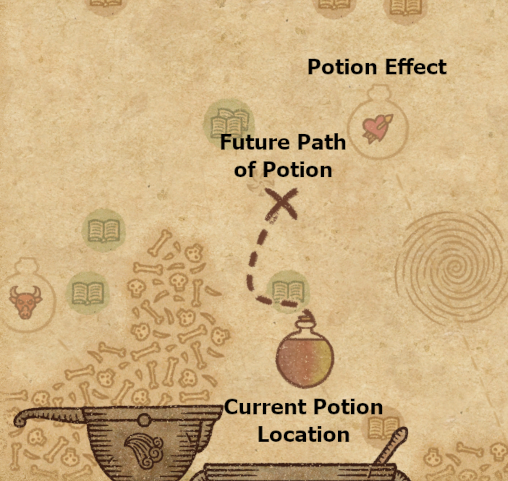
On the mixing table for Potion Craft, we stare down at a map. The X-axis on that map represents the waterness of our potion, and the Y-axis represents the airness. A bottle on that map stands in for the air and water values of our potions, and outlines of flasks mark the target range of coordinates to add new traits. So, if our liquid currently has -7 waterness and -19 airness, it will appear at the coordinates -7, -19. If a potion trait requires us to get our mix to 0 waterness and 28 airness, the marker for that trait will appear at coordinates 0, 28. When we add ingredients to the pot, a line extends from our potion bottle, showing the range of coordinates it will move through when we stir our cauldron.
By rendering the data in the same medium that the player experiences the real world (spatially), the developer makes the data readable to the player. If the user understands the game board and their tools, they can then make informed choices about how to affect that board. Creating a spatial representation of the data also implicitly leads to a graphical experience for the player, and that has aesthetic implications. Potion Craft uses the visual metaphor of an old seafaring map in order to respect its themes of spatial representation, anachronism, and discovery. As in our earlier examples, in Potion Craft, we can understand the act of changing some value to be synonymous with moving around a space. The game's interface constitutes an alchemist's periodic table.
Misconceptions
Recognise that information spaces exist whether or not we present their information spatially. Even if Potion Craft didn't spread its numbers out on a map, they would meet our definition of a space. On the flip side, having visual elements represent data across a space does not necessarily mean the graphics stand in for an information space. It's having a set of adjacent information that we can move through rather than just having some information visually encoded or even arranged by a property that makes something a space.
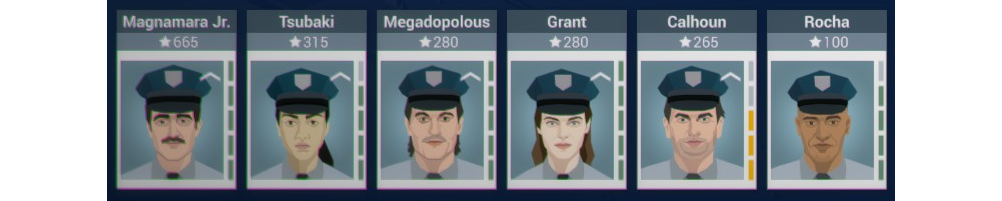
In the management play of Weappy's This is the Police, we see the officers under our command listed across the bottom of the screen in order from highest to lowest professionalism score. Here, we might say there is spatial representation as the ranks of the officers determine their positions in the space. Still, we know the officer cards do not constitute a space in themselves, as there's nothing and no one that could traverse them. What would it mean to "move" from Officer Calhoun to Officer Rocha? Or, in Mortal Kombat 11's Krypt, we can journey around a mausoleum with chests we can open. However, it's not like we can only crack chests adjacent to one we occupy or have occupied, nor does the relative layout of these lootboxes tell us anything about their nature. Therefore, the chests do not comprise a space even if we find them contained in one.
Information Spaces in More Games
It is the norm for games to represent at least some otherwise abstract information spatially; it's not just Potion Craft's idea. We can argue that any game staged across a physical space takes abstract coordinates and presents them spatially. But more than that, any time you have data plotted on a spectrum or graph, you have an information space and a spatial realisation of data. Obviously, health bars or Zoo Tycoon's revenue graph would qualify, but a space doesn't have to be a line or square. So, whenever a game contains a meter, that's a space-based visualisation of figures, even if it's in the form of a radial meter like the stamina gauge in Zelda: Breath of the Wild or the speedometer in Winning Run. It would also apply for one of the radar charts that represent stats in Ragnarok Online or Brain Age.

Under our opening definition, an information space does not have to be numerically-based either. I started this article looking at a phone menu, but also think about tournament ladders or the unlock trees in titles like Monster Hunter: World or Dead by Daylight. Those spaces don't represent one or two numbers in a system. Nonetheless, they have discrete points we can move between, some adjacent and some non-adjacent. And as when I introduced Potion Craft, we can speculate about the alternative. Imagine if Dead by Daylight gave you a list of every perk and, for each one, the abilities you needed to already possess to unlock it: an unthinkable hell. Once again, the power of representing information spatially is that it clarifies the relationship between entities in the information space.
When games present information spatially, it becomes the job of the developer to translate the abstracted data in the information space into the physical representation that is the most legible to the reader: A radar graph to show relative equalities or inequalities between values, an unlock tree to represent progression contingent on reaching previous points in the information space, and so on. The gifted designer can find hugely successful representative schemas that most other people wouldn't consider, like niceplay's cartography expressing attributes of potions.
For the player, the challenge in these systems is in traversing the information space. As in games that use physical spaces, there are goal locations, limitations to the abilities we use to pass through the space, and regions that are punitive to land in. In Potion Craft, points of failure are represented by deadly shoals, while potion effects are desirable land. We might view the bottom of Breath of the Wild's stamina gauge as being like a platformer's spike pit or the far end of Ragnarok Online's strength meter as having similarities with a brick wall.
Conclusion

With that, we come to the end of this brief glance at information spaces and spatial representation of information in games. We reiterated that a space is where you can exist at a range of positions but only move to adjacent points and not non-adjacent ones. We looked at how rendering information spatially, rather than in an abstract style, reduces cognitive load on the player and provides a basis for graphics. We also talked about the spatial representation of information in a variety of forms, from meters to graphs to trees, and how they can integrate with the act of play. Thanks for reading.