
Carry, Fight, Increase, and Be Eaten: An Analysis of Pikmin
by gamer_152
Note: This article includes major spoilers for Pikmin and Planet of the Apes, and mild spoilers for Alien and Undertale.

Pikmin is a game about evolution. Both evolution as media growing towards new generational competencies and the ape kind. One type of ape is humans, and one human is Shigeru Miyamoto, who, with his work on Pikmin, held a mirror to himself as a seasoned developer. You see a pioneer who's been around the block a few times and is searching for new horizons. After more than twenty years in the industry, Miyamoto was stepping back, assessing what games are and reimagining what they could be, engaging that same creativity that kickstarted his most magnificent series in the first place.
Shigeru Miyamoto
From 1981 to 1983, Miyamoto invented the platforming genre with Donkey Kong, Mario Bros., and Super Mario Bros. Between '83 and '84, Nintendo released Baseball, Golf, Tennis, Devil World, Clu Clu Land, Hogan's Alley, Wild Gunman (NES), Duck Hunt, and Excitebike, and Miyamoto served as designer, director, or producer on every one of them. He also supervised the creation of 1985's Ice Climber, and in 1986, he and Takashi Tezuka lit the torch of modern action-adventure games with The Legend of Zelda. In the afterglow of the NES era, Miyamoto's attention turned away from wholly original creation and towards refining what Nintendo had already lathed. The designer lent his charmed touch to sequels like Earthbound in '94 and Metroid Prime in '02, as well as spin-offs like Mario Party and Mario Golf.

There are non-sequels attached to Miyamoto during and past the 90s. Take a cheeky peep of F-Zero and Pilotwings in 1990, Wave Race in 1992, and Star Fox in 1993. I'm also not trying to denigrate Miyamoto's output during this period or suggest that you can't introduce new concepts and standards to a medium within existing series. World and Sunshine are two of my favourite Mario games, and they're follow-ups. Mario 64 and Zelda: Ocarina of Time provided a blueprint for 3D character action games that designers base their work on to this day, and they released in 1996 and 1998, respectively. But whatever value you place on newness, there's a lower density of Miyamoto originals after Nintendo found its feet in the console market, and maybe Star Fox aside, the company doesn't find an iconic new first-party series during the SNES and N64 generations. For two decades after Donkey Kong, no other Miyamoto game would be the apotheosis of a new genre either. Such is the prestige of the ape.
But then, around this seam between the 20th and 21st century, Miyamoto took up gardening and more than flowers would bloom in his backyard. One day, the designer sat among the foliage and saw a platoon of ants carrying leaves back to their nest. He imagined what it would be like for the player of a game to be one of those insects, not trying to fill a glass to a target level or dunk on an opponent but cooperating with others, sharing a purpose.[1] He questioned the mandate that games have to be competitive. It's with this scepticism towards the established rules that Miyamoto would later contribute to the Wii, which asked why the traditional audience for video games is its audience and why our controllers are our controllers. But closer to our mile marker of the year 2000, Miyamoto would knead his ant awakening into Pikmin.
His concepts of uniting players and forgoing competition did not make it to disc. However, an insectoid scale, back garden stomping grounds, and cooperation between natural couriers did all see the light of day in the 2001 stratege-'em-up, Pikmin. Pikmin, like many of Nintendo's other series, follows the beautifully simple logic that if you have an unlikely source of inspiration, you'll get a unique game. Mario stands out because it was reinventing classic American iconography. Zelda is an alternative fantasy game, partly because it came from Miyamoto's childhood rambling around the Kyoto countryside, and Pikmin is individual because no one thought about what it would be like if they were an ant and an astronaut at the same time.
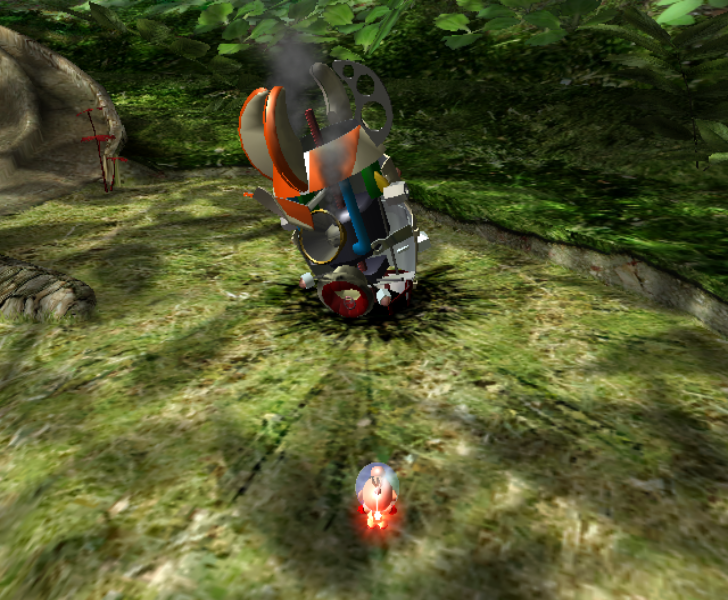
Pikmin's imperilled protagonist is Captain Olimar, a faster-than-light freight haulier from the planet Hocotate who happens to be about an inch tall. During a routine flight, his rocket, the S.S. Dolphin, is hit by an asteroid. He crashes on a planet that is clearly Earth, although is never named as such. His ship is far too damaged to regain flight, the surrounding environment is home to hungry predators, and his air supply will only last him for another thirty days. Oxygen is poisonous to Hocotations, and Olimar presumably breathes some other gas abundant in Hocotate's atmosphere. But for all of his woes, the captain is lucky enough to meet the pikmin, a species of plant-like humanoids that see him as a queen pikmin and do his bidding. Through the avatar of Olimar, we must command these vegetable workers to defeat enemies, break down obstacles, and ultimately, recover all essential parts of the S.S. Dolphin before thirty in-game days elapse.
Mascots
Arguably, Pikmin breaks the golden rule of branding in that it doesn't have a single prolific icon you can associate with the product. Miyamoto's most successful series had travelled the world on the recognisability of their superstars: Mario, Link, and Donkey Kong. It takes a lot of bandwidth to communicate all the features that make up a piece of media, but associate that media with a symbol and communicate that symbol instead, and it becomes faster and easier to transmit the essence of that product. Thereby, more people gain awareness of it.
In Japan, everything from power plants to prefectures have mascots to embody them. It may explain why Japanese companies inundated the gaming space with mascots through the 80s and 90s: Donkey Kong, Pac-Man, Sonic, Mario, Bonk, Toru Iwatani. This place setting caused the West to follow with their own spokesanimals like Crash Bandicoot, Spyro the Dragon, and the alluring Bubsy. Even Solid Snake and Lara Croft are mascots. They serve the same semantic role for their games as Ms. Pac-Man or Banjo, even if they don't have the Pixar eyes. Mascots have made for highly memetic symbols in the past because, as people, we understand and recognise other people easily, at least at a shallow level, and a mascot can humanise a piece of media. Pac-Man is eating humanised, Sonic is speed and edginess humanised. A mascot is a logo you can relate to.
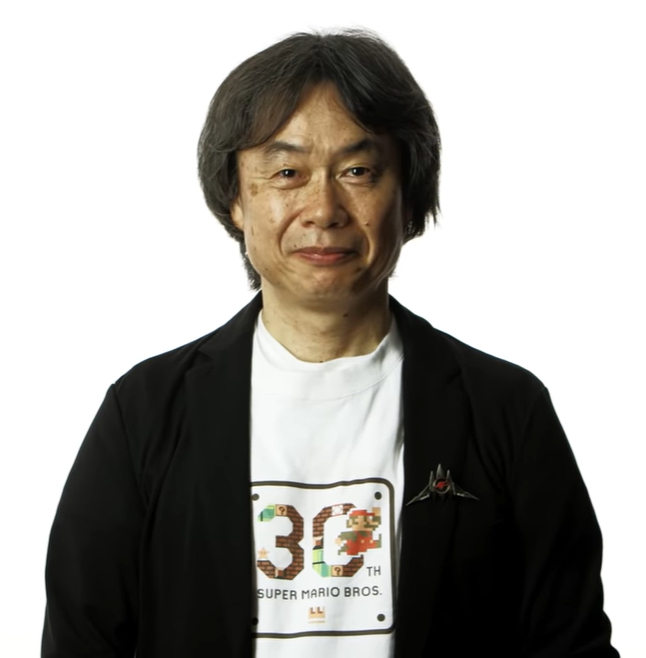
Miyamoto is a master of the instantly recognisable character, and his predilection for protagonist-led games may be a product of his education. While we often speak about the man as if he popped out of an egg in his late 20s, he studied as an artist at the Kanazawa College of Art and joined Nintendo as an artist. But with Pikmin, he doesn't draw Nintendo one main character to slap on the box: they get hundreds. Even Pokémon, with its 151 original animals, had Pikachu. Pikmin does have Captain Olimar at the helm, but the game's not called Olimar. It's called Pikmin.
We could attribute this mascot multiplication to the development team beyond Miyamoto. While I've taken this opportunity to talk about the Mario creator's impact on the series, Pikmin is not The Shigeru Miyamoto Show. Miyamoto produced, but the game had other directors (Shigefumi Hino and Masamichi Abe), another designer (Hiroaki Takenaka), and another writer (Motoi Okamoto). Yet, Miyamoto is still relevant here because a superabundance of title characters was part of the vision he had for the game back in his garden. In media about wide-scale mutual cooperation, bringing one character to the forefront is impossible.
The start of the new millennium marks the end of the golden age of video game mascots. You still get plenty of releases that prominently feature a protagonist in the window, but proportionally, the culture becomes more interested in the worlds and ephemeral aesthetic aspects of titles, and games are less often named for some leading animal. Crash Bandicoot, Sonic the Hedgehog, and Spyro the Dragon are out, GTA III, Fable, and Snake the War Man are in. When even Nintendo is launching a new series without a cuddly individual on the dashboard, you know the idea's gotten somewhat fatigued.
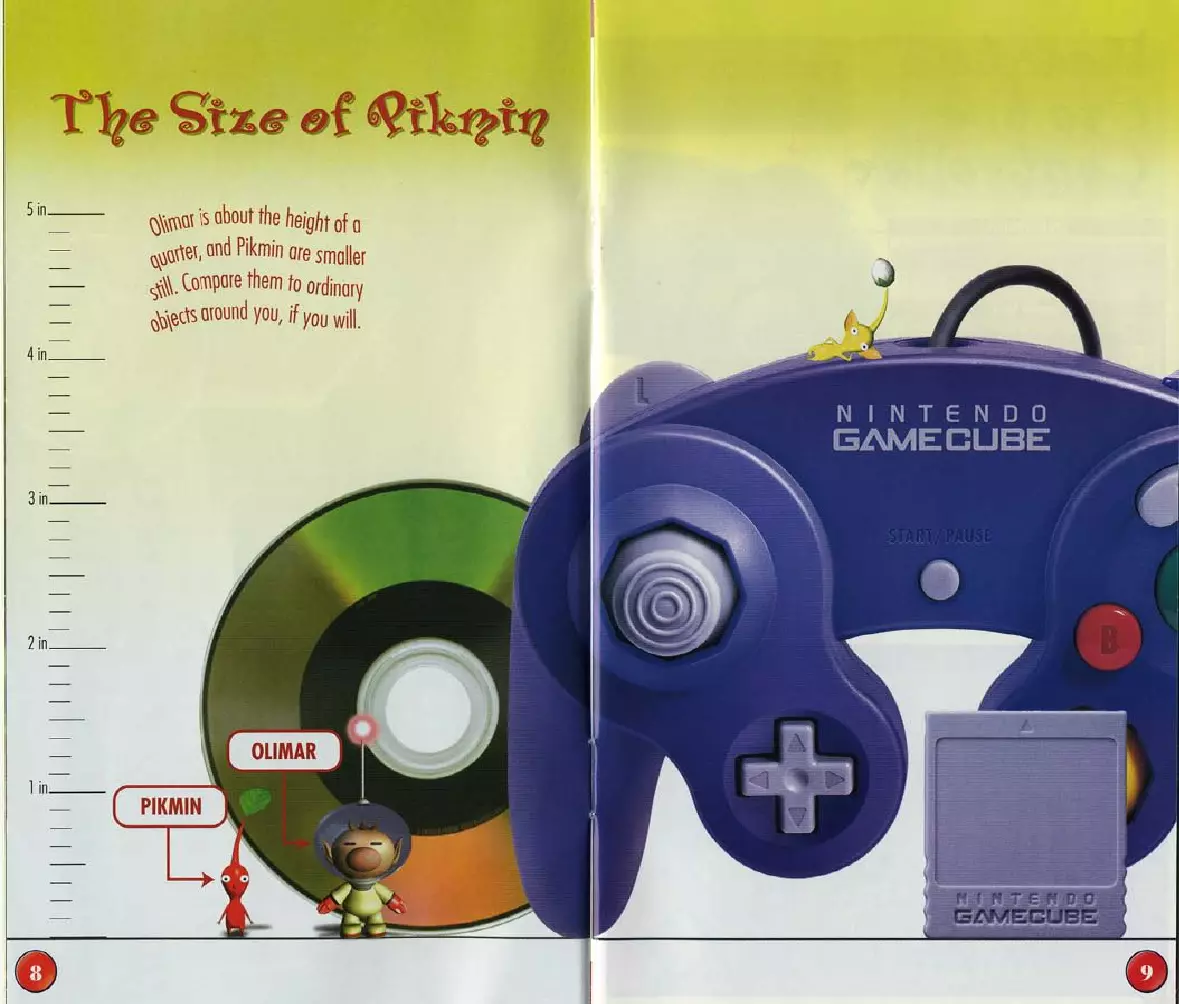
Speaking about that emphasis on worlds, you'll see that the full delight of the pikmin only comes across when you consider them in relation to their environment. Half the fun is how tiny they are. I don't normally discuss manuals in these articles as they were not part of the games themselves, but they did inform the average user's experience with the media. So, it bears mentioning that the Pikmin manual doesn't just instruct you on how to play; it also shows you a scale image of a pikmin and Olimar next to a GameCube disc, controller, and memory card. By using the hardware needed to play the game as points of reference, Nintendo guarantees that the objects they use for size comparison are ones the player will have to hand. Having compared the pikmin to some possessions in the room, it is easy to then imagine them making themselves at home alongside other items you own, running around table legs and peeking out from behind coffee cups. The booklet invites you to "Compare them to ordinary objects around you, if you will". I will.
The game's animations go on to fill out the personalities and physicality of Olimar and the pikmin wonderfully. The movement of these characters confirms that they are lightweight and spry. In the case of Olimar, we also see someone equipped with some nifty future tech whose antenna leaves an afterglow behind him like you've been staring at a lamp. His helpers are visibly attentive but easily startled humanoids who jump to attention at the sound of his whistle and bob along behind him, looking a little lost as their arms flail at their sides. When you relinquish an item to an onion (one of the pikmins' nests), it bounces upwards, making you feel like you've delivered some weighty treasure back to the mothership.
Super Mario 128
To have both an engine and a console that could run a hundred LGSs (Little Guy Simulations) at any one time was proof of the GameCube's technological chops. Every one of the pikmin has to be able to cooperate with each other to calculate paths and traverse terrain. The Pikmin's home console, the GameCube, was earlier codenamed "the Dolphin". During the sixth console generation, Sony and Microsoft had auras of being the companies serious about computing power, while Nintendo was thought to rely more on stylistic charm. However, in terms of raw number-crunching muscle, the Dolphin was no slouch. There is no one measure of hardware capability, and gamers forget that architecture, in addition to the flat speed of parts, is a decisive performance factor. But for what it's worth, the GameCube's CPU ran about 200MHz faster than the PS2's, and by FLOPS, it had 50% more graphical processing power.[2]

But Nintendo was never going to boast their new hotrod with polygon counts and reflection models alone. That's too wooden for who they are. Their most memorable tech demo in the run-up to the GameCube was at the Space World expo in 2000. There, the developer ran a sandbox in which 128 Marios could be active at the same time, running atop a flat surface, and picking up and throwing objects. The demo operators then deformed and shook the ground, with the Marios imprisoned in the TV physically reacting to these transformations. This demo was titled "Super Mario 128", the name also associated with the sequel to Mario 64. You don't hear about it now, but through the 00s, you couldn't move for rumours and speculation about Super Mario 128.
Yet, by 2007, the game had not materialised, which left many fans climbing the walls. At that year's GDC, Miyamoto revealed that unbeknownst to players, they'd already played Super Mario 128 in the form of Pikmin. Nintendo also smuggled elements of the 128 prototype into Mario Galaxy, but it was Pikmin that directly incorporated 128's platform for hosting over 99 cooperative AIs.[3] Just as much as any open-world game, Pikmin was a demonstration of accelerating hardware power. And it was using that silicon and cooper not to just slap a layer of paint on dated tropes, but to imagine play that would have been impossible in previous generations.
The Division of Powers
Pikmin had to break the patterns of Miyamoto and Nintendo's character action games because it divests the player abilities from one big guy into 101 small guys. If Olimar encounters a stone wall, he cannot do what Link would and throw a blinking bomb at it. If he's accosted by an enemy, he cannot blast it with a well-timed laser pulse like Fox McCloud. Instead, he's reliant on other animals to do the heavy lifting, and each of those animals contributes only a tiny bit of the task-solving power that one regular game protagonist could. It's as though the lasers and bombs have been cut gossamer thin, and a piece distributed to each pikmin. It is the puny power of each of the plantmen that means we must command a whole hive of them to make an impact.

The need for collective organisation of a group of entities might make Pikmin sound like a real-time strategy game, but Pikmin and RTSs have us use different gloves to drop our units into those DLZs. Compared to a war game, Nintendo's title also has more construction tasks. Channelling the industriousness of the social insect, the pikmin don't just fend off predators. They can unroll bridges, break down walls, and carry parts and organic matter many times larger than them back to base camp. While other games have you complete tasks and then reward you with valuables, the diminutive stature of the pikmin means that collecting valuables is itself a task. It looks like Olimar is once again hauling freight.
Collection
Writers who want to make their storytelling engaging usually need a protagonist who surmounts problems personally meaningful to them. The hero will duel a shogun who threatens to destroy the village they've lived their whole life in, a student will have to pass a test that decides whether they get into a prestigious college, etc. In games, however, it's common for the enemies, locations, or items to have no meaningful relation to the protagonist. Pikmin feels at least a couple of degrees warmer because every milestone item Olimar gathers is a part of his beloved rocket. Appropriate to the tiny scale it takes place on, the primary goal of Pikmin is to build a model spaceship. The game takes the time to showcase every whimsical whirring doodad, from the Omega Stabilizer to the Anti-Dioxin Filter. It can do this because every one is relatively humongous and has to be slowly transported back to the ship.
Because Nintendo gives you thirty items to collect in thirty days, you can quickly calculate whether you are on track to beat the campaign. You compare the number of parts you've salvaged with the number of days elapsed. To win, you must, on average, recover one part per 24 hours. You quickly learn, however, that some chunks of the Dolphin take longer to win back than others, and that the further across the planet you venture, the more time it takes to reclaim metal from the landfill of Earth. So, even if the number of components you have hovers around the number of days you've spent on the Planet of the Pikmin, you're aware of the stressful possibility that you could fall short of your target in the future and be permanently stranded.
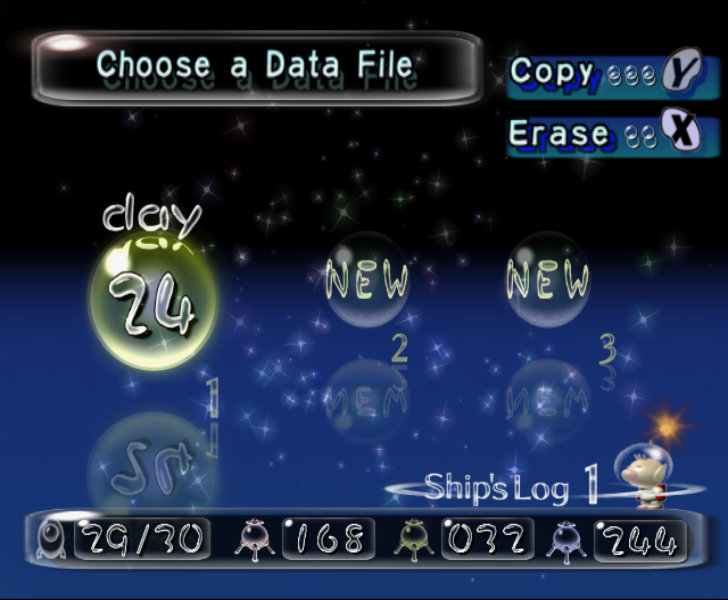
That apprehension can turn to anger, though, when you realise that not all systems are essential for your ship, but you can't get a clue as to whether a technology is necessary until you're standing in front of it. At that point, you're more than halfway to collecting the part anyway. It's one more source of encouragement to manipulate the save system to your advantage. I know what you're thinking: that's save scumming, the dark arts, but it's like Pikmin wants you to do it. At the end of every day, the UI gives you the option not to save, implicitly asking if you'd like to roll back your file. The Pause menu also lets you reload your previous save with a few button presses, and as in plenty of Nintendo games, we can clone a save file. As reloading saves lets you travel back in time, a system for save manipulation is welcome in a game where time is a precious resource.
To Pikmin, the save system is not just a management utility but is part of the gameplay as much as the onions that store your units or the whistle that calls them. On the GameCube's hardware proper, you can do with game states what people would be doing in emulators years later. Although, with only three save slots, if there's another person on that same memory card, one of you can't write a backup save. If there are three of you on the same card, no one can. And when Pikmin doesn't give you a crash course on save manipulation, many players were unlikely to work out it was an option at all, leaving them with no respite from the red herring items.
Multitasking
If you want to secure Olimar passage home, and especially if you want to 100% the game, you'll need to master the art of multitasking, which the pikmin are perfect for. To reiterate, Pikmin takes the abilities that, in a character action game, would be housed in a single avatar, and splits them among a population. It would be understandable if you thought that whether you have one character performing a big attack or a hundred characters performing attacks a hundredth as strong, you have the same net amount of labour power. That is not the case, as the quantisation of our abilities, combined with the autonomy of the pikmin, means we can get multiple jobs done at once.

As Metroid Prime's Samus, we might kill a Space Pirate, then sprint along a ledge and shoot open a door at the end, then turn into the Morph Ball and roll into a slot where we can use our bomb to activate a mechanism. This is a linear mode of interacting with a level, but in Pikmin, tasks like these can all be done in parallel because of our ability to split the pack. The game's levels are full of jobs which require continual input over time to complete, like demolishing walls and transporting pellet poseys, so we can leave more than one huddle of pikmin chipping away at a problem unsupervised. The successful Pikmin player is someone who can complete three tasks in the same time it would take a beginner to complete one.
The trade-off is that pikmin require timing and micromanagement to coordinate. Unlike in an RTS, we can't drag a box over these panicky plants to select them and can't teleport anywhere on the map to issue marching orders at that location. The interface believes in nothing less than artisanal, hand-made player direction. We can only gather pikmin on the same screen as our avatar and must lead them to any water we want them to drink. This means that if some of our organisms have opened a path or finished transporting a dead bulborb on the other side of the forest, and we're not there, they sit languishing, unutilised until we can arrive and put them to a new task. To act with efficiency, you must time your routes through the level to arrive as soon as possible after each group of pikmin has finished a job, ready to escort them to the next operation.
While Pikmin is not a straight character action game, Nintendo introduces staples of character action to the strategy biome through these direct interactions between avatar and world, transforming both formats in the process. Via Olimar, Nintendo solved the age-old problem of how to speak to a strategy game with a controller. Try and dump a whole box of base-building and unit actions onto the console, and you'll end up with more unit abilities than buttons to access them through. However, we do know that all the powers in a character action game can be mapped to a controller, so it's possible to make a strategy game for console by having all strategy action ordinated through a player character. Ingenious.
Pikmin as a Shooter
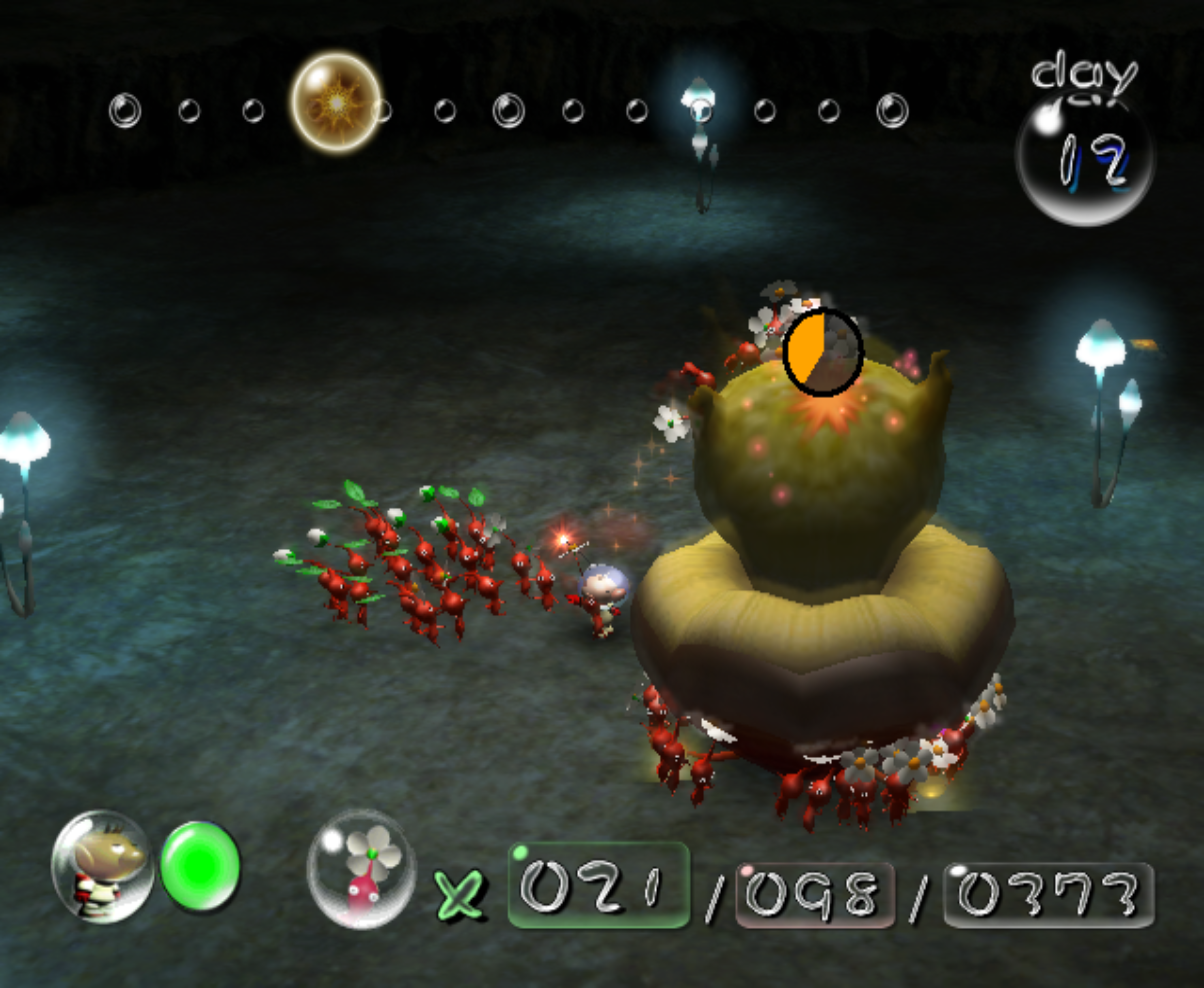
This hands-on coordination persists into the combat. If we want the pikmin to fight an enemy, we can have them crowd around it, but this approach almost always leaves them open to becoming predator chum. Enemies are humungous and don't pull punches; pikmin are tiny and gentle. In a synergistic display of uppies, Olimar can throw pikmin onto enemies' backs to have them dish out pain while staying out of harm's way. By requiring us to catapult projectiles at our targets like a spirited pitcher, Pikmin actually ends up sharing some ideas with shooters. Although, in this regard too, it is determined to be a misfit.
Where most bullets in shooters cut a straight line to a target, the pikmin arc. This curving path means we can land them on the other side of objects in our way, provided that the apex of their arc is higher than the top of the obstacle. It also means that we can select any spot to retrieve our pikmin from, as long as it's within the map's boundaries. We'll want to do that as our bullets are recyclable. The split-second cooldown when throwing these creatures is integral to Pikmin's game feel. One of the most satisfying actions in the play is to maniacally hammer on the A button, flinging troopers towards the sky with all the speed we can muster.
In Pikmin, a bullet that lands on an enemy doesn't just inflict damage and despawn; it continuously damages the animals until they shake them off or we call our rounds back. This dynamic tests our accuracy, but also asks us to regulate an internal clock, as we must get a feel for when a foe will shrug off the pikmin. We must slip into a rhythm where we call our fighters to retreat right before they're scattered and redeploy them immediately. It's left-field mechanics like these that sell Pikmin's fantasy of discovering Earth as an alien world. It's very Planet of the Apes.
Extraterrestrial Earth
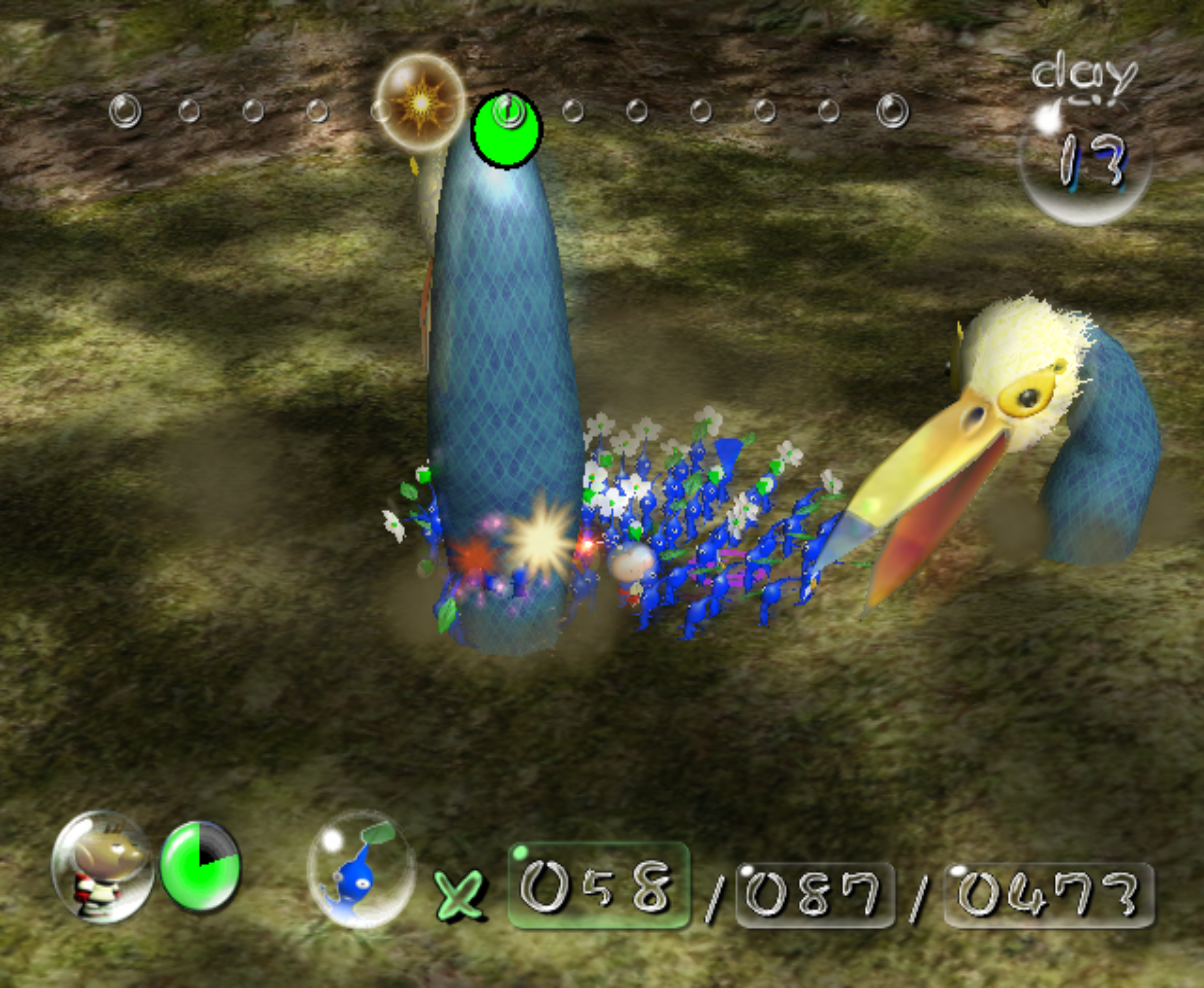
Even Pikmin's GUI, blobby and cellular, exists where the minuscule meets the biologically foreign. Hajime Wakai's soundtrack also does its best to trip you out. The track for Impact Site is split into irregular phrases with jolting starts and stops. There's minimal repeating pattern in the melodies, which makes it hard to tell what's coming next. Zelda: Breath of the Wild, which Wakai directed the audio for, also uses sound that pokes its nose in and out of view to mystify. The music for The Distant Spring is shimmering and sleepy, and The Final Trial sounds like a song written to be merry and then shifted into a poisonous minor key. All these tracks follow Pikmin's conviction that what lives down in the undergrowth is creepy, kinda cute, and would happily eat you alive if you were any smaller than a GameCube disc.
Evolution
Given enough time, evolution would make the life on any familiar planet alien. The pikmin themselves are marvels of natural selection and reflect an understanding of the compatibility that develops between animals and their environments. Playing Pikmin 3, skittering about under willow-sized bananas, I began to think about a film series that also embraces evolution: Alien. Alien plays with our expectation to see ourselves at the top of the food chain. Homo sapiens have grown to become the apex predator on Earth. We're so dominant that we don't even have to think about existing within a pecking order.
But chances are there's life on other planets, and if you roll the evolutionary dice often enough, eventually, you're going to land on something more formidable than us, which is what happens in Alien. The crew of the Nostromo find an animal capable of parasitic impregnation with acid for blood and a hearing that borders on ESP. For the first time in a long time, humans become prey. Video games, a medium that has often thrived on great power imbalances, gobbled up this series' tropes with gusto. Yet, parking the apex extraterrestrial within a fair gameplay context has always required some finessing.

The ruthlessness of the Xenomorph or any stand-in for it means it would rip through the typical player character like tissue paper. Series like Dead Space dealt with this by radically tamping down the power of the monster relative to the player, but when you do that, you stop depicting the power dynamic in Alien. No, if you want to retain that power asymmetry, you need to do what Carrion does and make the player the beast, or use the Alien: Isolation method and not try to have the game be about overcoming the enemy. Embrace the imbalance. Pikmin is a more roundabout solution to the disparity: the pikmin sum to make up the Xenomorph. Nintendo gives us creatures that are scarily well-adapted for their environment, but only when they act as a group, so there's no one button you can hit in the game and bite clean through a crewman's head.
With the fragility of the pikmin, you might think of them as nature's bar snack rather than the next stage of Earthling evolution, but they are tremendously strong for their size and multiply like rabbits. Based on subspecies, they can stand unharmed in jets of fire, breathe underwater, and stay insulated against any electrical charge. I can barely do one of those. Victory arrives when we align our pikmins' abilities to the environmental challenges they're adapted to withstand. But like the weapons in Breath of the Wild, the subspecies in Pikmin don't harbour single traits, so the game is not a rote exercise in pattern matching.
Red are inflammable and pack the most wallop. Yellow can not only handle a shock, they fly higher when thrown and can pick up bomb rocks. The amphibious blue have access to more map than any other colour due to how much of it is covered in water, but blue are the colour that folds fastest in a fight. As in Breath of the Wild, the combination of different properties in single play tools means those tools can remain relevant even as environments change. If you are entering The Distant Spring, the game's water area, you could go in with all blue pikmin to scoop up every sunken treasure in its ponds, but when you know the blue pikmin are liable to get thrashed by wollyhops sitting on the shores, you need to figure out how to offset your blues with other colours that can better defend themselves. If yellow pikmin were just shock-proof, you might leave them at home when hiking into fiery caverns, but if they can reach high cliffs in those caves that other pikmin can't, you now need to find an equilibrium between red and yellow alien boys.

Just like I don't normally discuss manuals because they are not part of the game proper, I don't usually discuss marketing, but again, it can be part of the holistic player experience. So, I'll happily tell you that Nintendo's commitment to depicting biological adaptation goes far enough that they had a lifeform genetically engineered to promote Pikmin. Nintendo commissioned Syngenta to breed bacopa cabana, a plant that looks like the bloom at the top of a Pikmin's head. It makes you wonder, if Sony was really so committed to their mascot games, why did they never clone a Gex?
A perpetuity throughout Pikmin is that there are no signs of any animals bigger than about a guinea pig, which raises the possibility that the game may take place in the future and that, over time, life downsized. This has happened on Earth before. There used to be a lot more megafauna on this planet, but for a number of reasons, many of them to do with the impracticality of large bodies in warm climates, the average animal size dropped like a lead weight before humans showed up on the scene. Even now, rising temperatures are shrinking animals as a lower mass means you run cooler. Perhaps when Olimar lives, being the size of a pretzel is just good acclimatisation for the planet's thermodynamics.
The Final Trial
At the very end, Pikmin's expectations for your adaptation outstrip what's possible with Olimar's simple gauntlets and whistle. If you can collect 29 ship parts, a secret area opens up: The Final Trial. Remember, 5 of the 30 Dolphin components are non-essential, so you don't have to beat The Final Trial to complete the game, but you do if you want to 100% it. The jewel of the region is Emperor Bulblax, a remorseless eating machine. For most players, Bulblax is not just the game's most formidable boss; he also constitutes a moral threshold similar to those in Undertale's violence run. His sudden wide-area attacks can wipe out tens of your adorable allies in an instant. So, if you want that perfect score, you probably have to get comfortable with laying waste to the whole pikmin population. The game can let you say goodbye to most of your little buddies at this point because you won't need them after you've finished the last challenge.

But the final boss needn't be this hard, nor require copious sacrifice. There's an intended methodology for playing David to Bulblax's Goliath: You have a yellow pikmin carry a bomb rock over to him, bait him into eating it, and when it blows up, he will slouch into a prone position for a few seconds, allowing you to pile your pikmin (especially the aggressive red ones) onto him. Then, beat a hasty retreat before he can find his feet again. Rinse, repeat.
The operation demands a lot of switching between colours of pikmin, summoning and dismissing. It's not a reasonable ask because you don't have the precision to pinch one colour of pikmin from the bowl at short notice. Your only means of calling them is a selection circle, which quickly expands outwards from your cursor when you press B. If you want to separate your minions into hues, all you can do is command all of them to stand at ease and then beckon the ones you need back to you. But once dismissed, these creatures are sitting ducks for a brute like Bulblax to devour. It leaves sizeable room for improvement.
Endings
Both Pikmin's "best" and "worst" endings trade in the theme of environmental adaptation. If you can't repair Olimar's ship within the thirty days, he collapses, and the pikmin carry him back to an onion. The onion remakes him as a Hocotatian-pikmin hybrid. It's not hard to imagine that he might be permanently moored to the planet by this change. He wouldn't survive in another ecosystem, having irreversibly habituated to this one. This ending must be non-canon throughout the rest of the series, as Olimar arrives back at Hocotate in Pikmin 2 with no red skin or petals. It's an example of the goals of sequelising media and writing conclusive endings for characters clashing.
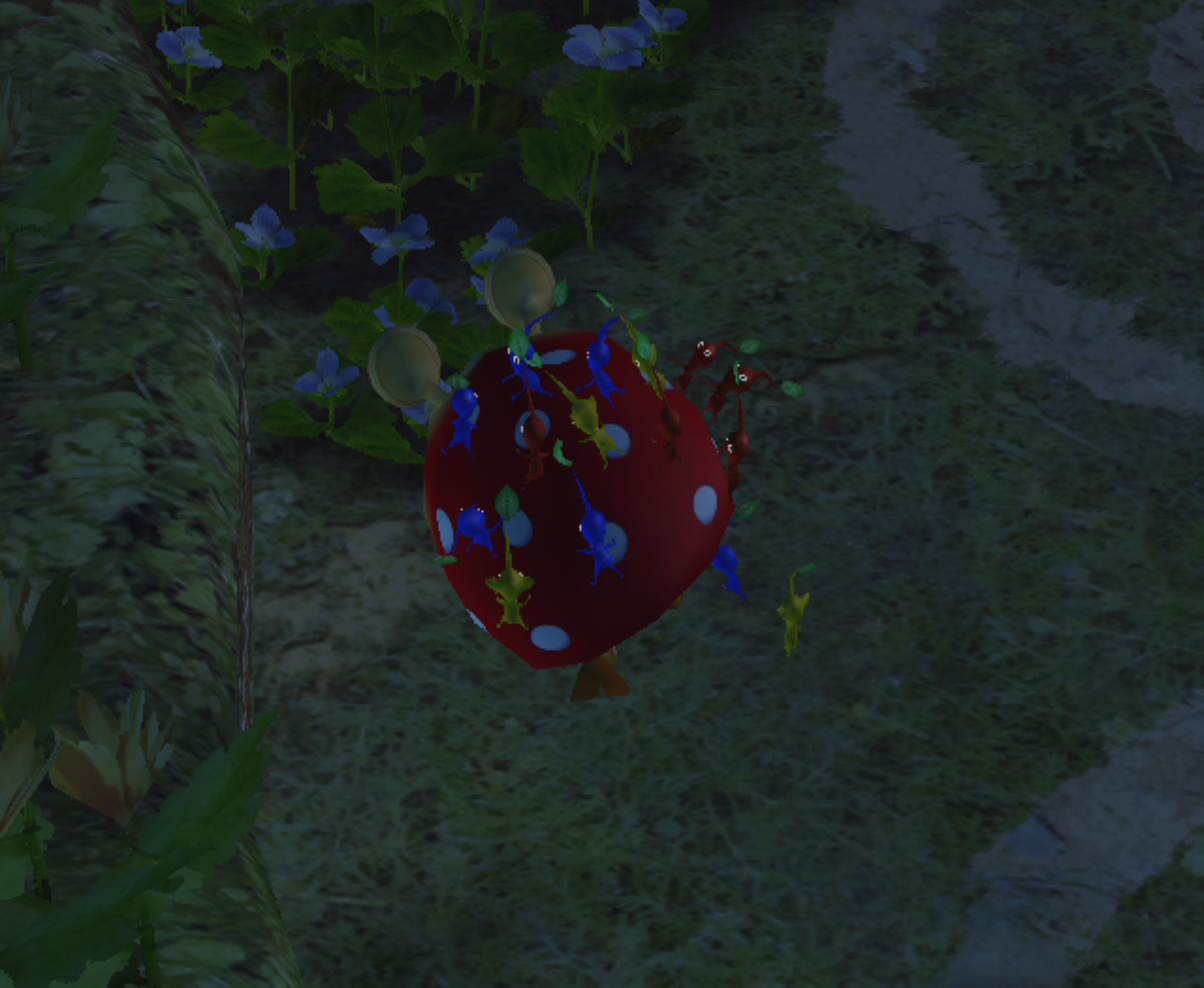
The basic close sees Olimar salute the pikmin and leave the planet, but if you fully reconstitute his ship, then after he does, his newfound friends attack a nearby bulborb. The implication is that the pikmin have learned to independently defend themselves from their time with Olimar. This is the next stage of their development: not the biological development that takes course over millions of years, but the educational development that allows a sapient species to adapt at the drop of a pin. Command a pikmin to fight, and it will live another day; teach a pikmin to fight, and it will live to its maximum lifespan. There is also a scene in which a colourful range of onions lift off the planet, letting our imagination run wild with what the other pikmin subspecies might be capable of, although most of them will not be included in the coming series.
Ending
Pikmin's originality becomes most apparent when you try to succinctly explain what it is. There are other games that we can convey the gist of with simple genre labels or comparisons to other titles. We pick adjectives like "Roguelikes", "Soulsbornes", or "Sim racers". But which of these names would we apply to Pikmin? It is a strategy game that takes place in real-time, but to describe it as an RTS would be a denial of the avatar-based interfacing and lack of free unit construction. We could stamp it an action-adventure, but then we would lose the pikmin bit of Pikmin. I most commonly hear it compared to Lemmings, but not only does Lemmings not put you in charge of an avatar, it uses a side-on camera, narrower roles for each entity, and ultimately, different goals.
Pikmin is probably closer to 2007's Overlord, but that is more of a traditional fantasy combat game, and not a useful point of reference when explaining Pikmin because it is obscurer. Both the protagonist and minions in Overlord are also less vulnerable, and the player is more directly involved in fights, with the ability to cast spells and buy equipment. Overlord also prominently features a morality system nowhere to be found in Pikmin. Pikmin's nearest neighbour is probably Tinykin, but only by virtue of Tinykin being made as a Pikmin-like. And what about setting and narrative? Pikmin doesn't feature the earthen caves of Lemmings, the grotty medieval burgs of Overlord, or the cozy domesticity of Tinykin. It shares a resemblance with Obsidian's Grounded, another game about being very small and very outdoors. But not only do we then end up with the gameplay comparison problem again; Grounded lacks the otherworldly mystique of Pikmin.

In attempting to prove Pikmin's link to other media, you only end up explaining how self-possessed it is. Pikmin is in a genre of one, and I think that's beautiful. Nintendo, and Miyamoto's games, especially, have a reputation for obstinately adhering to a formula. Not pushing the boat out too far for fear of forcing players into unfamiliar, and therefore, uncomfortable waters. But Pikmin shows a studio and a producer that, even after more than twenty years in the business, still had deep wells of creativity to plumb. Pikmin was a reassurance that after a lifetime of exploring, there were still new planets for Nintendo to explore. It was evolution for the start of a new millennium, and it managed to be so enticingly alien that, even two decades on, there's nothing quite like it. Thanks for reading.
Sources
- Pikmin Has The Best Origin Story by Yannick LeJacq (November 11, 2014), Kotaku.
- Hennessy, J.L., Patterson, D.A. (2002). Computer Architecture: A Quantitative Approach, 3rd Edition. Morgan Kaufmann. (p. 481).
- Feature: Remembering Super Mario 128, The Groundbreaking Masterpiece That Never Really Existed by Damien McFerran (October 3, 2018), Nintendo Life.
All other sources are linked at the relevant points in the article.