
RARE REPLAY RELAY, PART 3: Live & Rebooted
by jeremyf
When Microsoft acquired Rare, they gained both a studio with boundless ideas and a library of IP that had attracted loyal players. We can get a sense of where their head was at in 2002 with the announcement video, which I had not seen in full until now. The video promised that Perfect Dark, Banjo , Conker , and a new character would be gracing Xbox consoles in the future. We’ll get to that last...
When Microsoft acquired Rare, they gained both a studio with boundless ideas and a library of IP that had attracted loyal players. We can get a sense of where their head was at in 2002 with the announcement video, which I had not seen in full until now. The video promised that Perfect Dark, Banjo, Conker, and a new character would be gracing Xbox consoles in the future. We’ll get to that last character later, but for now, I want to bridge the gap between Nintendo and Microsoft by focusing on the N64 legacy. Out of the dozens of games Rare had put their name on, these three franchises were apparently the crown jewels. And while the logical decision would be to make those games playable for a new audience, the opportunity took longer to arrive than players may have expected.
Conker was first to arrive on the scene, with a full remake of Bad Fur Day hitting the original Xbox in 2005. That’s way later than I realized! Still, just four years removed from the original release, Conker: Live & Reloaded is a noticeable distance in visuals from Bad Fur Day. It’s also a fairly controversial remake, and not included in Rare Replay. I’m not about to do extra credit for this challenge, so we’ll have to leave it there.
The remaining N64 hits would not arrive on Xbox until even later. As Xbox Live Arcade came onto the scene, smaller downloadable titles became a valuable revenue stream for publishers. Knowing that the window for N64 nostalgia was opening, Microsoft and Rare hired 4J Studios to remaster Banjo-Kazooie, Perfect Dark, and Banjo-Tooie, showing the games in a whole new light. An HD light! When you boot up Rare Replay, you have access to these remasters via backwards compatibility. The mission from there is simple: Get 75% of the Gamerscore in each title and determine if they hold up in the first place.
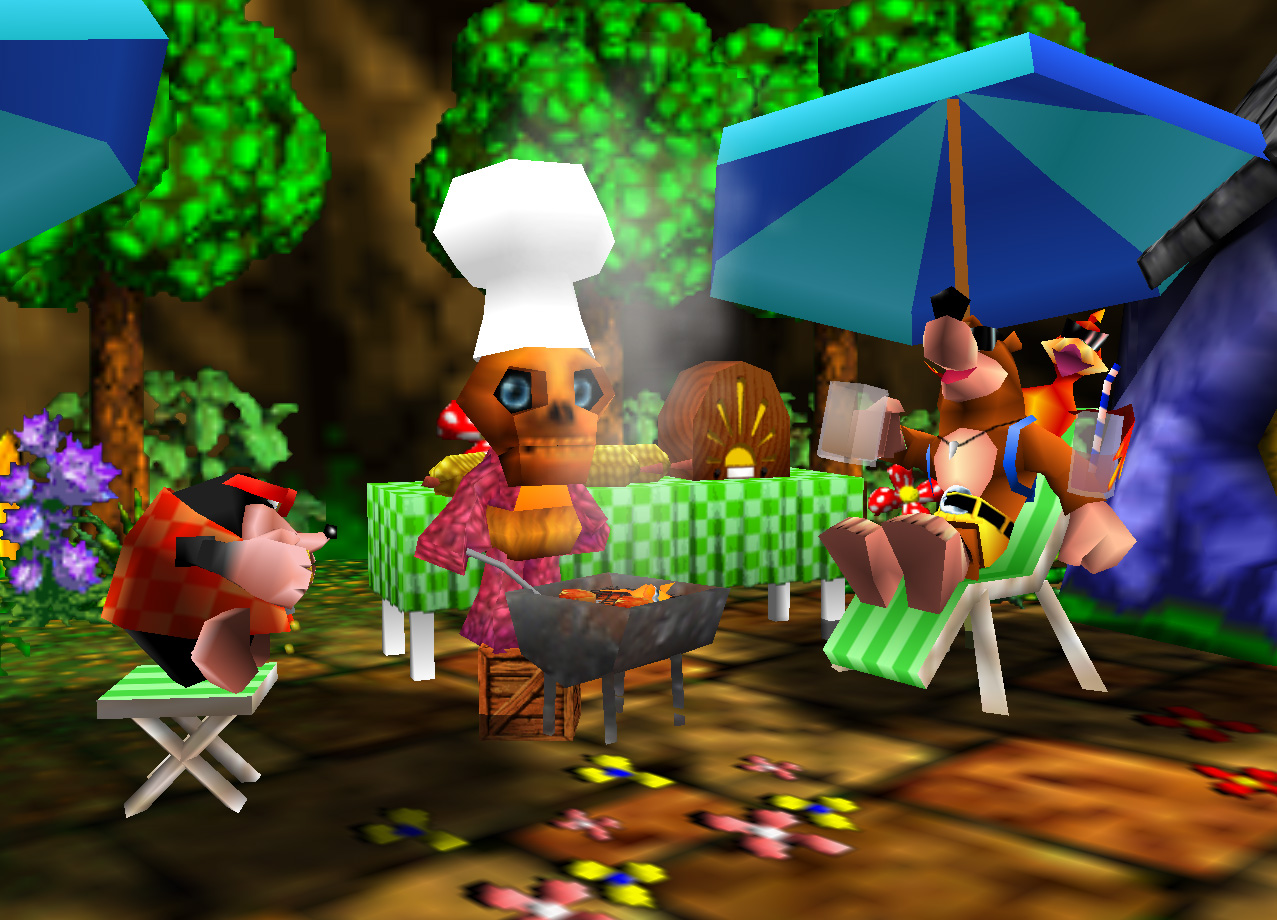 Banjo resonated so much with me as a kid because the characters leapt off the screen.
That last part might be difficult because Banjo-Kazooie is the only game out of all 30 for which I can’t approach anything resembling an objective stance. It’s a game I’ve played and loved since I was a tyke. If I hadn’t, I wouldn’t even be interested in Rare Replay. The buddy-duo dynamic of the two titular characters is endearing, and the abilities that result are always a blast. Gruntilda is a funny villain you love to hate. Plus, appropriately for a title named after instruments, the music is head-splittingly catchy. I was very much looking forward to completing Banjo again. While I was certainly under the fog of rose-colored glasses, I enjoyed every minute of this replay. To get the most out of Banjo-Kazooie, you need to collect 100 jigsaw pieces, 900 notes, and 45 Jinjo creatures. Unlike Jet Force Gemini, you do have a little bit of wiggle room to miss some stuff, but not as much as you might think. It’s something like 98% completion required to fight the final boss. You might as well. Regardless, the first Banjo can be breezy and comfortable once you get to know it. Most of the worlds are basically circles with things to do dotted around the edges. You don’t need to check a map all the time because it’s intuitively laid out. The actual surface area is usually small, giving a playground feeling to the whole thing.
For a newcomer, there may be some pain points. The engine room Jiggy inside Rusty Bucket Bay gave me a lot of trouble this time around. And despite the cool seasonal gimmick, Click Clock Wood overstays its welcome. Finally, the quiz board at the end can be maddening if you aren’t prepared for it. So many of Banjo’s particulars are etched in my brain that it’s never a problem. Well, I did miss an instant death question at the very end and had to redo the whole thing… dang it. Like I said, though, none of those sections can diminish the warm feelings I have for this game. I blasted through it in two sittings without even paying attention to the achievements that closely. It’s important to hold on to those games that rekindle your childhood joy, and Banjo-Kazooie will always be one of mine.
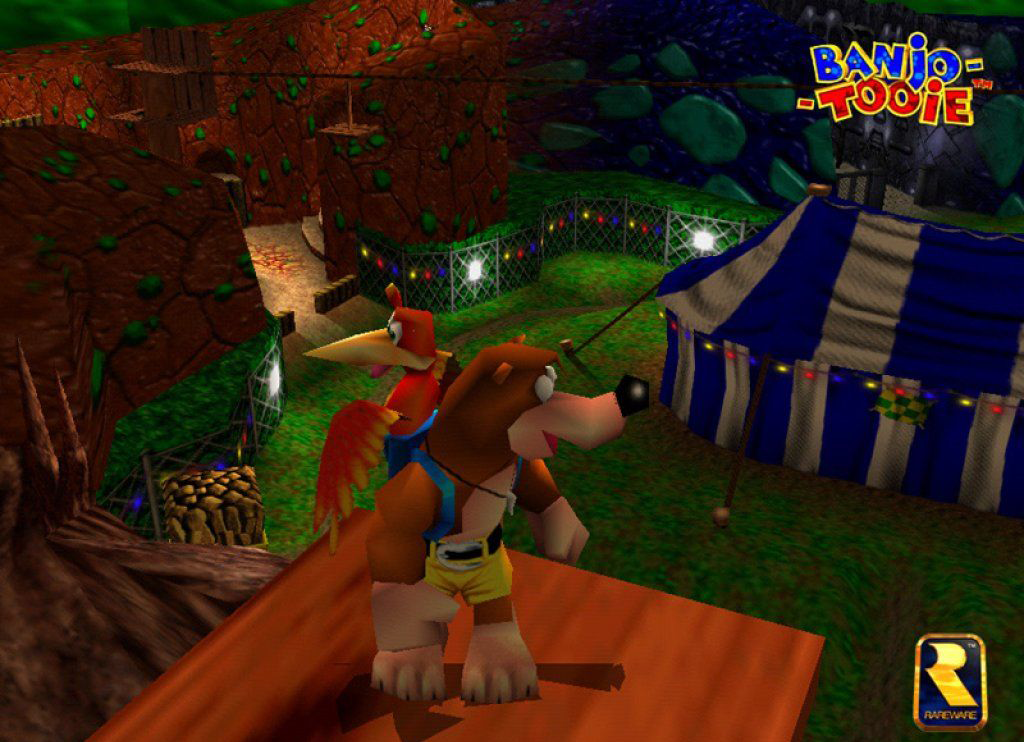 Everything is a lot more cynical this time around, including the carnival level. I like its atmosphere, though.
Then you get to Banjo-Tooie, and that… well, it kind of blows the whole thing up. I hadn’t dived into Banjo’s sequel before because I didn’t have access to it as a kid and I was wary as an adult. The subtitle for Banjo-Tooie might as well be “bigger is better.” Sure, the total number of collectibles might be close to the ones above. But say we dot all of Banjo-Kazooie interesting stuff on a balloon. Then we inflate the balloon, and that’s Banjo-Tooie: a bunch of empty space between the game parts of the game. Where Banjo-Kazooie used memorable buildings and simple layouts to orient the player, the worlds of Banjo-Tooie are tangled mazes within mazes. They get gigantic by the end, but they have a lot of empty rooms with a tunnel on each wall leading to another such empty room. You’re also asked to switch between characters and forms often, meaning you run back and forth across these worlds, checking your watch all the way.
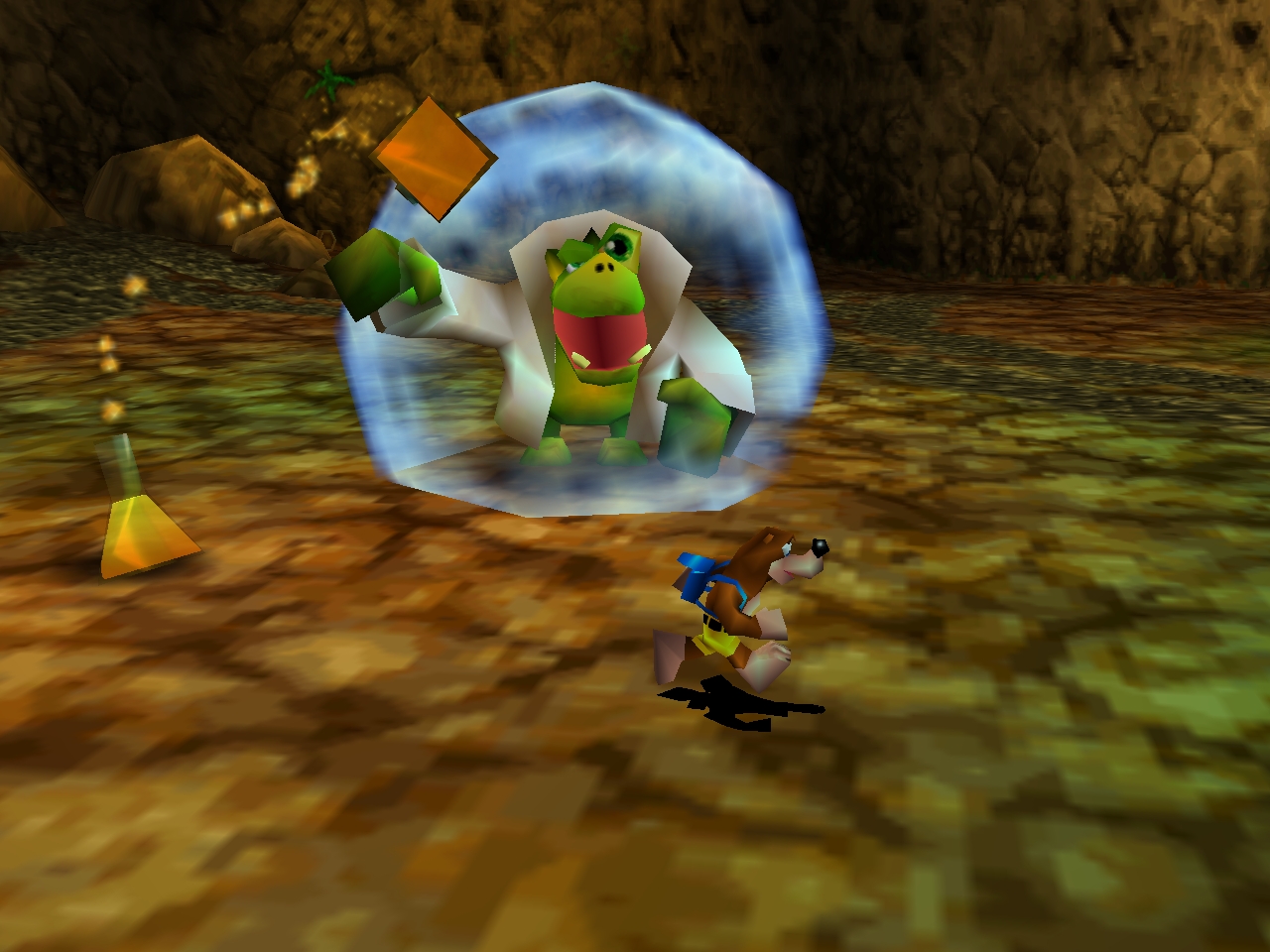 Strictly speaking, we can't DISPROVE that Klungo was the inspiration for Shrek.
To my surprise, though, playing Banjo-Tooie for this challenge was a lighter task than I expected. All my stamps were earned in a single sitting. It’s all thanks to whoever implemented the achievements into this remaster. Many are for simple tasks accomplished in the first hour or two. Others can be unlocked by completing one out of multiple conditions – something I hadn’t seen elsewhere. I wrapped up my stamp requirements after the fourth world of eight. At that point, the game is just reaching the threshold of becoming annoying. The most difficult and tedious parts of the game can be totally avoided for this challenge – and if it weren’t for that preexisting achievement list, I’m sure that wouldn’t be the case.
Because I didn’t have to worry about every last thing, I was able to appreciate the things Banjo-Tooie succeeds at. Though the execution is poor, crisscrossing paths between levels is an ambitious idea I would enjoy seeing in a refined form. The first game borrows heavily from Mario 64, with each level denoted by a disconnected painting. Here, though, the Isle o’ Hags feels like a cohesive place that exists when the game isn’t on. Speaking of the first game, I love that Banjo and Kazooie keep all their moves from their last adventure. Losing your powers in the sequel is a common trope, one that this snarky series could have easily indulged in. It immediately crystalizes Tooie’s mission statement: using the end of Kazooie as the starting point and adding more and more. The graphics and music are once again aces for the N64’s limitations. There are people who prefer Tooie to the first game, and I guess I can see why with these things in mind. For my money, though, it takes things too far to remain as consistently engaging. Eventually, I went back and finished the game on my own time, just because I was enjoying it. It ended up ranking very high on the final list.
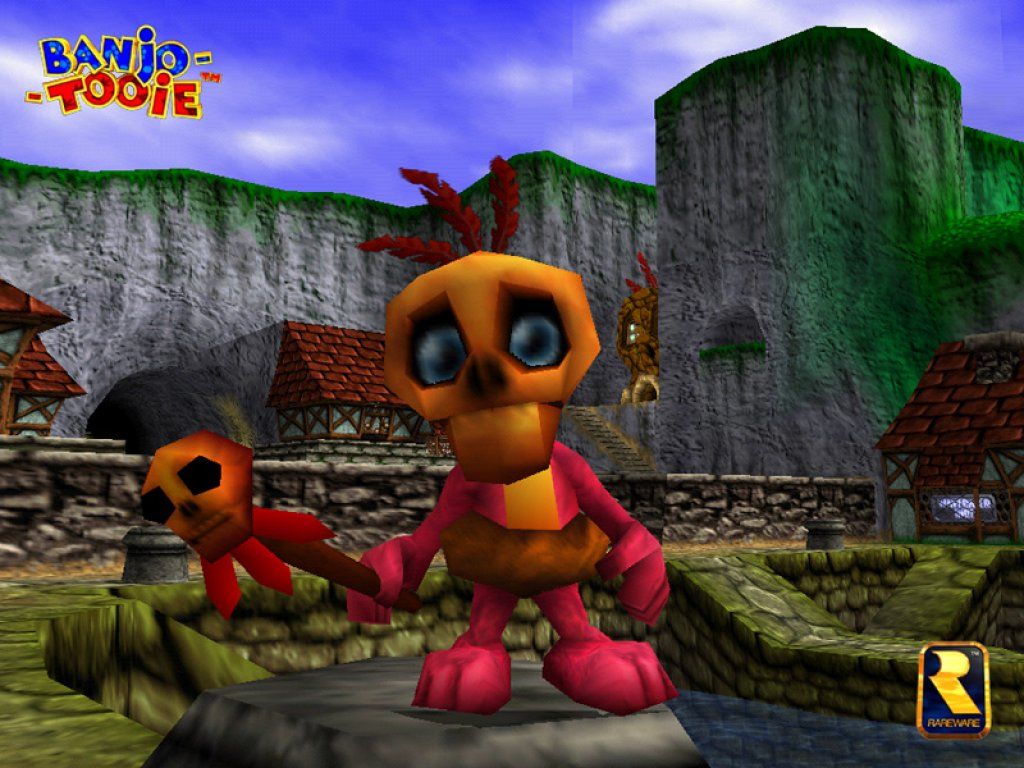 Mumbo's implementation is underwhelming. Good for an achievement, though.
My nostalgic association with Banjo may have colored that experience, but no such association existed with Perfect Dark. Born from a desire to iterate on GoldenEye without the pesky license holders, the game features secret agent Joanna Dark, who would evidently become popular after this debut. The best part of these remasters is they replicate how one might remember the games looking and playing. With graphics far sharper and frame rates far smoother than possible on the N64, these games get to put their best foot forward to any new players. What issues I did have with Perfect Dark were fleeting, and I generally enjoyed Rare’s approach to shooter design here. That makes three for three of these remasters hitting for me.
With these 360 games, I liked to go in with a plan of attack for the Gamerscore threshold. Here, with the assistance of Imaginary Player 2, I wouldn’t have to finish the campaign on anything other than easy. That’s quickly become the way I most enjoy shooters. Enemies were weak enough that I could blast through most stages without too much trouble. When I did die, it wasn’t long before I was back in the fight. These stages don’t have checkpoints, but they don’t need them. While their layouts may be complex, it doesn’t take very long to traverse them. In most cases, it’s very quick to get back to what you were doing. I say “in most cases” because the last stage is a bit of an exception. It’s a linear maze that culminates in a scary boss that’s unlike any other foe. He destroyed me the first time, and I was not happy about starting all the way over. Luckily, I avoided a repeat of Mizar by taking him down on the second attempt. My hair may have stood on end, but I won out! When it comes to the mission environments, I definitely preferred the earlier espionage focus to the following ancient aliens motif. But that was in style at the time. If I really needed to, I think I could have gone back for higher difficulty runs. I very much enjoy how more objectives are added for them. It’s more interesting than basic damage modifiers, and it enhances the spy fantasy. It could get confusing, though, identifying what I did and didn’t need to interact with to finish each level.
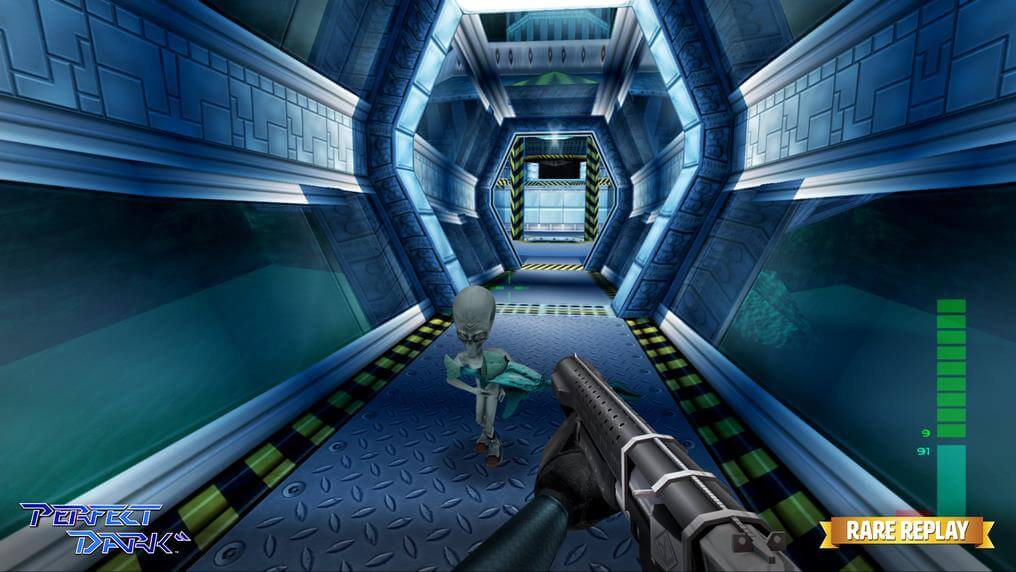 Sometimes the game tries to be a dramatic spy thriller. Sometimes Elvis is there. It's Elvis, everyone!
Once my full campaign run was finished, it was relatively easy to mop up the miscellany. Then, it was time for some bot matches. I was awed by the amount of options and scenarios for multiplayer. Had I discovered Perfect Dark earlier in life, I could see it as a go-to option with friends. In 2022, though, I was just there to rack up a bot body count. The easiest way to accomplish my goal was to set up a kill room with laptop turrets and program the A.I. to swarm it. I remember thinking it was a boring task. I had no idea how good I had it then – but that’s a story for later. And that’s about all she wrote for this game. I’m not attached to Perfect Dark after this – in part because the audio balance was too low for me to understand what anyone was saying – but it gets a thumbs-up for design and the improvements in the remaster.
Before I finish this post, though, I’m including a bonus entry that loosely fits the theme of old Rare franchises revived on XBLA. Jetpac Refulled (sic) is a tiny downloadable title that, were it not included in this collection, I never would have even thought about. It’s clearly riding the coattails of Geometry Wars and other titles that shiny up retro gameplay with colorful particle effects. Indeed, Refulled is brighter and more chaotic than the original Jetpac ever was. Its loop is relatively the same, though – build your ship, fuel it up, and escape to the next level. They’ve also added new weapons like an L-shaped beam or a spread shot to counter the ever-increasing mob of alien baddies.
 Now imagine the screen with ten billion enemies.
 Since Refulled is so simple, the achievements simply have to do with your skill. Score a lot of points, reach X stage without dying… that sort of thing. It also includes the original Jetpac, with Gamerscore to earn for clearing all 16 levels. This was a harsh wake-up call that I suck at Jetpac without the cheats I had become accustomed to. Clearly, that wasn’t going to happen, and I also wasn’t about to drag anyone in for online multiplayer. My only choice was to finish all 128 screens of Refulled. Thankfully, you get a permanent checkpoint every four stages, but succeeding in later levels is truly a crapshoot. As I alluded to, enemies envelop the screen ferociously. I’ve been playing a lot of Vampire Survivors recently, and that’s the level of chaos we’re talking about here. They sometimes spawn on top of you, so successfully maneuvering Jet Man to the pickups can be herky-jerky. The art direction doesn’t help either. With a flat cartoony style and zoomed-out view, it’s inevitable that you won’t see a little goober that causes your doom. But the only remedy is to keep plugging away at the thing. I felt like I was playing roulette most of the time, but the checkpoints gave me the willpower to keep making progress. And since none of you will follow suit, I’ll say that the ending screen reveals that the whole time, Jet Man was… stealing from his company and going on the run? A weird wrinkle to a game that otherwise has no story, but I kind of like it.
Anyway, Jetpac Refulled is a weird slice of a gaming trend that would fall out of fashion. A few years later, they would have made it a mobile game. Nowadays, I don’t think they would bother making it at all. Even with something as seemingly cheap to produce as this, the market has to be right for a company to devote those resources. Even then… I get the feeling that Jetpac Refulled wasn’t as warmly received as the other three games we just discussed. Enough about the old days, though. Next time, we’re looking at the new franchises Rare launched under its new ownership. Will they blow the lid off this Xbox, or will they fizzle into obscurity? The only way to know for sure is to read the next installment of Rare Replay Relay.