
RARE REPLAY RELAY, PART 2: Get N or Get Out
by jeremyf
If there's one good thing about this challenge, it's that no bananas had to be burgled. We’ve hit a three-year time skip, and in that time, Rare has gone from a mercenary studio with ambitions to a cutting-edge partner of the industry’s most iconic company. Rare’s work in prerendered technology in Killer Instinct and Donkey Kong Country positioned the developer as one to watch as the 3D era ful...
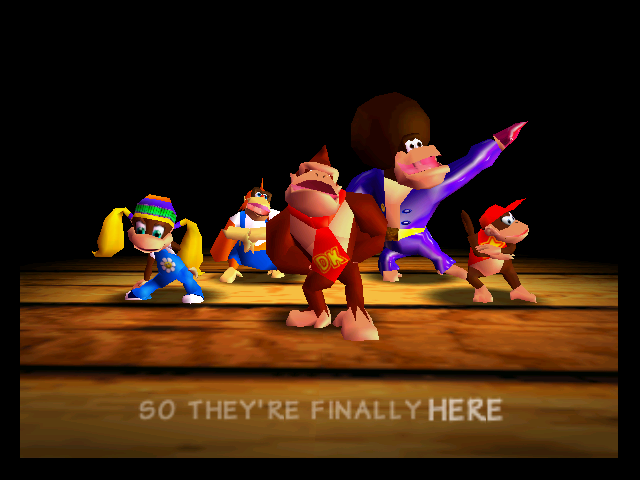 If there's one good thing about this challenge, it's that no bananas had to be burgled.
We’ve hit a three-year time skip, and in that time, Rare has gone from a mercenary studio with ambitions to a cutting-edge partner of the industry’s most iconic company. Rare’s work in prerendered technology in Killer Instinct and Donkey Kong Country positioned the developer as one to watch as the 3D era fully conquered the gaming public. On the Nintendo 64, the company would become seemingly indispensable to the Big N. While historical third parties were jumping ship to PlayStation, Rare supplied a sizable volume of successful titles on the 64. Even without the use of outside IP, that footprint is big enough for seven games to represent the console in Rare Replay. This is the era that birthed everyone’s fondest memories.
That said, this is also where I’m veering wildly out of sequence. I want to break up these seven games into two categories: those contained natively in the Rare Replay app, and those already released on Xbox Live Arcade. The process for the latter titles is a little different, and they are a nice bridge to the controversial events that followed. They will be covered in the next section. Here, let’s go over the remaining four games in order of how much time they demand.
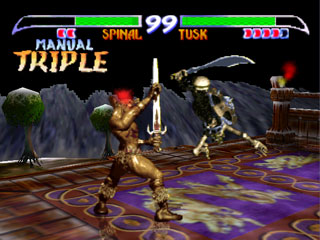 This looks... okay, right? It's not just me?
The breeziest of them all is the fighting game Killer Instinct Gold. I have reiterated this point many times, but suffice it to say I respect the genre much more than I succeed at it. Fortunately, skill is hardly a requirement for these achievements. All we have to do is enter an in-game code to access a secret menu and tweak some settings in our favor. Then, it’s a straightforward checklist of fighting as every character, winning arcade mode, and mashing out a high enough combo to excite the announcer. The biggest catch is the sole achievement – in the whole collection – to require a second controller locally. And it’s more of a technicality. One stage mandates a real player two to access. There’s just no way around it. I found another Xbox controller for a reasonable price at Target, and I’m happy with it. Not only did Imaginary Player 2 save my sorry self many times during this challenge, but it feels nice. It’s become my primary PC controller. I’m looking at it right now.
That one hoop aside, getting through Killer Instinct Gold really is that simple. And there’s more to the appeal than I gave it credit for. Obviously, the vibe is very comparable to Mortal Kombat. Yet the art style itself is substantially different, having a sculpted look that benefits the nonhuman fighters (and only the nonhuman fighters). Of the two franchises, Killer Instinct also has the better theme song. Deal with it. Those are about the only levels at which I can appreciate fighters, so I’m not a well of knowledge here. But playing this version did give me the most fleeting of desires to try the 2013 reboot. At this point, though, I would rather wait for the next reboot, or just appreciate it from afar.
Like I said, we’re going way out of order here. The next N64 game to cover is actually the last Rare released on the platform, and one of the last N64 games in general: Conker’s Bad Fur Day. Starting life as a typical cutesy collectathon, the decision was made to pivot Conker into a crude adult character – one who could swear, drink, and urinate like Duke Nukem. This juxtaposition had been used in other media, but it was novel for video games, especially on a Nintendo console. That unconventionality seemed to have significantly loosened the design ethos around the game. The designers inserted so many brief and disparate gameplay moments that I’m reminded of Battletoads. Both games are far more concerned with putting characters in cool scenarios than building difficulty curves or ensuring that these scenarios, you know, work. With Conker, though, these mechanics had to be built and tuned for the most detailed 3D environments Rare had yet built.
If you’ve followed the blog, you know how much of a red flag this is for me. Platforming games relying on gimmicks like these is one of my pet peeves. They almost always come out underbaked and distract from the core gameplay. The practice has ruined games for me that use it far more sparingly than Conker. That’s to say nothing of the offensive humor the game bandies about, which is a whole separate topic. Still, I went in with an open mind. The temperature towards Conker may have shifted over the years, but maybe something would shine through. Would my good faith be rewarded?
The thing about these cinematic games is that they don’t let you forget it. Conker’s opening goes on and on, introducing you not only to the squirrel himself but also several plot points which won’t advance for hours yet. Even the moment we get control isn’t satisfying, as Conker is hung over and moves like a snail. It’s more cutscenes still until we earn full mobility, meaning this Bad Fur Day is off to a slow start. Seeing as Conker is pointedly focused around comedy – featuring constant fully-voiced jokes – seeing them fumble the element of timing is not promising. In the early game, you’re constantly stopped by unsympathetic characters so they can give their shtick. You can only skip cutscenes once you’ve already seen them, which just enforces the slogging pace.
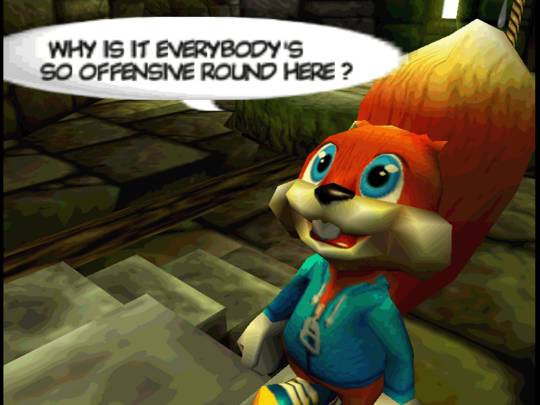 There's the pot calling the kettle blue.
We have to address the edgy elephant in the room: the game’s style of humor. There’s already a raging debate on what topics can be joked about and by whom, and what the role of comedy is in breaking those boundaries in the first place. Regardless of your stance, it’s true that material that gets laughs sticks around, and vice versa. And since jokes targeting the “different” are so often the most tired and lazy type of comedy, they are also almost never funny. Nearly every character you meet is a garbage person, and the few others are only around to die for shock value. Conker himself isn’t exactly admirable either, going along with all sorts of horrible stuff for the promise of cash. It’s hard to stay motivated to keep playing without anyone to connect with. More than that, after so many years of Adult Swim and the like, the game’s dark sensibilities don’t even feel that envelope-pushing anymore. What’s left? A bunch of movie references, mainly – quite possibly the second most lazy form of comedy. Seriously, there were hundreds of Matrix parodies by this time.
That’s not to say that every joke falls flat. For instance, I think The Great Mighty Poo is a funny little moment. It caps off a whole swath of the game that is nothing but fecal humor, so the presence of a giant poo monster – not especially creative. But making him an opera singer and staging a whole production about it? That’s an extra layer that took a lot of work to realize. It’s all capped off with Conker flushing Poo away and quipping, “Now that’s what I call a bowel movement!” It works, and it’s deservedly one of the most remembered moments from the whole game.
I have to confess now, though, that I never fought The Great Mighty Poo. I was dropped off right after that cheeky line. That’s because at the very start of Poo World, you have to jump up this room of hanging ropes in a silo of flowing poop. I spent maybe five or ten minutes trying to catch these ropes, but the depth perception just wasn’t working for me. I kept falling off, sliding all the way down and out of the room. And at this point, I hit that moment you may be familiar with, the moment you know that this isn’t worth your time. Even if I did clear this challenge, I knew I would have to deal with water levels and escort missions and races if I continued down the path. And I decided that I just wasn’t interested. This is the very last time where we can use game-breaking cheats to skip the game, and Conker has a code that lets you unlock and jump to any scene. The achievements are only concerned that we reach the last part of each chapter – which is often just a cutscene.
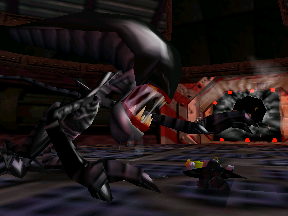 Fox's lawyers were asleep at the wheel.
Cheating, in this case, felt unbelievably good. I amazed myself by clearing the treacherous barrel-rolling section at the end of Spooky on my first try. Knowing the It’s War section trailed on interminably, I was thrilled to see none of it. There’s even an achievement for entering a cheat code, so I felt like the people who worked on Rare Replay where subtly pushing me in this direction anyway. The only legitimate challenge left was the game’s final boss, a not-quite legally distinct Xenomorph that comes out of absolutely nowhere and leads to yet another wholly new gameplay style. The goal is to stun it with a few punches, then grab it by the tail and spin it around just like Bowser in Super Mario 64. I appreciate thematically linking one of the last N64 games to the very first in a full-circle moment (no pun intended, honest!). But this fight really got under my skin. Even the guide I was following didn’t have a consistent method of hurting the creature. It would block my punches nearly every time, then knock me down quicker than I could react. There seemed to be no set rules for how many times it could attack in a row, the duration I could stun it, or what it would take for my attacks to even land. I lost track of the time I spent throwing hands, but by the end it was definitely less of a “so long-eh” and more of a “good-eh riddance.”
The remaining achievements are for the game’s varied multiplayer modes. You can get these easily by throwing a few bot matches. I won’t say that the door is permanently closed on a “legit” playthrough of Conker in the future. While my time with it wasn’t a total disaster, I also wasn’t impressed with any of the aspects that had made the game stand out when it released. Anyway… I’ve got other stuff to do.
A subversive mascot is still a mascot. We are hard pivoting again to a game that not only lacks a mascot but confines its only “characters” (read: faces) to tiny thumbnails in the corner of the screen. This is Blast Corps, a game unlike any other in Rare Replay. The premise: a nuke-carrying truck is locked on a deadly path, and it’s safer to destroy everything on that path until scientists can disarm the bomb. Initially, this setup leads to highly enjoyable romps. Making things blow up is one of gaming’s deepest pleasures, and the destructive races against time in which your vehicle levels buildings are great. The truck is slowly drifting towards doom, and in the game’s best moments, you’re eking out just enough time to keep ahead. Of course, sometimes you accidentally bump the truck, and the camera dramatically pans while the fireball erupts. It’s great stuff.
 Every screenshot and piece of promo art has this robot in it. It's the best part of the game, but it's also in like two missions.
Puzzlingly, though, these levels are just a small portion of the game. Blast Corps doesn’t know how to keep its fun. That starts with the mixed selection of vehicles. For every enjoyable one, there’s a gimmicky or unresponsive one. There’s a type of cycle that shoots missiles, but aiming its shots is untenable. The worst of the bunch is the Backlash, a dump truck that’s only effective when drifting with its backside. First, the hitbox for the back is unclear. And missing by any amount stops the truck dead, impotently scootching against the building. The number of levels that force these vehicles feels disproportionate, even if only because they took me more tries. Then, there are the later levels which turn the focus more towards puzzles. You will need to use more inventive methods to clear a path for the truck, be it bridging a river, slotting blocks into the ground, or lifting obstructions with a crane. Accomplishing those tasks while running back and forth between vehicles felt like busywork, especially when I failed repeatedly. I couldn’t help longing for the simplicity of the early game.
The vast majority of time with Blast Corps, though, came from bonus levels. You can find items in stages that unlock them, but those stages will also have unlocks, and so on, until the levels select is a confusing trail of lines and circles to unfun challenges. So many levels are races, which, who cares. There are more racing games than any other genre on the N64, and these slot cars are in a game where racing is not the main focus. Why would you think I would want that right now? Then, there are the esoteric ones, like searching out and destroying random spheres or playing Pac-Man, for some reason. Even the stages that uses the main game’s destruction mechanics tend to be needlessly strict and/or use the annoying vehicles. Blast Corps is a game that will not end. Once you save Earth, you go on to levels on the moon. Then – and I’m not kidding – another level on each additional planet! And if you’re wondering if they successfully programmed low-gravity mechanics for these levels, no, I’m pretty sure they gave up after 10 minutes. Props to the developers for including so much value in their game, but I was interested in very little of it.
As for the achievements, it’s insult to injury. We need to explore every inch of every stage, lighting up all the little dots on the ground and blasting anything that can be blasted. Not only that, but we need to get a gold time on every single level – and one platinum time! Some of these are easy to clear, and others are intense. By this point, I was really tired of Blast Corps, which is too bad. For many people, getting 100% often ruins their enjoyment of games. I try not to experience that, so long as the journey remains engaging. Blast Corps should be a fun completion, but it ends up wasting its concept by pulling focus in too many directions. Even if I had only played the story mode, the game’s appeal would end up as a missed opportunity.
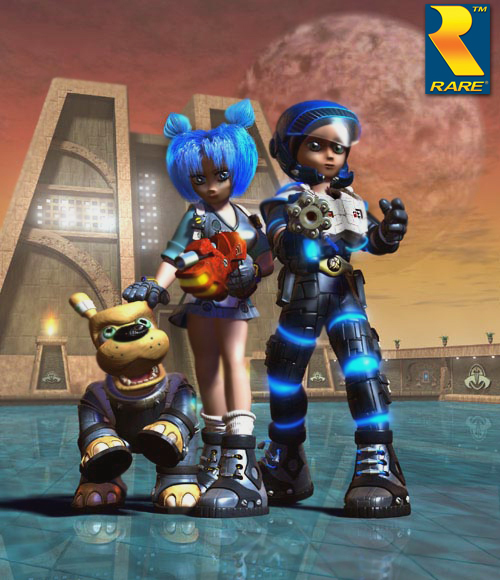 That dog is tweakin'.
For the next game, Jet Force Gemini, I had no idea what to expect. Precisely one person I knew once talked about playing it as a kid, but aside from that, no one ever brings it up. Many of Rare’s games around this time implemented shooting mechanics as a secondary gameplay style, but Jet Force is a third-person shooter first and foremost. Rare Replay adds an option for a more modern control scheme, which is what I went with. Shooters have changed a lot since 1999, and the Xbox controller layout is quite different than the N64’s. This touch shows extra care from the Rare Replay team, and I appreciate it.
Compared to Conker, Jet Force’s storyline is far more perfunctory. An army of alien bugs has descended on a peaceful system of planets, enslaving the bear-like Tribals living there. Twins Juno and Vela, along with their dog Lupus, swoop in to save the day. The trio is separated in the opening scene, so the initial objective is to reunite them while blasting ants and saving bears. Knowing that achievements would ask me to do every little thing, I settled in for the most complex N64 title in the collection.
Immediately, I recognized that this would be a playthrough where I would need a guide to lead me by the hand through the whole adventure. If you want my advice, doing so is absolutely essential to getting through Jet Force Gemini. The most obvious reason is the Tribals. I strongly hate how they set it up. If a level has 10 bears, you must save all 10 at once. If you miss one, the rest will all pop back in as if they were never rescued. Have fun going back and repeating all that work. This is also how notes worked in the original Banjo-Kazooie – they were taken away when you died or left a world and recorded as a high score. But that was a design concession based on programming difficulties. Using this system again is even more egregious here because, not to get ahead of ourselves, you must save every Tribal to finish the game! There is no point to a high score system when maxing out the score is required.
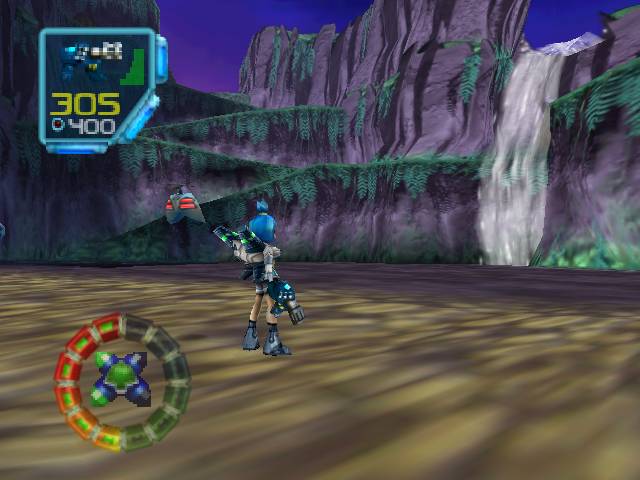 There are plenty of big, varied planets to sweep for collectibles.
This choice already made me bristle against Jet Force Gemini and led to further awkward moments of design. In many stages, you won’t be able to save some Tribals because you lack an ability from further in the game. Which means there is no point in saving any until you revisit the level hours later. There are also rare enemies that beeline towards Tribals and try to kill them. If you’re not fast enough to intercept them – or if you accidentally kill a Tribal by other means – go ahead and give yourself a game over. You will have to replay that whole level just for a chance to rectify your mistake. I remember this happening repeatedly at one section, and I felt like pulling my hair out. If Tribals were cumulative, the backtracking would be somewhat more digestible. I hate it.
Once you have all three characters available, you will be carting them around to every planet, not only for the Tribals, but also for the ship parts needed to confront Mizar, the final boss. Their unique abilities are needed to reach certain areas, although keeping track of the sprawling paths in your head is madness. Jet Force Gemini was certainly designed for the strategy guide. Some item chains are reminiscent of older adventure titles, and the signposting within the game is next to none. Effectively requiring three visits to most levels only makes the game feel more padded out. The game throws in some other mechanics to stem the bleeding – racing, disguises, and jet packs to name a few – but these are mostly, um, bad.
As I said, additional weapons and upgrades are littered around the various planets. There are some interesting options to choose from, but many end up feeling weak. The shuriken decapitates most basic troops and can be picked up after. It’s good for efficiently collecting ant heads needed for an achievement. Sadly, most other weapons are fairly standard. My go-to option was running wild with the laser machine gun. Although every character eventually has access to all the weapons, they are not shared between them. I would often get confused as to why I no longer had rockets or what have you, and this is a case where I would prefer a break from immersion to cut me some slack. Handling these guns wasn’t always comfortable on my hands, either. I don’t know if it was the alternate control scheme or my gripping the thing too tight, but it didn’t help my growing aggravation.
In these early-3D shooters, boss fights are often a major pain point that strain the game’s mechanics. For the few bosses in Jet Force, they decided to change things up. Your character is confined to a 2D rail and always facing the boss. I have to imagine this is because full 3D movement in boss fights wasn’t fun, and I approve of the decision. Limiting your options does make the encounters more intense. I just wish I had received more feedback while fighting them. The bosses’ weak points change every phase, and the fleeting moments where they are vulnerable are not always communicated clearly. I did have the walkthrough for advice, and most of them went down without that much trouble. The final fight against Mizar, though, makes Conker’s Xenomorph look cuddly.
Mizar has a laser that can shave down your health in under a second. You only need to get caught by it once before you’re put in mortal danger. When you’re done waiting for his whole extended attack pattern, he will become vulnerable for just a few seconds. I had a lot of trouble figuring out the window for when I could shoot and have the rockets reach him in time. When that scant time is done, it’s back to dodging his barrage until you can get another chance. On top of everything, I did not have enough ammo capacity as Juno to win the fight. After dozens of tries, I finally had to quit out and search around some more for upgrades. I always hate doing that in RPGs, and this was no different. Between Mizar, the Xenomorph, and the Licking Foot, I would have to give Mizar the nod as the most obnoxious final boss in the whole collection. When I looked up video to see just what the heck I was doing wrong, I saw comments saying they never beat him. Could you imagine doing all of that backtracking, saving all of those stupid bears, just to be stopped at the eleventh hour? That pain drove me to finally overcome the gauntlet.
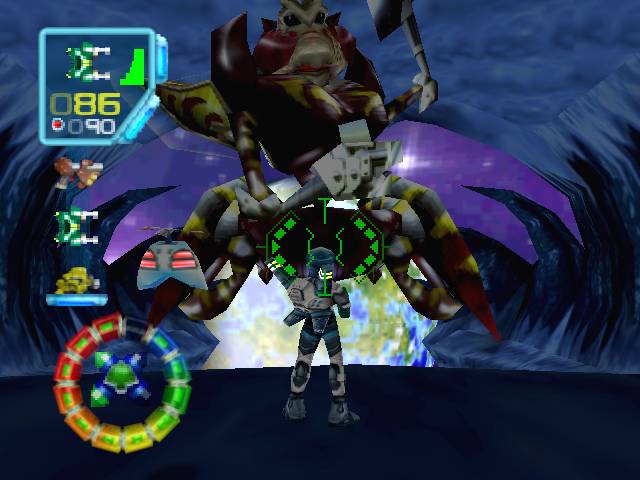 Fighting this boss may induce entomophobia.
If I haven’t mentioned the achievements much, it’s because there’s not much special about them. Jet Force Gemini doesn’t really distinguish between beating the game and getting 100%. You will need every bear and item just to get a crack at Mizar, and everything else will just happen along the way. I could not recommend this game with its current structure. Pointless collecting is kind of this whole challenge’s M.O., but for anyone just wanting a fun third-person shooter, know that it’s mandatory to see credits. I could go on about the frustrating parts of these N64 games, but believe it or not, I don’t like complaining on end for its own sake. I hope that, even if not all of these titles have been complete winners, I have at least been able to articulate why and provide some silver lining.
If this was the B-side of Rare’s Nintendo 64 era, though, it’s time to flip to the A-side. Next time, we will be covering the titles that were popular enough to earn remasters on XBLA. Hopefully, their success equates with how well they hold up.