
Quick Hits! Vol. 3: Summer’s Last Gasp
by jeremyf
It’s been a little while, but The Game Lord never truly rests. We’re all just killing time until Astro Bot releases, yeah? I’ve been playing a smattering of older games while I wait. Back to the ‘90s… Again This colorful, picturesque landscape is just one of the many appealing worlds to explore! There’s a conception in gamer world that if you haven’t played the right titles from the 1990s, you’...
It’s been a little while, but The Game Lord never truly rests. We’re all just killing time until Astro Bot releases, yeah? I’ve been playing a smattering of older games while I wait.
Back to the ‘90s… Again
 This colorful, picturesque landscape is just one of the many appealing worlds to explore!
There’s a conception in gamer world that if you haven’t played the right titles from the 1990s, you’re a poser. I think that’s been allowed to persist because some titles from those days really are that good, and I’ll let you imagine I’m talking about your favorite ones. A lot of old games landed on my backlog for that reason. Unfortunately, it’s often a gamble whether you’re experiencing a classic or regretting your choices.
 Playing as enemies is a nice power trip, if nothing else.
A few years back, I tried Oddworld: Abe’s Oddysee and pretty much despised it. There’s a blog post for it, but I can’t endorse the person that I was after that experience. I vowed then and there that I would play only what I truly loved from then on! It didn’t work! The problem is, I bought all the Oddworlds in a bundle, so they still hovered over me like a guillotine. Last month, I either wanted to conquer my fears or just punish myself, and I booted up the sequel, Abe’s Exoddus.
 I guess Abe is holding his breath, because he's thankfully immune to the crazy gas.
Exoddus is practically an expansion pack to the original. You’re Abe, a little blue guy, and you have to save your fellow blue guys from the evil corporation that’s enslaved them. This is a cinematic platformer where gameplay is tied to prerendered animations. That was the single greatest cause of frustration last time - Abe not responding to my inputs because his animation cycle wasn’t finished at the precise moment. It felt so mushy that I couldn’t imagine anyone having fun with it, ever. Well, in Exoddus, all that stuff is identical. The big difference maker is that they implemented quicksaving into the game. Turns out, it’s a patch that covers a lot of wounds. You ought to be hammering that thing like mad if you want to make it through with your sanity.
The game hides triple the Mudokons to rescue compared to Oddysee, but it’s clearer (read: indicative at all) about signaling secret areas that contain them. There are a handful of new mechanics, like fart explosives, new enemies to possess, and different emotional states for Mudokons that make it even more of a headache. Still, I was scraping my way through the game, and while I was out of patience for saving every single Mudokon, I had found over 200. In the last stretch of the adventure, I made it past a series of agonizing challenges and was approaching the end. Then the game crashed. In all my fervent quick saving, I had forgotten to make a permanent save after that stretch. I was unhinged by then, and after a few more tries, I decided that if the game played dirty, so would I. I used the level skip code to jump back to where I was. Unfortunately… that reset my rescued Mudokons. I reached the end of the game, but Abe died piteously. And you know what? Good. I hate that blue bastard.
 Not you! Although...
The same year Exoddus was terrorizing the public, The Legend of Zelda: Ocarina of Time came out and changed everything. Or so I’m led to believe, as I hadn’t played through it until now. It’s as surprising to me as it is to you. As someone who loves most Zelda games and Nintendo games at large, I really did feel like a poser. A friend sold me his copy of Ocarina of Time 3D, so I was ready to respect myself again.
 It will always be funny to me that Link ditches this childhood memento without a thought.
Of course, there was never a chance Ocarina could resonate with me like it did for so many others. If you ate cookies n’ cream ice cream for most of your life, trying vanilla for the first time isn’t going to be that exciting. I appreciate how much Nintendo got right on the first attempt. Everything they laid out here, though, was tweaked and improved in the decades following. It’s still a fun game, but one eclipsed by its successors.
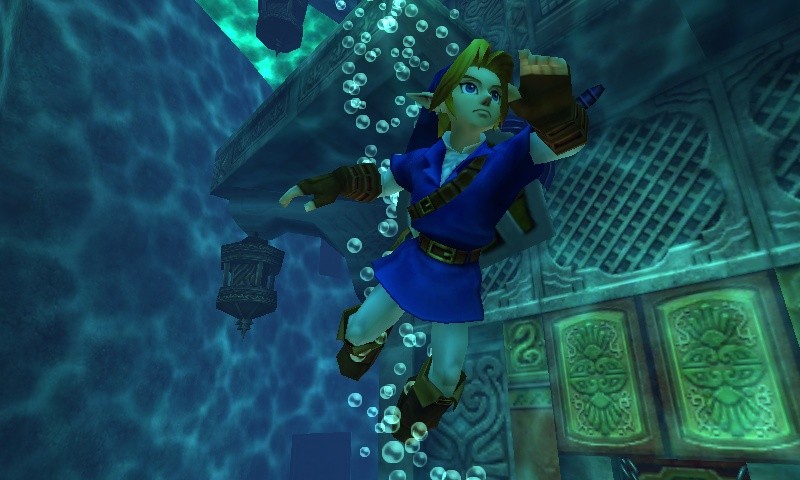
My arc through Ocarina probably matches some players’ while being the inverse of a great many others’. The whole child Link section is inoffensive. I can’t really name anything that annoyed me besides the lack of tools limiting what you can do. Once Link grew up, I began to get a little concerned. The Forest Temple had me stuck for longer than I’d like criss-crossing rooms to find the way through. The Fire Temple was even worse with that, and the dreaded Water Temple, even with the 3DS changes, was maddening. What all these have in common is an open-ended design where Link can go down any number of paths across multiple floors. I lost count of the number of times I used a small key on a door, only to find a second locked door immediately after it. Time to go back and scrounge around again! I was almost always able to get back on track myself, but the constant halting of momentum made these dungeons a real challenge for a first-time player.
 This was back when people cared about the 3D mode on the 3DS... it's pretty dang nice.
The Spirit and Shadow Temples, though, abandon this design. They’re largely built on a linear track, so you only have to worry about one thing at a time. And for me, it doesn’t come at the cost of good puzzles. With the pacing of these dungeons so tight, I strongly felt the pull of adventure the designers hoped for. A lot of Zelda players prefer the nonlinear, messier design of the earlier temples. I can understand that, but I think that works better in the 2D games. In 3D, navigating so much space can be arduous, and I prefer having a guiding hand in that case. For what it’s worth, Nintendo seems to agree: 3D Zeldas after the N64 largely hew to the more linear style. Heck, in Wind Waker, I don’t think you ever hold more than one key at a time. And despite the memorable set pieces in Twilight Princess and Skyward Sword, the path through those dungeons is largely predetermined. When the recent Zeldas returned to open-ended dungeons, they wisely allowed you to complete objectives in any order.
After that high note, Ocarina capped off with an appropriately epic and thrilling finale. I rarely engaged with side content, so my Link was far from as powerful as he could have been. I’m kind of glad for that. I hit the sweet spot for Ganondorf to be a threat, yet wholly manageable. The climax is one area that still holds up against any of Ocarina’s sequels. So, my mood was at a high at this point, and I enjoyed the credits roll that shows everyone celebrating. I was glad to cross this off my backlog. Then, the 3DS remake credits kicked in. For the first time, the music breaks from the N64 sound library for a gorgeous orchestral rendition of the main Zelda theme, which had been cruelly denied to us the whole game. As dumb as I feel saying this, I was holding back tears on a random Monday afternoon. But I had this exact reaction to the end of Skyward Sword, a not-as-good video game, so they clearly know which buttons to press. It may surprise you to hear that I’m not that interested in the new Zelda game releasing this month. After praising the franchise’s airtight design formula, Minecraft-building around obstacles doesn’t excite me. “You liked it in Tears of the Kingdom!” I guess that’s another thing that hits different in 3D versus 2D. You’ll have to let me know if I’m overreacting.
Am I Truly A Live?
One last ‘90s product to examine here, and it’s one I was looking forward to finally playing. The pitch for Live A Live should instantly cement it as an all-time favorite. A 16-bit RPG taking place over a variety of time periods and genres! A historical predecessor of Chrono Trigger, which really is that good! A Yoko Shimomura soundtrack, for crying out loud! I finished Live A Live shortly before the original’s 30th anniversary, a complete coincidence. Of course, we’re talking about the remake for the Nintendo Switch, here. HD-2D is my fetish.
 The prehistoric chapter is told in pantomime; creative, but a strange impression if you pick it first like I did.
At the start of Live A Live, you play through seven distinct chapters in any order. Chronologically, they are Caveman, Chinese Martial Arts Shifu, Shinobi, Cowboy, Street Fighter, Mecha Anime Boy, and Robot on a Spaceship. Each is different in structure, with a varying amount of how much RPG you want in your JRPG. The robot’s chapter, for instance, has no combat, whereas the fighter is nothing but. No matter your choice, battles take place on a chessboard-type grid, with each available attack having a particular area of effect. Elemental weaknesses and status effects are in play too, of course. In this first phase of the game, Live A Live’s unconventional choices have benefits. Each chapter is between one and three hours, so it’s very easy to build play sessions around them. And with the knowledge that everything resets with the next character, there’s less stress about playing optimally.
The problem for me is that no one chapter stands out as a great story on its own. As you read the list, you probably held an image of each genre in your mind. Live A Live works strictly inside the lines of those archetypal stories, and in doing so misses opportunities. The moody cowboy defending a town from bandits is just that, and the shinobi and fighter are similarly one-note. The wise old martial artist is going to behave exactly as you’d expect if you have any experience with these stories. I will relent for the chapters set in the future: I did have a few moments of surprise there, but maybe that’s because I haven’t seen enough anime to know if melting a turtle and pouring it into a robot is weird or not. When the game was created, simply having a JRPG in these settings was novel enough. 30 years later, it’s hard to hold onto those seven characters beyond their barest elements.
 You can't mention Live A Live without Megalomania, the absolute BANGER of a boss theme.
I also thought this game would be funnier? Most of the jokes are "caveman horny." There's a running gag between the chapters of a boy watching his father die? And while the blocking and timing indicate it's supposed to be funny, they just play it straight?? There are times when the game goes for dark and it really works, but I don't know what they were thinking there.
Ah, but surely you didn’t expect that to be it? Of course there’s a hidden eighth chapter! And this is where the best and worst of Live A Live resides. From a story perspective, the Middle Ages chapter is far and away the best one. No longer bound by novelty, the writers are able to play with a setting that had been thoroughly covered by RPGs for over a decade at that point. The result is a straightforward adventure that turns into a Shakespearean tragedy worthy of the thees and thous in its dialogue. By the end, I was sympathetic for all sides of the conflict, while acknowledging that some folks may have gone a little far in a few places.
From a gameplay standpoint, this is where Live A Live starts to buckle. The first half of the chapter is great. You have a party of old-school-meets-new-school, and you’re kicking ass left and right. Midway through, that gets taken away from you, and you’re struggling against enemies that were once no problem at all. It’s an effective linking of story and gameplay, but it isn’t exactly fun. You also go to all the same places you already went to, now with harder foes and no backup. Live A Live does not use random encounters until this chapter, and their introduction feels like a rude awakening. I’ve been spoiled by RPGs where you can turn them off - here, there is no such luxury, and the interruption is frequent. On the whole, though, it’s manageable. You realize the end of the story and it’s all good, right?
 The HD2D graphics are appealing... but I hate to say, it looks a little muddy on the Switch.
Well, no. The seven previous characters then get pulled into the Middle Ages. Now the real game begins as you find them and get strong enough to take on the ultimate evil. Technically, this last section can take as long or as little as you like. But your strongest guy is likely to be only level 10 or so. Each character is found in a different location, so you’re retreading the same ground for a third time, now. Plus, you’re still dealing with random encounters that aren’t really challenging, but tanky enough to drag on and on. The Live A Live main theme song isn’t that memorable, but it’s used as the battle theme for this section, so it’s etched into my brain. By this point, the battle system has become flat, with little reason not to spam your most powerful attacks. There was much more I could do to make the final boss a pushover, but by that point I was truly sick of fighting, so I struggled through many attempts until I took him down after much pain. But the game didn’t like that I did that, so it gave me a crappy ending.
Okay, the gameplay falls apart, but is it worth watching the story on YouTube? I don’t know, man, I just see more missed opportunities. The biggest is how the folks pulled from all corners of time hardly interact at all. They may have something to say when they join the party, but because you can get them in any order, there’s no real development between them. Not that there’s much to work with for most of the protagonists. In hindsight, I would completely rearrange the structure of this game. Start with the subversive Middle Ages chapter, then move between the various time periods linearly to build momentum. Aaaaand I’m kind of describing Chrono Trigger, aren’t I? As I said, there are advantages to Live A Live’s structure, but the drawbacks are just as heavy. None of the good guys really understand the context and consequences of what they’re participating in by the end.
While it was officially hidden from non-Japanese audiences for decades, I still think Live A Live is an important step in RPG history, and to achieve that it needed to be as experimental as possible. In the moment, it didn’t pay off, but looking back you can trace a lot of the genre’s evolution to it. It’s possibly more influential than my beloved EarthBound, which released less than a week earlier. So, cheers to you, Live A Live. I just don’t think I’ll ever play you again.
Finally, The Beginning
I snagged Atarti 50: The Anniversary Celebration on sale the other day. Like with the Llamasoft collection earlier this year, it’s full of fascinating history, great interviews from notable figures, and a bunch of old games I don’t want to play. I would put money on the vast majority of owners never playing any one of these emulations for longer than three minutes. No one is denying the importance of the Atari era, but no one is going to bat for the playability 40+ years later. To bring it back, that train of thought led me to a question: Will people similarly move on from retro games of the ‘80s and ‘90s? It’s already started to happen, to some extent, but the loudest voices in gaming still revere that era. The kids playing Atari probably grew up and got new hobbies… you and I didn’t. I play a lot more old games than the average person my age, and while some really are that good, it’s becoming the exception more than the rule. Ultimately, it’s a personal preference. There are still people playing and developing for the 2600, as Atari is eager to tell you. I’m just curious what “retro” looks like in another 10 years. And I’m totally pumped to wallow in Astro Bot’s nostalgia, so I’m a big hypocrite.
Thanks for reading, I didn’t exactly stick to the definition of “quick” this time. But if you’re on this website, you love when that happens!