
Exploration in gaming - Outer Wilds and Breath of the Wild
I have no clue whether I'm alone in this, but as a five or six-year-old child, games were incredibly mysterious to me. I remember playing Ocarina of Time with a friend and us stumbling our way through. I permanently handed over the controller after seeing and, more importantly, hearing the ReDead for the first time. I had no clue what I was doing and my friend only had a vague sense of what to...
I have no clue whether I'm alone in this, but as a five or six-year-old child, games were incredibly mysterious to me. I remember playing Ocarina of Time with a friend and us stumbling our way through. I permanently handed over the controller after seeing and, more importantly, hearing the ReDead for the first time. I had no clue what I was doing and my friend only had a vague sense of what to do, because he had watched his older brother play through the game before. In Pokémon Red, I got stuck in the dark cave on the path to Lavender Town. I had no clue that I could use Flash to light my way or an escape rope to get out, and promptly got so stuck that I could neither find the exit nor entrance. The thing that makes my early gaming experiences so strange is the fact that my native language isn't English. I couldn't read or understand most of what was said in games. This meant games were like magic to me. They all offered these mysterious worlds which I couldn't fully grasp. Worlds seemingly without limitation. I had to poke and prod at everything simply to progress and see a bit more. It felt almost overwhelming at times. Like there was simply too much to learn. This feeling quickly got lost as I, in part thanks to games, rapidly improved at English and learned more about the technical and non-technical limitations that games have. I've rarely had that same experience of mystery or intrigue since those days. I tried to find it in games that focus on exploration, but it never invoked that feeling and I walked away from those attempts thinking that exploration really just isn't my thing. Recently a few games have made me doubt that conclusion. That's made me want to write about how I look at exploration in games, and later on more specifically about Breath of the Wild and Outer Wilds.
Let's rewind a bit and take a look at how exploration played a role in certain types of games from the past. First of all, I want to go back to arcade games and early-ish console games. At this point in gaming history, the length of games arguably played a more important role than it does now. In order to make a profit, arcade games had to limit the amount of time players received with each life/continue. Short lives on their own didn't mean much if the game had no longevity to it, so they also had to maximize the total amount of time a player could potentially spend on the game. Especially the latter was no easy feat considering how limited arcade games usually were content-wise. There really was only one obvious and surefire way to achieve both at the same time. Increasing the difficulty. It both makes players die faster and causes players to need more time to beat the game, which meant more money. Ok, there was also the option to make a multiplayer-focused game, but we can ignore that for this post. Console games ran into the same issue, though for different reasons. It was hard to justify the cost of games, especially for genres that naturally led to less complex and shorter games. If a child (or their parent) can pick between a game that takes dozens of hours versus one they can finish in one sitting, why would they ever go for the latter? Difficulty was still an often employed solution in this case.
 Prince of Persia (SNES) is just one example of a game that you would never be able to beat on the first attempt
There were, of course, many ways to increase the difficulty of a game. Keeping in mind that this post is about exploration, I want to specifically talk about the "knowledge barriers" or trial-and-error gameplay we sometimes saw in games. This was mostly a thing in (action-)platformers, a genre that most definitely leads to naturally shorter games. Sometimes developers would add situations/encounters to their game that couldn't really be beaten unless you knew they were coming. Think Raiders of the Lost Ark, only Indy gets crushed by the boulder nine times out of ten. Blind jumps, crazy attack patterns, unfair enemy placement... Things you couldn't realistically prepare for, realistically beat on your first try and involved mostly sheer luck or knowledge rather than skill. I don't take the term "knowledge barrier" literally, otherwise many things could be considered such barriers. For example, the completely bonkers solutions in adventure games, also known as moon logic, would also fit that particular bill. In this case, I specifically mean knowledge you could only obtain after losing to something at least once. It might be a bit of a stretch, but I consider these knowledge barriers a form of exploration. I also consider it a form of bad game design, but thankfully games have come a long way since then, which is why it's now mostly relegated to Mario Maker levels.
As you've probably deduced from the intro, I haven't personally experienced the heyday of the arcade. Not that it would've mattered much, because arcades were never a big thing in my country. I was also too young to experience the days of the NES and SNES I did go back and play some of the classics. Classics like the original Zelda, which I played and finished some 25 years after release. This game fits the standard definition of exploration much better than the platformer example I gave above. What impressed me most after playing it is how anyone ever finished that game without the internet. As someone who grew up in a more modern era of games, that game was impossible for me. I didn't have the patience to bomb every nook and cranny for possible hidden entrances. It's actually quite similar to my experiences as a child where poking and prodding was literally the only option I had, only it was more so a chore than mysterious or intriguing to me now. I didn't want to figure out everything myself without as much as a hint. Where do I need to go? Why is my map so useless? What happened to Ganon's dorf? So, I did the only logical thing when faced with a challenge in a video game... I looked up a guide and followed it step by step.
 Cool, what now?
I wouldn't blame you for thinking that I'm just a spoiled modern-day gamer. Especially after I picked such a lauded and well-known game, which even has exploration as the primary focus, and decided to ignore the main draw of the game by playing it with a guide. I think it's become a common opinion that modern games have ruined exploration. That we've come to expect that games will tell us exactly what to do. That it's now simply a case of opening your map, picking one of the ninety points of interest, and following the flashing arrow if not given the option to fast travel to it instantly. Basically the opposite of exploring. If there's anything hidden it's usually not much more than a voice log or chest placed somewhere off the beaten path, but never too far away. I'll agree that very few modern games get exploration right and that more approachable, streamlined and inclusive game design have caused games to move away from what games like the original Zelda did. Games are now usually designed to be fully experienced by anyone who plays them. What's the point of designing and building something if 90% of the players aren't going to see it or don't know how to get to it? That's a waste of money. With games being more expensive to make than ever, that's a serious waste of money. There is very little trust in players to figure stuff out on their own. This attitude is also a self-fulfilling prophecy. If you always hold the player's hand they will eventually get accustomed to this and indeed be clueless when this is not the case. However, I wouldn't go so far as to call exploration ruined. I would go so far as to say that games never got exploration right in the first place.

The reason I looked up a guide to get through Zelda wasn't that I was spoiled by modern games or because wanted someone to hold my hand... Ok, it might have been part of it. More importantly though, I simply wasn't having fun. The idea of endlessly trying to bomb everything in sight, while enjoyable in Grand Theft Auto, didn't seem like fun here. Exploration is indeed barely a thing nowadays, but I don't think the particular lack of direction that Zelda employed is any better. Zelda almost feels vague for the sake of vagueness, not because it introduces fun exploration. I've seen someone make the argument that Zelda might've been so vague just to sell magazines, those official ones that contain tips of some sort and telephone hotline numbers of some, costly, use. That might be a bit of a stretch, but to me it doesn't seem like an entirely unreasonable hypothesis, which says a lot in and of itself. Of course, this is simply my opinion. Even modern games that many people praise for their sense of exploration don't really do the trick for me, like the Bethesda games, Witcher 3 or even something more obscure like Etrian Odyssey, which has you literally draw your own map. Don't get me wrong, those are some good ass games. Witcher 3 is a strong contender for my favorite game of all time, but did it give me a sense of exploration? Not really. That magical and almost overwhelming sense of intrigue was still something I would only occasionally encounter, mostly in games that simply defy the norm. Pathologic and E.Y.E. Divine Cybermancy pop to mind. Janky, drenched in weirdness, with more mechanics than sense. Games where you never really know what to expect from the setting. However, the fact that exploration, somewhat counterintuitively, never really managed to create this feeling is also what makes Breath of the Wild and Outer Wilds so interesting to me. Both of them praised for their sense of exploration. One of those does work for me, for perhaps the first time ever. The other one doesn't. What gives?
Let's start with Zelda. Breath of the Wild feels like a Zelda game from an alternate universe. What if Ocarina of Time wasn't a 3D version of Link to the Past, but more based on the original Zelda instead? Breath of the Wild feels like the latest iteration of that Ocarina of Time. It's a modern and new interpretation of the very first Zelda, acting as if all the previous 3D entries in the series don't exist. It feels experimental, both in a positive and negative way. I don't want to spend too much time on what I think of Breath of the Wild as a whole, because there are lots of game design choices in BotW that I understand, but don't necessarily agree with. I could write many more paragraphs on just that, but let's focus on the exploration aspect instead. It feels like that is what most people consider BotW's strongest aspect anyway. It's a game without any sense of direction. Total freedom in how you approach the ultimate goal of defeating Ganon. No clear indicators of where you should go. Sounds reminiscent of the original Zelda, doesn't it?
The map in BotW starts out empty, leaving you to scan the horizon yourself in order to discover and mark points of interest. By doing that it does the exact opposite of what every open-world game in recent years has done. And yet, I don't consider that particular aspect of the game important in regards to exploration. It adds a layer to the usual open-world checklist (looking at you, Ubisoft) by making you create the checklist yourself. Does that really make a difference? It's cool at first, sure. However, there are usually several very obvious locations to mark whenever you climb a tower and having to do this process yourself doesn't really add much of value. Of course, this does solve the issue the original Zelda had. The fact that you can scan the horizon and the fact that important stuff sticks out like a sore thumb means it's no longer completely vague. I honestly have a hard time telling if having to do the marking yourself adds anything to the experience. I think my biggest problem with Zelda is simply the lack of variety in what you can find. Finding the thirtieth puzzle room, which always offer the same rather boring reward, or one of the 900 Korok seeds doesn't really feel rewarding. That's not to say that there is nothing of interest to discover in BotW, but I also wouldn't say there's much. The weapon durability system also killed any excitement I might have had at the prospect of finding an awesome sword hidden away somewhere. The familiar open-world game feeling of "oh, another one of those" is still very much there, only this time you simply don't see all of it on your map by default. I rarely felt intrigued by what I found in Zelda, and in that sense, I wouldn't consider Breath of the Wild a good example of rewarding exploration. Luckily, there's more to it.

You see, the thing Breath of the Wild truly excels in, is the movement. Being able to climb everything offers a sense of freedom that no other open-world game can match. This has been echoed by a lot of people and, since I don't even think highly of the game in general, it might come as a surprise that I'm repeating it, but Zelda has ruined all other open-world games for me. Always having to think about how to get somewhere and truly feeling like you can go anywhere is really cool. Different areas also offer different challenges when it comes to crossing them. Be it heat, cold, rain or simply the height of a mountain. It doesn't feel like a linear and specifically designed challenge. It feels completely natural. It's just an aspect of the world you're in. How you deal with it is up to you, but you'll have to deal with it because that's how nature works. The only boundaries you'll face are natural ones, you are truly free to go anywhere, and there's enough variety in the environments to make it work. Simply getting somewhere is fun in its own right. This is also what makes the lack of direction work whereas, for me, it didn't in the original Zelda. It's the first game that lives up to the infamous "See that mountain? You can go there" quote without the involvement of horses bred with mountain goats. Your goal is very clear from the get-go and there is no right or wrong way to go about it, you're not just looking for a hidden linear path disguised as an open-world game. It makes any other open-world game feel restrictive and "gamey".
Modern game design has this "look, don't touch" approach which few games dare to diverge from. Even in open-world games, every experience is carefully designed and control is often taken away from you to make that work. There's nothing inherently wrong with that and there are lots of amazing games that do this, but it's nice to see some games move away from it. There's obviously a technical and graphical aspect to this which makes such freedom possible for Breath of the Wild, while most other open-world games, sadly, couldn't achieve something similar or would have to make big sacrifices. On the other hand, the fact that most games couldn't replicate it is what makes Breath of the Wild so remarkable. So maybe it's not a sad thing at all. All in all, Breath of the Wild got one crucial aspect of exploration spectacularly right. It was enough for me to enjoy the game and, at first, the game did invoke that feeling of intrigue. It didn't stick though and I didn't end up loving the game, as it simply didn't feel rewarding enough to me and quickly became repetitive.
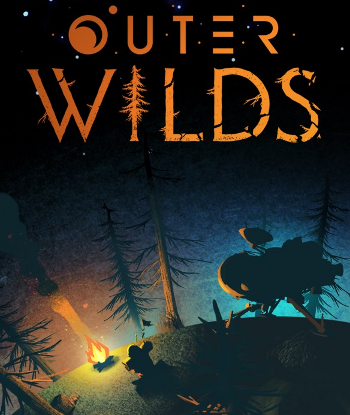
Luckily for us, we also have a game to talk about that gets the other aspect spectacularly right. Outer Wilds was totally not on my radar and at first I confused it for Obsidian's upcoming Outer Worlds... which actually led to some disappointment when I realized that game would take several more months to come out. Outer Wilds is truly something special though, which is something I don't say often. I've never experienced a game that has exploration as the pull, challenge, and reward, ALL AT THE SAME TIME. First, let's give a quick rundown of the game because this title isn't particularly well-known like a Zelda is. So, in Outer Wilds, you play as an alien who's about to have his first space expedition. Many of the tools you have available are based on tech left behind by another alien race. The goal of the expedition is not only to explore nearby planets but also to find out more about this other, more advanced, species. After some quick tutorials, you jump into your ship and the rest is up to you. You can freely choose where you want to go within the solar system, in which order you would like to explore planets, and how exactly you want to go about it. The gameplay itself is actually fairly simple. There are no enemies to defeat and no coins to collect. If you look at the raw gameplay out of context, it's just an occasionally difficult and fairly basic first-person 3D platformer. So, what makes it so special?
I talked about nature and exploration itself being a challenge in Breath of the Wild. This game takes that to a whole different level. Of course, there's still the basic challenge of platforming, just making your way around without overshooting your jump and dying. The platforming itself can be difficult sometimes as it's all about jetpack speed management, fuel management, and properly accounting for gravity. This on its own isn't particularly hard to get right, but mistakes can result in hard punishment. The more interesting challenges are the quirks of each planet. One of the first planets you'll likely visit has a natural occurrence which will, at first, punish you heavily if you don't pay attention to it. Later on, you might find out that it can also be really beneficial to you in multiple ways. You really have to learn your way around each planet and learn you shall. Simple and basic exploration will find you more places of interest, paths, and shortcuts to take. You'll also find logs left behind by the alien race. Sometimes these logs will hint about how to circumvent certain obstacles, refer to potentially useful places on different planets, or inform you about the culture or history of their race. You'll see certain names popping up repeatedly in these logs, which even allows you to get to know these individuals on a personal level. Sometimes you'll find buildings left by these aliens. Potential treasure troves of information that aren't always clearly accessible and often require you to puzzle your way in or, you guessed it, explore some more.
The game keeps track of everything you find and displays it in a very clear and readable overview, though I still found it useful and enjoyable to make my own notes as well. This is the kind of game that really makes you want to write down everything you've discovered. It almost made me dislike that it kept track of everything, because connecting the dots and trying to convey it in a clear way in my notebook was fun on its own. In the end, I wouldn't want to miss it as it does clearly point out when there's more to find somewhere or if you're done. Having this information stops the player from ever feeling completely directionless and streamlines the exploration somewhat. This is what makes it differ from the original Zelda. You're still given complete freedom, but it isn’t anywhere near as vague and aimless.

It also helps that the planets themselves are actually rather small. This means that after some exploration you'll usually have a few clear objectives you'll want to spend more time on. During the exploration process I described above, you really get to know each individual planet and their quirks. Had the planets themselves been bigger, it would've likely become too difficult to keep track of everything. It also means the game keeps up a good tempo and you're not spending ages simply trying to find anything of interest. It's a carefully curated experience while allowing you complete freedom in how you approach it. The game doesn't outstay its welcome, though it can sometimes be frustrating due to finicky controls. An awkward jump can cost you dearly which doesn't mesh well with the controls not feeling entirely great. This also means that the BotW joy of simply going somewhere isn't as present in this game. There's also another thing that did somewhat frustrate me, but I'll get back to that later on. Overall, this is not a perfect game, but the frustrating elements pale in comparison to everything this game gets right.
The thing about this game is... You aren't rewarded with experience points, loot, or gold. The one and only reward is knowledge. And despite that, there's still an incredible sense of progression. You don't become stronger because you hit an arbitrary number on the experience bar and one of your stats went up by one. You become stronger because you can actually put the knowledge you gain to good use. You aren't suddenly more capable than you were before because you found a shiny new tunic, you instead improved by learning, observation, and execution. It even feels like you're doing all of the heavy lifting yourself. You are rarely straight up told how to do something, instead, the game hints at things and you are allowed to connect the dots yourself. This is a game that truly turns knowledge into power. The loop of exploration rewarding you with knowledge to allow for more exploration is brilliant. It's one of the most rewarding feelings I've ever had in a video game to date. At this point, you might think there's very little left to be said about the core of this game, but I've left out one of the primary gameplay mechanics on purpose. Talking about the mechanic has been considered a spoiler by some people, though it's also straight-up mentioned on the store page. Personally, I knew about it before going in and didn't really mind, but I can imagine that finding out yourself is more fun. If you don't know which mechanic I mean and you have gained some interest in the game by reading this, go and experience it for yourself first. If not or if you don't care, read on.
Honestly, knowing what this core mechanic was almost stopped me from getting the game. It has the Groundhog Day element of being forced to repeat a single day until you get it right. Only instead of a day, you have twenty minutes until the sun goes supernova, turning your solar system into a bright blue orb of light and placing you back on your home planet with the clock ticking once more. I have always despised timed elements in games. I hate the pressure it adds. To this day, I refuse to play Majora's Mask because of the time mechanic (also I don't think Ocarina of Time held up all that well, which means I'll likely think the same of Majora, but I know I'm in the minority on that one). Strangely enough, this mechanic is what glues everything together. It doesn't just give you an end goal and an overarching mystery to solve. It's also the reason why you need to learn, why even basic knowledge is so powerful.
You need to become faster at traversing the planets, otherwise you won't make it to hard-to-reach locations, which in turn makes finding shortcuts and new paths so rewarding. This is what reminds me of old arcade games. Always starting from the beginning, learning as you go, getting better at the execution all the time, learning tricks and getting slightly further each time as you break another knowledge barrier. But it's also managed to, mostly, prevent the downfalls of such a run based system. You are rarely completely repeating the same steps. There are so many ways to change and optimize your routes that it doesn't get boring. Arcade games often had massive difficulty spikes, resulting in you wasting time by having to repeat the easy part before getting another go at the difficult part. There were a couple of times in this game where I died due to silly mistakes, which the finicky controls often contribute to, very shortly after reaching a planet. That's definitely a frustrating result of this time mechanic, but the positives it brings are worth it. Given how harsh I normally am to games that have any kind of time pressure, that's really saying something.
This game feels like a whole new approach to exploration and yet, if we look at all the mechanics separately, it doesn't really do anything new. It simply dares to do what modern games tend to avoid. It isn't afraid of being too short and doesn't add difficulty for the sake of lengthening the game. It gives enough direction to avoid the player being completely lost, but doesn't take away control. It offers limited, but hand-crafted and well-made content instead of offering you tons of cookie cutter planets or hundreds of points of interest which rarely live up to their name. By doing that, it delivers something that's actually worth exploring. Quality over quantity. It manages to create that sense of mystery, of constantly wanting to know more and feeling overwhelmed at first. Like I mentioned before, I've always thought that I just didn't care much for exploration, and Outer Wilds has proved me wrong.
It does what Return of the Obra Dinn did last year. It's just one of those games that, despite its faults, feels completely refreshing. After so many years of playing so many games, I'm just glad that there is still room for that. Games that show that there is still so much remaining potential and that experimentation can pay off in a big way.