
Might and Magic X — An Fitting End? Part Three - The 3DO Era
Notes:
- I made a mistake, there is not Heretic of Might and Magic, instead, what we had was Warriors of Might and Magic, which as far my memory goes, it was exclusive to 3DO or maybe just console only.
- I mostly like focus on the general aspects of the series during this period, commenting on visual, “rule set” (mechanics) instead of covering the plot of the games in detail. Again, the games during this period still high playable and there is even some nice mods out there.
Nature of the World - II
With MM VI we not just enter the 3DO era, but the moment which MM games moved from the grid toward “full 3D” (for contest, during this time, many crpg games are moving toward this and more action design, often dropping party in favor of single character) a transition which isn’t very smooth and a couple problem will crop up. During this period, there will be four games, of which three (MM VI to MM VIII) will use the same engine and sort the same “rule set”, this is also the moment, where HOMM and MM cross paths a lot, but this is also the moment which lot of inconsistency elements pop up. The last game, the infamous MM IX, uses a new engine and sort a new “rule set”.
Now it is important to understand, before we move on : under 3DO thing get difficult for NWC, while themselves believed that they might need between two and three years to really make a good game (either a MM or HOMM), 3DO didn’t care about that at all, at best they give them a year, sometime even less. This mean that NWC never had enough time to proper polish or push their engine. With that said, let’s continue.
When I say the games went full 3D this isn’t the open world game where might expect today, MM world space still organized in much the same way it was on the grid era. You have overland maps, which side by side, compose the whole world. To travel to one map to the other you could either reach its border and the game would tell you that it would take a couple of in game days to get there, or you could use some fast travel, in way of either carriages and ships, which instantly teleport you to a place following a certain schedule.
The world design sort tries to reproduce or follow, HOMM design, as you might find yourself visiting places such as Steadwick, Avlee, Tatalia, Barcada and so on. However, some places really don't match the HOMM representation, Steadwick has no walls, Avlee look like generic elf city, Tatalia, which in HOMM was the town with Lizardman, Gnolls, ect… having a swamp theme, somehow is just a human town with some snow in the north and a few swamps in the south. Meanwhile, Barcada is a city floating in the sky.
This is the moment, where both in plot and design, while MM and HOMM follow close together, with entire story arch happening either before or after one game or another, but this is also the point where things also get or fell very inconstant, sometimes they try to fix that with a spin off or in one of the sequels for HOMM, but unless you have played them you might don’t know.
This also extend itself to enemies you face, which sometimes, are akin to HOMM design, but other times they, don’t match it at all and other make very little sense.
Weight of Time
The question of how much something did or did not age well, is often the first thing we think about 3D, which is complicated question — because it is too easy to fall on “false necessity” mindset and simple assume everything which isn’t the current top is “too old”. But, 3D sometimes, more than 2D or even earlier 3D (specially the 3D gird first person view) can age a lot.
However, I personally think, that while 3D model/asset age faster, the world itself, is less about how exactly is, but how things around work. Let me give an example, if you compare Arena (ES 1) and Daggerfall (ES 2), the graphics itself aren’t that different, what does change, and sometimes make Arena feel much older, it’s to that navigate in that world is much harder, due stuff like cities being generated in a bizarre way where they are simple too huge and the map on the game not only does not make shops and normal building different, you have to either have a npc mark it to appear on the map or do it yourself, meaning that simple finding a shop can become an issue. Daggerfall in other hand, possessed much better generated cities and navigate in them was easier, since stuff like shops, taverns and other begin color different in the map, while simple looking at a building, will mark it on your map.
But what MM? At least between MM VI and MM VIII, the graphic, visual and design of the world itself good, however, the engine is very angular meaning that meshes often feature acute angles. The textures in MM VI are very crisp, but more vivid and colorful, while MM VII textures are more muted and saturated, however they are more uniform, which at time can feel bit bland. MM VIII on the other hand, feature again a more crisp visual and more color. Remember, NWC never had enough time to push or polish really anything thanks to 3DO.
The design of individual spaces (such as towns, dungeons, open spaces, ect…) can feature memorable places, such as, Kriegspire (MMVI), New Sorgipal (MM VI), Harmondale (MM VII), while other might feel bland due textures or design such as the Tunnels of Nighon(MMVIII), Castle Alamos (MMVII), Darkmore (MMVII) or maybe a let down depending on of your expectations (like Regna in MM VIII).
Major part of assets/models, look ok, overall, since they follow HOMM design, the general direction is more toward a standard high fantasy. They don’t change much between games, in fact many would be reused in two ways, often an enemy model would be reused for different variations of the said enemy, sometimes by changing individual details or some colors, other times what did was reuse the whole model but with entire new color in an overlay effect. As example, in MM VII you have Rats (which are gray) and its variations, which the same model but the colors changed to purple or green.
Talking about assets and models, MM 6 to MM 8, alongside the animated avatars, it also featured paper dolls for the party members, which you drop gear to equip them, it was a nice feature, as some armor and weapons did look excellent, however, sometimes, they don’t appear to match the paper doll really well.
The paper doll themselves are good, they were fairly simple in MM6 but in MM7 and MM8, they are 3d models, however the MM7 does look better than MM8, as the later feature some strange colors and the model itself look a bit strange for some characters. Also is worth mention, the npc portraits are actual photos in MM6, but from MM7 and foward most where 3d models.
Now, one major change, is that while in the older games, they could leave things for imagination, specially the more sci-fi elements, here they are more literal, which sometimes work, like when in MM VII when you explore the Lincoln Spaceship, which features a very dark sci-fi themes with robots, whose design, isn’t so much different from what you meet in MM 3–5, but with much lesser colors. Others look out of place, like in MM VI, where you visit the Tomb of Varn, which have its outside looking like a Mayan Pyramid, while the interior looks like an Egyptian pyramid, some enemies there are the Defender of Varn (and its variation, Sentinel and Guardian) an Anubis like figures which look straight from Stargate.
Rules of Engagement
One of the major struggle the games during this period face is they sort try to have MM massed combat again, which isn’t itself a bad idea, however get the whole “party vs enemies” in early 3D working the same it did on grid is rather trick, there was also the tendency of crpg during this period moving more toward single player action. In the MM games, the result is sort mixed, overall it works fines, but it can get repetitive or fell less strategic. But let me explain the basic of it:
You move in more free 3D first person view and enemies move around freely too, you can either engage them in real time (even attacking them at distance, like Xeen, in fact you will use this a lot), or you can enter a “turn base” mode, where at the end of each turn you can move around a bit (this was introduced in MM7, before that you had to leave turn based mode to move).
Now, this mean that most time you either be using long ranged attacks as mobs approach you or using melee, something you do it over and over again. Spells still crucial, but since now space itself is represented in more literal way, it also introduces an issue, back there, due enemies begin all in one space, area effect spell had their range work at 100%, if a Fire Ball is meant to hit up to six or eight enemies and there is six to eight of them, it will hit all of them.
However, now, you can’t be that sure, meaning that area of effect spell become sort less reliable and some spell have area of effect so specific, that it make hard use them at all. Since the game never show their actual area of impact, while enemies often are grouped in mobs, is hard to figure exactly how many enemies will be hit, or how much distance you need to keepin order to avoid the spell hit your own party.
Outside of spells, you have no other mean of facing mobs, outside of single melee (or long range) attack against a single enemy (you still have the concept of attack per round, however these are all used in a single enemy).
Which mean you keep attacking over and over again, something which can get old fast, but thanks to a sort of balance, between how your party grows powerful and enemies most of the time don’t have inflated HPs, this is sort avoid most of the time. However, there are moment when problems rise, specially the end of MM6, where you can only use Ancient Weapons against the Kreegans which have inflated HP and number beyond counting or the end of MM8, inside Escaton tower, this happens again as you face several Crystal Guardians and Planes and Chaos Overlords, which also have tons of HP or the Nighon Tunnel on MM7 is also another moment, as there are tons of enemies there and again, with lots of HP.
Another issue that arises, is that during 3DO era, due everything begin a 3D model, which isn’t easy or cheap do to, you sort have fewer variations of enemies (Xeen had fixed encounter but featured tons of sprites for enemies), what you have is the same model recolored with different stats, which means that, per example, during the exploration of the Dwarven Borrows in MM7, you face just Rats, Bats and Skeletons, over and over again, maybe in some different colors, but the same thing.
There is an old joke about how a dungeon with bugbears in one room and orcs in other make not much sense, and that sort true… but it also misses the point that an entire dungeon with the same enemies risk it became tedious, unless you have some means to keep it fresh, however, 3DO era games, don’t have that luxury and that sort becomes a problem as time passes, as it all it could do is have a room full of enemies over and over again.
Another issue, is that face lots of enemies in real time had the weird side effect of making any enemy which cast spells, suddenly becoming way more dangerous, simple by the fact that you will be hit over and over again in maybe causing you to be overwhelmed, this is the reason why people often dislike Castle Alamo in MM6, where simple walk around mean get hit by lots of spells all at once.
Music
Probably one of the most memorable aspect of MM games this period, it is the soundtrack, it is so good, that at times if feel carries the games around and is part of the charm. As often soundtrack for video game it is very non-intrusive, I mean, really non-intrusive, to a point where it can dangerously feel almost bland, but it does feel very different from average score for a fantasy crpg, begin soothing and peaceful at times.
Now, the other sounds are a mixed bag, most of them work well, expect ion maybe begin the infamous fanfare that plays every time you enter in turn base mode, get ready to have it play over and over and over again.
The voice work is ok, when you create a character you can choose a voice, many npcs are voiced too. Most sound fine, but some line delivery can either feel very weird or at best dorky, such as npc making Star Trek references, other feel strange, such as shopkeepers which insult you if you have a lot of money but don’t buy anything.
With that all done, lets at last talk about games:, to keep things short, I mostly talk a bit about the plot and how characer creation and other mechanics around worked.
Might and Magic VI: The Mandate of Heaven

Like I said, earlier, MM6 to MM8 would feature around the same “rule set” with some small changes between each game. From this point on, parties would be reduced to four character, only growing to five in MM8.
You would have the classic atributtes (Might, Endurance, Luck, Personality, Intellect, Accuracy), but in MM6, there was only one race of character, humans, and only a six classes — Knight, Paladin, Archer, Cleric, Sorcerer and Druid.
Back from MM2, is the concept of promotion, now each class would have two levels of promotion, Knights, as example could get promoted first to Cavalier and later to Champions. Each promotion would require a special quest and would increase some stats of the character.
New to this trilogy, is the addition of skills: in MM6, each class have access to certain skills, either weapons (Sword, Axe, Bow, Dagger, Spear, Mace and Blaster), armor (Shield, Plate, Leather or Mail), elemental magic (Fire, Air, Earth, Water), clerical magic (Body, Spirit, Mind), and the spell of light and dark. However, all classes have access to all miscellaneous skills (disarm trap, merchant, mediation, identify item and others).
It would go some like this:
Knights (All weapons and all armor), Archers (All weapons, Chain, Leather and elemental magic), Paladins (All weapons, armor and clerical magic skills), Clerics (Mace, Staff, Bow, Shield, Plate and Chain and all clerical magic skills, alongside with Light and Dark magic skills), Sorceror (Bow, Staff, Dagger, Leather, all elemental magic and Light and Dark), Druids (Staff, Dagger, Bow, Leather, all cleric and elemental magic).
To improve your skills you would spend points, which you gain when you level up, when you got enough you can find a skills trainer and promote first to Expert and later to Master.

Now this trick part for MM6, the npc which would train you were scattered over the world and the game didn't record it, so you had to do it by hand. Also, the actual requirement for upgrade, could change, weapons often require the skill begin at level 7 for master, but magic would require 12. To make things even more confusing, certain skills might require attributes at certain level or even perform a quest. Remember the game don't record, so you had to not only knew where the npcs are but the requirement too.
While you might wander, why exactly this game have the subtitle of “Mandate of Heaven”, unlikely other subtitles in game, this one make sense. You see, Enroth is facing several disasters, the first being nothing else that the Kreegan invasion, at this time however they where less “demons” and more insect like aliens, even featuring a hive mind. They kidnap King Roland Ironfist (yeah, the same guy from HOMM 2, which the son of the main knight leader in HOMM 1), leaving only his child Nicolai in the throne, while his mother, Catherine is busy in her own kingdom, Erathia.
Alongside the Kreegan came a vast array of problem plus an apocalyptic cult, the Cult of Baa, which start to preach around the idea that the Ironfist have lost the “Mandate of Heaven” to sow unrest and rebellion.
Your party had just survived one of the Kreegan attacks which destroy your hometown of Sweetwater, thanks to Falagar (also a character from HOMM 1 and 2), he trains your party until they can set out and uncover what is going on. Your adventures will lead to a lot of places, even meeting some old faces, such as Archibald (from HOMM 2), visiting a computer and then destroying the Kreegan colony.
For many people this is the highest point during the 3DO era, while later games would feature a couple of polished aspects, MM6 was the best. Now, I have to confess, that I played them out of order, back there when the game was released could never found MM6 where I live, so I skipped to MM7 and MM8, only later via GOG that I could play it. while I enjoyed when I played, I did feel fatigue from the combat system towards the end.
Might and Magic VII: For Blood and Honor
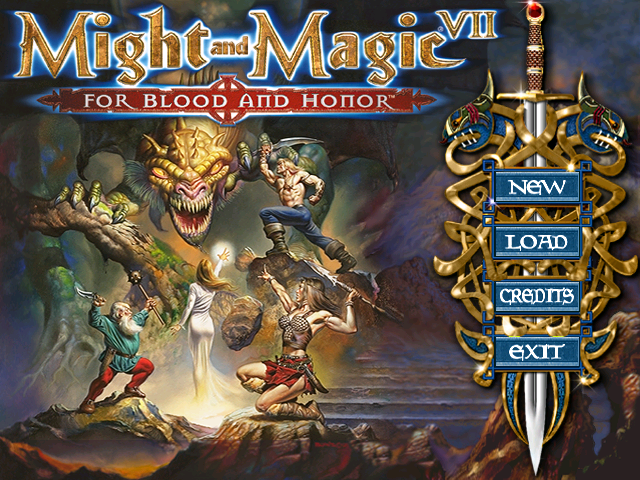
While MM6 title made sense, this one is does not make. The plot start in a curious way, first you see eight mysterious figures emerging from the sea, but once they got on the shore they have a fight and split up, as the event is narrated by both a group of goblins under Archibald and some elves under Gavin Magnus.
After this you have Lord Markham doing a scavenger hunt on Emerald Island, the winner become the lord of Harmondale, if you think this sound suspicious, because it is. This is also the literal tutorial island.
Once your party become lords of Harmondale, not only you have to restore it (much like you did in New Castle in Xeen), but slowly uncover a mysterious plot unfolding in Erathia. There will be a lot of famous characters showing up, from Catherine, Archibald, Roland (which at least is rescued) and couple other… including that group I mentioned, they were nothing else that the default party from MM3! (you might remember way back I told that the MM3 party is composed of six characters, so you wonder how are this extra two figures: They are meant to be hirelings).
While MM6 plot is pretty linear, MM7, does have more choices, even if an illusion of it, as things unfold, you have to choose a side in an unfolding conflict. The actual effect of said branch are quite limited, but for a game that like had at best a year of development, it does work, this along with some changes made to character creation and promotions, giving the game lot of replay value, as you can experiment some class combinations in different paths.
There was two different endings, on the Good ending, your party build a gate from which they can contact the Ancients again and even meet Corak, well not to THE Corak, but another one. On the Evil ending, your party build the “Heavenly Forge”, a device of the Ancients, which allow the evil side to arm themselves with futuristic weapons. For a short while, this was the canon ending, until the whole “Forge Town” incident.
In MM7 the character creation was expanded, there are now four races: Humans, Elves, Goblins and Dwarves and three new classes — Thieves, Monks and Rangers.
The promotion quest changed, as the final level is now split, depending on of the choices you make in the plot, as main point you need to either choose Good or Evil path, and the decision would unlock the final promotion. So, again, using a Knight as example, you would promotion to Cavalier and then either Champion (Good) or Black Knight (Evil). Special mention goes to Sorcerers, which would first become Wizard and them, either Archmages (Good) or Lichs (Evil). Yeah, you could become a Lich in MM7, it was pretty cool.
There was also new skills, such as Unarmed and Dodge skills and old one got reshuffled around, while a whole new level of expertise, Grandmaster was added… This is it point where some issues happen:
While all classes in MM6, could learn their skills at maximum level, in MM7, they introduced the concept, that classes not only would have their own skill selection, but the maximum level they could be learned was different for each class, as example, only Knights could learn Sword at Grandmaster level, Thieves and Paladins would be limited at Master, while, Archers, Monks and Ranger can only reach limited to Expert. This restriction were extended to miscellaneous skills too.

This made classes feel more unique but also introduced some problems, as some classes might have access to skills at such limited level, that sort made pointless to even acquire it, like — Thieves could learn only the Basic level for Air, Fire, Water and Earth magic spells, which open the question, why you even bother to do that?
But the worst case was Disarm Trap, which without you risk dying by simple trying to open a chest or simple being unable to open it, of all the classes, only Thieves could learn it at Grandmaster, beside them, only the evil path promotion for Monk, Ninja, could learn at Master. Everybody else either didn’t have access or where limited to Expert. This means, you have not many options but have a Thief, unless you go in the evil path and had a Ninja. But even if you do this, without Grandmaster level, you could die by opening a chest. Now, there are some ways around as a spell for the Earth school of magic would allow you to open chests at distances, but still…
Also, while the game feature promotions for either Good or Evil, the classes themselves don’t change at all. Champions and Black Knight are identical, as many other, the exception, was that evil Paladins, Clerics and Sorcerers got access do Dark Magic (while the good ones got the Light magic) the only classes which felt slight different, is the already mentioned Monk, which in the evil path, got access to Disarm Trap but in the good promotion (Master), only allow you to learn cleric magic at Expert level.
However on the good side, skill trainer npcs where better spread around and now the game register where they are so you don’t need to keep manual notes.
Between the expended character creation and the two paths the story could unfold, combined with the more uniform design and colors, make for a very good game, even if at times, it appears to lack the crisp and vivid colors of MM6 or some of it design.
Might and Magic VIII — Day of the Destroyer.

Now we are approaching the end of the 3DO era, MM VIII was also released in a tight schedule, but still manage to be a good game. The Ancients, maybe in a zero tolerance police, decided that every planet that was infested by Kreegans should be destroyed and so they send Escaton, to unleash the end of the world.
But, if you played HOMM 3 and it sequels, plus previous MM6 and MM7, you might rightly make a case of the Kreegans already being defeated and you will be most correct...Not that the Ancient cared about that, they still follow the doomsday protocol to the letter no matter what, and here is a missed opportunity, but I talk about this latter.
Anyway, Escaton arrives in Jadame (a continent in Antagarich) where he summons a crystal tower, from which he releases several natural disaster upon the land. Your character (which the game call “Hero of Jadame”) emerge during this chaos and soon is tasked by the Dark Elves to find and contact the five major factions of Jadame and make alliance with three of them to counter the disasters.
Here is when MM8 shines, because while the choices in MM7 can feel a bit hollow, here you do have more choices with a more sense of trade off, because some factions are enemies of others and you have to choose one You have Dragons and the Dragon Hunters (led by no one else that Quixote, a npc from MM7) and Priest of the Sun vs Necromancers (lead by Sandro, a classic character from HOMM). To be fair, while picking up a side, might mean not get the other, you still have a party composed of characters from conflicting factions, like a Knight and a Dragon, or have a Priest of the Sun and a Lich at the same time, despite picking one side or the other. If memory didn’t fail me, I think that shops in the Dragon Hunter camp might be closed to you, if you choose the Dragons, but I could be wrong.
Problem is that the plot, despite these choices can feel like it does not really react to you. Escaton appear, summon the tower and cause the disaster in the start of the game, but that is it. From this point on, he does not confront you at any moment nor tries to interact with you, even while your party slowly disrupt his plans. He just stands there, until the final moments. It is implied he didn’t mean or wish to do what he was doing, but you only learn this at the final moments. Also, the aspect of the Ancient, which were often portraited as good figures, going in a different direction isn't explored at all.
On character creation is where MM8 change things a lot — first, here instead of creating a party you create a main character and could recruit characters, also the party got expanded to five slots.
Also, here you outside of Humans, which could only be Knights, Clerics and Necromancers (it is a sorcerer which already have access do Dark magic), you have Monster Races/Classes: Minotaurs, Trolls, Vampires and Dragons (which aren’t available in the character creation).
Now, most of them, sort fill already existent roles of older classes, such as Dark Elves, which are sort a mix between Archer and Thieves, Minotaurs which are between Paladins and Rangers, Vampires and Trolls are slight hard to pinpoint however, while Dragons are simple broken, but not in a bad way (we will talk about this later).
The promotion quest got now reduced to a single promotion and there is now Good or Evil side, so now Knights go straight to Champion, while Necromancer become Lichs.
The skills didn’t change much, there is some small addition, such as Regeneration, a skill which only Trolls could learn at Grand Master, while Vampires, Dark Elves and Dragons, had access to their own unique skill, which represent their unique abilities (as example, Dragons at their basic level of their skills, got gain the ability cause fear, at Expert they got a fire breath attack, Master they can fly and at Grandmaster they can push enemies way with their wing). The only other notable change was that for some reason, Clerics can no longer learn Mace at Grandmaster level.

Now, does the change on party system work? Well, it complicated, while you have a main character and can change party members, this isn’t like other game of the same period, such as Baldur’s Gate, here you don’t have any conflict or complex rules to get the party together, like I said, you can still recruit a Lich to your party, despite have done the quest for the Priest of the Sun. However, this does not mean I think they should copy that Baldur´s Gate concept, I confess not begin a big fan, due the whole thing feel a bit restrictive at times often requiring you to check walkthroughs and guide just to figure which party member can work or not.
Also, the freedom of the party system does allow you to explore around more — as you can try to recruit a powerful character early on to speed things or pass some difficult part up or just to try someone else abilities. In fact, one of the fun things of MM8, was trying to get a Dragon to your party as soon as possible, and if you know where to look, the game get a lot easier and even better. Once you got a Dragon and manage to train it to reach Master level in Dragon skill, you get access to fly at will, which made the game much more fun to explore, as you might don't need a Sorcerer.
While the plot feel static at times and despite some last minute suggestion of something bigger happen in the future, as Escaton send some mechanical spider to tell the Ancients that he failed, MM8 feel mixed, in one hand feel more vivid and dynamic, with the alliance quest, the new races look great. But what I think leave this mixed feeling is that this is the end in more than one way.
In one hand, this will be the last game in Enroth and all your effort to save it are throw out the windows with the decision by the developers to destroy the world anyway in HOMM 4, so playing feel weird, like everything is about this eminent day of destruction but... even if you save the say and Escaton leaves some last minute hints, it all fell pointless or not so dangerous.
In the other is the last game of this trilogy too and the last one using this engine. But there is one more game... If you read up to this point, you might wonder: What about MM9?
So…
Might and Magic IX: Writ of Fate

This is a game kind hard to talk about because in the surface, while it is the worst MM game, featuring terrible design, pace, etc…it might look easy, almost fun to talk about… until you know the story behind…
You see, originally, MM IX was meant to be a sort “reboot” for the series, if would ditch (or that was largely implied) the old mix of fantasy and sci-fi, for a more traditional western fantasy, specially viking/norse themes. Meaning the series was sort giving up it own unique identity/distinction, in a dangerous gamble, since it risk “trying to be new, by becoming like everyone else”, but like any gamble, maybe just maybe, there was a chance that it could work, how knows? Except, that everything that could happen to make things more difficult and reduce the changes of success, did happen…
As 3DO collapsed, they tried hard as they can milk everything they could. The people at NWC maybe had a vision, but 3DO simple won’t give them time or resources to really do anything, forcing the game to be released, in something that the developers themselves could not call a beta (or alpha, I can't remember the exact words).

The result was a disaster, we all know. I won’t enter in details, but had everything you could expect from a rushed game, there is no shortage of videos and texts about. But, just to give an idea, npcs had really weird, “half faces” for textures, meaning, they just had time to draw half of the face texture and then had to simple copy, past and flip it. I might lack the screenshots, but believe in me, it was jarring. Other stuff was sometimes, npc instead of handling you something, they have the item just throw in the ground right beside them. Quests might end abrupt or bizarre way.
World design (and by this I mean, both towns, dungeons, forests, ect…) where very inconsistent, sometimes you can tell they tried to make somewhat “realistic towns”, but sometimes, they simply look strange and off scale, or other they feel like a huge let down, like the game stand in for Asgard, which just look like any other town. Places could only be reached by a single path, which lead to strange sequences, like — there was a place where the player can reach by following a tunnel full of ghosts, later a battle between armies was meant to be fought (off-screen) there, this lead to strange situation, since there is one only way was the tunnel, this meant that the wholes armies went inside? What they did with the ghosts?

The rest? Well, it was bad in a way, that I simply can’t remember almost anything. I played the whole game, and I can’t remember almost single location, everything sort became blur, expect the initial monastery and end dungeon, I had to even look some videos to refresh my memory, only to remember annoying places, such one map you need to do the whole “light and mirror” puzzle, but down to exact degrees.
The visual and design feel trying to be similar to early D&D 3 edition but with a light Celtic/Nordic theme applied over. Gone is the paper dolls, you still choose an avatar for each party member.
Like I said earlier, this was sort a reboot, for the series, despite your work to stop Escaton in MM8, the planet was destroyed anyway, if you remember HOMM and its expansion, there was the Armageddon Blade and another Sword of Frost which aren’t meant to be clashed, and guess what happen? They clash and the world goes boom (this is the main plot of HOMM 4), people have to flee to other worlds, and so we now move to another world.
The plot, was about the Belgarian Hordes invading Chedian, lead by Temur Leng. It upon the player to unite the Jarls to make a stand. But things are not so simple, very late in the game there is an attempt at a twist: you figure that Temur was being manipulated by the game equivalent of Loki, since he was given a “false writ of fate”, once the betrayal is revealed, he joins you as a hireling and you two set out to stop this god. However, due the game problems, you might never ever know this, since you might simply drop it way before.
Similar to what happened in MM8, the plot feel very static, if not frozen, you are just told the Belgarian are coming, but they don’t really do anything you can see, in fact you might spend almost 90% of the game with no idea of what they even look like. The Jarls you have to unite, are not much better, unlike MM8, where you different factions, but you could at least choose sides (like the Dragons or the Dragon Hunters), here you have an X number of Jarls and you need to get them all, despite them having either zero personality or at best single personality trait.
This does not mean, the game tries to have some original moments, in one scene, that happen off-screen, after you united the Jarls, they set out to battle the Belgarian, however, they are betrayed and defeated. For a moment all appear to be lost, however, then one of the most original quest of game happen, which heavily draw on Celtic and Finnish myths, where you must find a cauldron, from where you can bring back to life the defeated army. This all however, sort happen off-screen, I mean you do the quest, bring the Jarls back to life and their army. Once this is done is time to face Temur, there the twist is reveled, and he joins you.
From this point, you must travel to the in-game stand in for Asgard, there you receive a quest to trap the game stand in for Loki inside the Tomb of Thousand Horror (a classic dungeon in the MM universe) and the game ends.
I talked a lot about character creation, how the thing work here? Tip, not very well, now you have four races (humans, half orcs, elves and dwarves), classes now have three promotions, starting with only two (Fighter and Initiate) and form this two breaches out, at the first level of promotion Fighter could become Crusader or Mercenaries, Initiates could become Scholar or Healers. On the final level, as example a Mercenary could either become a Gladiator or an Assassin, and so on.
Spells now are no longer organized in schools, but instead to have access to them you often need one or more magic skills, but also made spell caster feeling identical at times. Talking about skills, what I remember most is that they were more confusing than previous game, due poor UI, I had often to check a guide to see which class can train at each level.
The pace was terrible, but again in a weird way, in one hand the Lithtech Engine, make you moving too fast, but combat often feel really slow due enemies having tons of HP, early one fighter classes appear powerful, but your magic users look useless, in late game the tables appear to turn and now magic classes appear slight better, while fighter fall behind.
In my own experience, with two fighters and two magic users, I found that early one, only my fighters appear to do anything, meaning that my magic users kind sit behind. Later, as I said, magic getter better and now the fighters sit and watch my two magic users keeping castings the same two spells (I think was Meteor Shower and Poison Cloud) over and over and over and over and over again. This made the pace feel even worst, specially in the last dungeon.
With this, the 3DO era close and I mean literally, because 3DO and NWC didn’t survive for much longer. The rights for the franchise would be later sold to Ubisoft once 3DO goes bankrupt.
While I could only play MM9 much later, I remember seeing people talking about the game in an MM forum which I visited (sorry I can't remember the actual name of the place) and the negative feelings toward it (or at best mixed), for me at the time, between all I read about bugs and problems, along with the game becoming more generic, left me with no desire to try it.
Only later, with a community patch I did played, and it is still bad, but in sad way, like you get this glimpses of what it could be, which is I think many people the community feel about the game now.
Links for All the Parts:
Part One: Might and Magic X — An Fitting End? Part One
Part Two: Might and Magic X — An Fitting End? Part Two - The Early Games
Part Three: Might and Magic X — An Fitting End? Part Three - The 3DO Era
Part Four: Might and Magic X - The End (Part 4)