
by gbrading
Many people still have great fondness for point-and-click adventure games. They were once the mainstay of PC gaming, until the first person shooter and role-playing genres took the helm and steered us out into the darker and more sinister waters. But still, the point-and-click has not died the death that many feared it might. In fact, recent years have seen a significant revival in what was once thought to be an unfashionable, out-of-date and essentially limited way of playing games. With titles such as Zach & Wiki: Quest for Barbados Treasure on the Wii, the extended re-release of Broken Sword: The Shadow of the Templars on the DS and Wii, Ceville on the PC, and new iterations of the irrepressible Monkey Island released (and re-released) on multiple platforms, it is clear that the genre is far from dead.
But what did point-and-clicks have that so many games have missed? The answer is somewhat uncertain. What is clear is that no matter how their subject matters differed, they were always quirky, imaginative and fun, never really taking themselves too seriously, even whilst battling evil zombie pirates or solving fiendish puzzles devised by ancient civilisations. If you were to group a selection of modern first person shooters into a room together, you wouldn't equal even a quarter of the life and character which just one cIassic point-and-click adventure manages to deliver.
Here then, in near enough chronological order, are just some of the adventure games which shaped and influenced the entire genre, and continue to have an impact on gaming today.
Showing 1-10 of 23 items

Released in 1976, this is the first text-adventure ever, as well as the first truly interactive fiction game which we might classify an adventure. It inspired Ken and Roberta Williams to begin making their own games with On-Line Systems.

West of House. You are standing in an open field west of a white house, with a boarded front door. There is a small mailbox here. If the previous sentences make no sense to you; you haven't lived.

Written by "The Hitchhiker's Guide to the Galaxy" author Douglas Adams (who also designed a Hitchhiker's text-adventure), Bureaucracy is a hilarious text-adventure where you must convince your bank that you still exist.

One of the most thought-provoking text-adventures, AMFV has very little humour and instead concentrates on telling a deep and highly political story, whilst also abandoning most of the conventional puzzles.

The first adventure game to ever have visual, pictoral graphics. Mystery House marks the beginning of On-Line Systems (later Sierra On-Line) domination of the adventure games market.

Another first from Sierra and the Williams', with the very first adventure game to use coloured graphics to display information. Commands however were still given through text-parser.

The real breadwinner for Sierra and Roberta Williams, King's Quest would go onto to become an extremely long-running series, and is also the first 3D animated adventure title.

The point-and-click interface begins on the Mac with Enchanted Scepters, despite the fact that the game did not use a mouse. Instead, the directional arrows were used to point to objects on screen.

Although Day of the Tentacle is met with greater critical acclaim these days, Maniac Mansion is LucasArts first foray into adventure games, and invented the SCUMM programming lanuage (Script Creation Utility for Maniac Mansion).
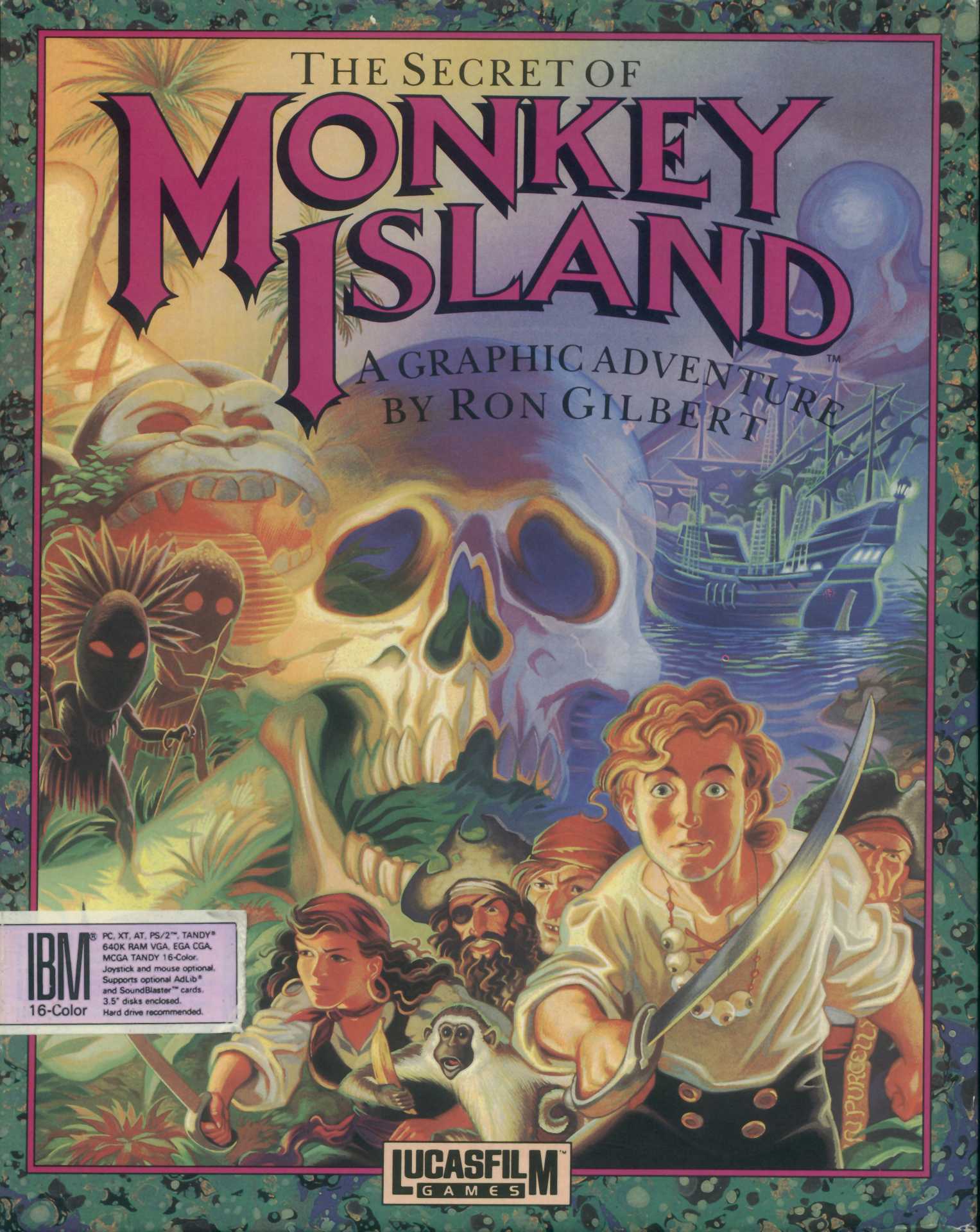
"You fight like a dairy farmer!" There is a good reason Monkey Island became so popular, and it is simply because the games were great. Guybrush Thiftweed (sorry, Threepwood) continues to amuse and delight to this day.