
by vyzndr
Last year, I put together a list of my favourite games released in 2017. This year, I just haven’t had as much of an interest in what’s been released so I haven’t even played ten games from 2018 that would fit that kind of list. So here we have it, every game I played in the past year, regardless of the actual release date!
These aren’t full-blown reviews so I won’t be giving detailed introductions to each game or a summary of their story/premise. This is more just a collection of my thoughts on each game after playing them, ordered from best to worst.
Showing 1-10 of 25 items

This game really surprised me. When I first tried it out, I expected it to be a fun little distraction to scratch my rhythm game itch for a couple of weeks and then I'd be done with it. However, several months on and I'm still tapping away to a song or two every day. Arcaea plays like a touchscreen cross between Chunithm and Sound Voltex, using a second note highway above your regular one in a way that is fairly analogous to Chunithm's infra-red sensor or SDVX's effects knobs. Unlocking songs can be pretty slow at first, using an energy system to traverse through a boardgame-like set of tiles. However, once you're getting onto level 8 and 9 songs (the game currently caps at level 10, with some level 9 songs still beyond my reach for a consistent clear) you'll find yourself wanting to play the same songs often enough that the initial slow progession isn't a problem. Eventually, you'll level up your character to a point where moving through this mode is a lot faster. There are nearly 40 songs available as part of the free set, which is more than enough to decide on whether or not you want to put some money down for more. Song packs are £5 at a time, usually having around 5-6 songs in them. Value-wise that's probably an okay price, but there's always at least one dud song per pack that you probably won't want to play much more of after you clear it. There's also a selection of songs that you can buy individually for £1 each. I think the best praise I can give Arcaea is that during my last trip to London, I only played for a couple of credits on Sound Voltex and JuBeat before leaving, as Arcaea had left me plenty satisfied for my otoge fix and I didn't need to binge on Konami's arcade offerings while I had the chance. This mobile rhythm game, to me at least, feels just as good as what you can play in the arcades.

I don't know if it counts as cheating to give one slot to three games, but Danganronpa 2 and V3 are elevated by knowledge of what came before them. I'm going to avoid spoilers here so it's very difficult to explain why, but I'll do my best to cover what makes each game interesting - as well as their unavoidable flaws. If you need a single-phrase summary of the series, I think "problematic fav" is very fitting. Danganronpa 1 If I had to sum up the Danganronpa series in one sentence, it would be "Ace Attorney, but more anime." The structure of the gameplay is broadly the same in both, so fans of one are sure to be able to appreciate the other. You witness a murder, investigate the crime scene and take testimonies from all the other characters, then play out a courtroom scene where you argue your case against everyone else, discovering new clues along the way. Where Danganronpa distinguishes itself from Ace Attorney is the mini-games that take place during the courtroom segments. Unfortunately, these mini-games are universally awful. From aiming a cursor at floating letters to try and spell out a mystery word to a rhythm game that doesn't seem to be synchronised with the music, the game would be much better without them. The only one that makes sense is a sort of jigsaw at the end of each class trial where you slot together panels into a comic book frame that describes the flow of events leading to the murder as a final summary of the crime. The characters are all cartoonish with extreme personalities and an eye-catching visual style, which fits well with the over-the-top tone of the game. For the most part, they are all likeable or interesting, with only a couple of exceptions. The death plots are equally outrageous, with these high school kids somehow concocting insane Rube Goldberg-esque plots to kill someone in the most convoluted way possible to throw the rest of the class off the case. The game certainly has its flaws, but these are vastly outweighed by its clever murder scenarios and stylish appeal. Unfortunately, the way one of the characters is handled is definitely an example of the problematic-ness of the series. No spoilers here, but you'll know it when you see it. Danganronpa 2 I could basically copy and paste and positives and negatives of the first game here and still have an accurate review of my thoughts on Danganronpa 2. The mini-games continue to be bad (including the new mini-game where you cyber snowboard down your psyche to come up with a logical conclusion to a problem) and the characters continue to be fun and crazy, with a couple of exceptions. The first game had a few issues regarding female characters and that continues here. The wacky anime lewds of one character who clumsily exposes herself regularly are plain embarrassing and it seems to be an accepted fact that girls wouldn't be able to move heavy objects that the boys could likely do. Luckily, these situations only come up occasionally but it's unfortunate that they're there in the first place. The game shines, however, is where it decides to subvert expectations. Players of Danganronpa 2 are probably well aware of a number of dramatic tropes and the game isn't afraid to mess with you for making these assumptions - gleefully building up the tension to absolutely no payoff, only to give you an even bigger surprise later. It's like the game is spiteful of you for thinking you saw something coming. Danganronpa V3 Eat, sleep, Danganronpa, repeat. Mini-games are still bad. Characters are still good. Some of them are still bad. Murder plots are still crazy. Writer still doesn't seem like he's ever actually met a woman before (lookin' at you, Miu). There is an absolute truth to the statement: "Danganronpa V3 is a sequel to the video games Danganronpa 1 and Danganronpa 2." The game even continues to screw with the player for having expectations, even though the player by now expects that Danganronpa to do it. Even the ending of the first trial goes in a direction that I don't think most players would see coming. If I didn't think spoilers might discourage people from getting into the series, I would go right into describing the ending of this game because it is one of the most surprising and memorable twists I think I've ever seen in a video game. All I can do is to recommend wholeheartedly that you play the entire main game series (no need to play Ultra Despair Girls and the DR3 anime is trash) - this ending is worth it. It uses your experience as a player of video games to make a point that, for me, puts it up there with NieR: Automata and Undertale.

I went into Return of the Obra Dinn expecting to mildly enjoy it and move on, but it ended up being easily one of my favourite games of 2018 - certainly my favourite game that was actually released this year. Both the visual style (using a monochrome filter to mask its 3D graphics) and the lack of quality-of-life features - forcing you to backtrack constantly or to manually flip through pages of a book - deliberately evoke PC adventure games of the 80s. Rather than feeling outdated, it felt nostalgic - much like the pulpy and simple story it's portraying. It's a type of game and a type of story that just isn't around any more. A little bit of guesswork is needed sometimes, like most old adventure games, but Obra Dinn is clever in providing you with just enough threads to pull on to identify the fate of the crew. If you get a kick from solving mysteries, Return of the Obra Dinn is 100% a must-play.

If you've played any other Yakuza game, you should know what to expect. A self-serious melodramatic main story with colourful and often genuinely funny side quests. Unfortunately for Yakuza 0, I have to almost consider the main plot as a non-canon gaiden story in my head, as it kind of undermines the arcs of Kiryu and Majima in the earlier games. The combat, as ever, isn't the game's strong point. Each character has 3 fighting styles that you can swap between mid-battle but they're all pretty shallow and you'll probably find yourself sticking with the one you like throughout the entire game, except for certain fights which seem like they're designed around one specific style. It's not bad, just not particularly fun. There are a plethora of mini-games to keep you distracted - from 80s arcade classics like OutRun to managing a hostess club - and the little touches (e.g. watching Kiryu pick up a phone) give the Yakuza series a charisma that effectively wallpaper over the mediocre gameplay.
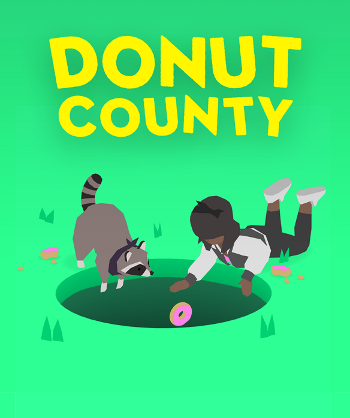
Donut County is goofy in all the right ways. The concept, the writing and the art all immediately charming and it's short enough to comfortably finish in a single sitting. I think of everything I've played this year, Donut County is the perfect example of "games for everyone" - something that can be played by people with no prior experience of video games but still enjoyed to its fullest extent. It's only £4.99 on iOS - play it!

If you've played the original Mirror's Edge, you already know whether or not you're going to like this. Movement still feels just as fluid and satisfying as before, any drastic changes there would've been unwelcome. The key difference in Catalyst is its open world which, unfortunately, doesn't add much to the formula - the best levels are the hand-crafted one-offs which feel much more akin to the first game. As the open world doesn't necessarily flow great in some areas, you'll find yourself using fast travel more than you'd like in a game that's all about traversal. Thankfully, fast travel points are unlocked through well-designed puzzle towers, so they don't feel like a chore to do.

Final Fantasy XV is the absolute epitome of a mixed bag. There are some great touches around an otherwise mediocre and unfocused game, to a point that it's very clear to the player this it suffered a long period of development hell. The story is the skeleton of a standard JRPG - you are a stylish teenager who is destined to save the world from a generic evil. Unfortunately, there's very little else on top of that to really flesh it out. The vast majority of the plot happens in the 2nd half of the game and feels like a treadmill of events and characters that you don't really know or have any connection to. In fact, the 2nd half does away with the open world altogether and makes me wonder if it was developed by an entirely different team. You visit a number of locations, but despite having finished the game only a few months ago, I don't think I could describe any of them in more detail than "the truck stop with a garage" or "a coastal town." Every location is just a five-minute drive away, making the whole world feel very small. Normally I'd be okay with this, but the story takes an apocalyptic turn later on (because of course it does) and I can't tell if the entire world is under threat or just this tiny area that I'm limited to. That being said, the open world looks absolutely gorgeous and it's satisfying to just drive slowly to your next location to take in the scenery and maybe snap a few photos along the way. Speaking of photos, that's probably the one feature that I can unreservedly praise. One of your travel buddies, Prompto, will take snaps throughout your adventure - always during the main story beats but often just in the middle of a random encounter or while exploring the world. At the end of each chapter, or when you give your party a rest at a campfire, you can look over all the photos taken during the last session and keep your favourites. It doesn't sound like much, but it is a surprisingly effective way of creating fond memories of your travels, be it a beautiful landscape or the very first time you fought a Morbol and had to run away. Somehow, I was getting nostalgic looking at photographs of an adventure that I wasn't even invested in. All this makes me sound like I hated the game, but I didn't. Final Fantasy XV is, admittedly, less than the sum of its parts - but there was just something about it that made me root for the game to be better than it was. I can't explain why I have fond feelings towards Final Fantasy XV, despite not having fond memories of it. There's some alternate universe out there where this game was completed smoothly and was able to fulfil the vision that it's going for. If there's any game that deserves a "re-imagining" in five years' time, it's this.

As far as walking sims go, Firewatch stands up there as one of the best for me. The characters are a little too quippy at times, but the naturalistic voice acting is some of the best I've heard in a video game - doing a great job of portraying them as likeable, but flawed, people.

Superhot, in a weird way, feels like the old games I played as a kid. Exciting, repetitive, addictive and frustrating. The levels are short enough where you can't stop playing just one more, no matter how annoyed you get at that shotgun blast that always seems to hit you from any angle. I've a few minor quibbles about the game. My hitbox regularly turned out to be larger than I felt it should be, meaning I would get clipped by bullets that I thought I had narrowly avoided. The pacing is a tad awkward too, the text portions of the game interrupting your fun and making it feel a bit stop-and-start. These are small complaints, though, Superhot is definitely something everyone should experience.

Let's get the negatives out of the way - it's a fairly standard puzzle platformer with controls that are a tiny bit sloppy and the voice acting ain't great, albeit it's bad in a way that reminds me of older Japanese games (see: Mister Mosquito from earlier). That being said, there are scenes with distorted voices that are genuinely quite creepy. Anyway, after Deadly Premonition, it's surprising that Swery has put together a fairly thoughtful and kind presentation of trans identity. It even starts with a text card reading "This game was made with the belief that nobody is wrong for being what they are." Throughout the game, you receive text messages on your phone which fill in the story as you go along. Aside from the explicit mentions that shows up near the end, there are some good subtle examples of setting up the game's themes of visual identity and presentation- for example, being told by your mother that "you need to take care of your body, or else you'll ruin it", in a game about disposing of your old body and regenerating into a new one, or your friend being judged unfairly due to their appearance. Of course, as a cis guy I might be missing out on some elements that could be problematic or completely misunderstanding trans-ness, but I was made aware of The Missing by trans gamers on Twitter commenting that it sticks the landing better than expected so I'm going to take their word that it's well put together in that regard.