
2018 is an extremely weird year to rank. As someone who doesn't own a Switch or a PS4 - and am operating on a thin budget - my year was divided between two enormous, 80+ hour games and two dozen short indie titles. It's weird to compare and contrast the infinite shiny racing game and the twenty minute PS1 psychological horror Thirty Flights of Loving-like, but, well, here we are.
To Be Added: Wandersong, Pandemic, Frostpunk
Showing 1-10 of 53 items

I've played and replayed IO Interactive's Hitman games for years now, and never once has an entry in the series felt quite as complete as Hitman 2. Besides the inclusion of the Hitman 2016 levels, all newly remastered with additional detail, it follows, for the first time in series history, a narrative that connects many of the disparate narrative themes woven incongrously from game to game since the year 2000. Every single Hitman game up to this point has been a clear attempt at reinvention, with the hopes of widening a niche playerbase; Hitman 2, in contrast, feels like the product of a confident studio with nothing to prove. There's always been a disparity between the larger, better-remembered Hitman titles and their more experimental sequels. The original Hitman 2, subtitled Silent Assassin, featured levels that felt classically cinematic, or that at least pulled from the ether of assassin fiction writ large. There's a mansion occupied by the Italian mob, a shootout in an old church, and a motorcade sniper assassination. You could easily map any of these missions onto any similar action franchise; Silent Assassin and Blood Money in particular, while excellent, can feel like staged recreations of classic scenes from action films, a kind of greatest hits of assassin fiction. Silent Assassin's follow up, Hitman: Contracts, was more esoteric. The opening mission is a monochrome fever dream escape from the cloning facility which built 47, which leads to a level featuring a leather orgy/rave in a slaughterhouse, which itself leads to a mission in which 47 infiltrates a weapons deal on a beached warship in Russia. I deeply prefer *this* style of level Hitman level design, which allow you to explore unusual spaces, spaces which in turn have more in the way of the little side stories and unusual methods of problem solving that make the series special. Hitman 2 is the contemporary AAA realization of this style of Hitman title. The first main mission of the game begins with the inspired choice of a NASCAR simulacra in Miami, Florida. It is without question one of the most perfect levels in the history of the franchise. It nails that unique sense of wanting to peak behind the curtain of a familiar space, and the ultimate feeling of satisfaction when you can so deeply subjugate the clockwork level design that your target is, say, doing a poisoned shot of Jaegermeister with you in the race’s winner’s circle. There’s the Mumbai map, which was you stalking a skeevy Bollywood producer on the set of his latest big budget debacle. A rival assassin has taken residence in an apartment building and set up a perfectly positioned sniper’s nest in one of the film’s production offices – except, the target needs incentive to enter his office. Another target owns a sweatshop across town in which an inattentive middle manager allows his employees to be worked into the ground. Perhaps, if one were to take up the middle manager’s position, a drastic improvement in work conditions could incentivize a public appearance from the target… There is also, of course, the fictional Isle of Sgail, Hitman 2’s satiric crown jewel. In short, it’s a castle full of the world’s 0.1%, burning money for fun and discussing their various escape plans from global warming. The targets in this one are a bit more straightforward, but the space is a tremendous cartoon of class stereotype. All of this is to say, Hitman 2’s levels are *flavorful*. The act of solving these puzzles doesn’t feel like finding the B inbetween the A and the C as in past entries – this time each hit is a series of surprises, one more unbelievable than the next, right up until you realize exactly what needs to be done to accomplish the mission. These levels don’t feel like homages to other fiction. Instead, they feel like brand new, innovative entries in an established canon. It makes for a less iconic game, sure, but also a far less forgettable one.

Return of the Obra Dinn is a compelling mystery that redefines our relationship with the murder mystery novel. In a murder mystery novel, besides the act of simply digesting the plot as it unfolds, there's also the indirect game being played between author and reader. The murder mystery author isn't only telling a story, but building a puzzle. Successful mystery novels feature two basic types of clues that resolve the story's central mystery: the obvious clues the reader is led to by the narrative explicitly, and implied or hidden clues interlaced in the rest of the narrative, there for the reader to compile and review after the solution to the mystery has been presented. Return of the Obra Dinn game-ifies this 'hidden' mechanic in mystery novels - it is the subtext of the murder mystery author/murder mystery reader relationship made explicit. The game leads the player to certain mysteries and solutions like a horse to water, but the game's most difficult mysteries can't be solved without diligent review on the player's part. There is no 'second read' in Obra Dinn in which all the subtle clues read as obvious later - the Obra Dinn only reveals its final mysteries and the full gist of its narrative once the player/reader has done the work of demonstrating a perfect understanding of each unsolved case. The game's demand of the player to execute a cohesive timeline for each crew members' end extends beyond plot comprehension; Obra Dinn's ambitions are greater than that. If Obra Dinn was simply a perfectly executed murder mystery plot it would be great, but what makes it special is that revealing the plot information using this mechanic also forces the player to reach a comprehensive understanding of who each of the deceased crew members were, as regular people. Our relationship with the Obra Dinn's crew begins at the casual morbidity of running a human being's death against a corporate spreadsheet that either awards financial restitution to a grieving family or a final blow to a thankless life, but it ends somewhere else. We learn about their various motivations and alliances, but we also learn about their humanity. We get to observe these people at work, what they like to do in their spare time, the kinds of friends they tend to make. It's this humanity to Obra Dinn that elevates it. To watch Return of the Obra Dinn's end credits isn't just to feel the satisfaction of solving a puzzle, but to see the bitter end of the lives of working people; to see someone best-laid plans and dreams unfurl into tragedy, and to feel empathy for even the most treacherous of the game's cast.
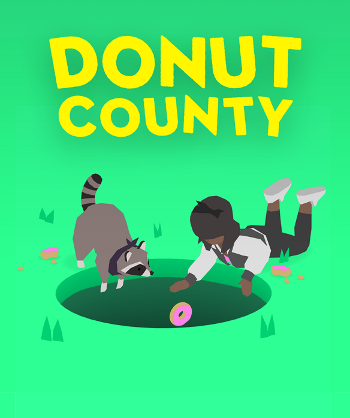
I played Donut County in a single sitting. It’s VERY good, and very funny. I’ve heard quite a few people discuss the ‘way too millennial sensibilities’ of Donut County – these people are bitter and not to be trusted!! This is a game in which a racoon – who correctly assumes almost everything in this world is trash – attempts to fill out an encyclopedia of human objects called the Trashopedia. Just like the rest of the game, it’s heavily inspired by Katamari Damacy to the point of copy cat-ing, but so gloriously stupid that I love it anyway. Every entry is perfect. I think once I get around to deciding who the character of the year is I’ll be tempted to sensibly place Sadie Adler from Red Dead at the top spot, or maybe the lovable underhog (wow I just thought of that I AM A GENIUS) Borman from Mutant Year Zero, but I will be lying, because it’s BK that is closest to my heart. It’s probably just that I love Ben Esposito’s rapidfire-ridiculous sense of humor, but I love that small garbage raccoon and his Trashopedia. I love his Trashopedia so much, I want to *eat* his Trashopedia, because it is perfect. My favorite entries are below: Cool Snake: Alive spaghetti with the ability to hate. Popcorn: Corn that was punished. City Building: Some apartments don’t allow pets, but you can keep bats if you pretend to be upset about it. Gecko (small): If I had sticky feet I’d walk on the ceiling and scream. And hey, side note: this game has an INCREDIBLE soundtrack. I listened to Donut County's soundtrack outside of the context of the game so much I forgot it was video game music. The game's final boss fight uses the same synthesizer-vocal effect used in the theme from Policenauts, which is an EXTREMELY cool thing to do.

I find it impossible to discuss Red Dead Redemption 2 without conjuring both glowing hyperbole and disappointment. If I had to catalogue my 90 hour playthrough, I’d say: Red Dead Redemption 2 is 40 hours of immersive western drama, 30 hours of unnecessary but still quite good content, and 20 hours of mashing the A button and staring off into space as I rode a horse from one place to the next. Those 40 hours are blissful, game of the year quality material…but those 20 hours with the horse are *unforgivable*. Some people like slow travel, and I respect that. In certain games I prefer long, quiet trips too, but in Red Dead – well, you don’t really get long, quiet trips. Plenty of people will describe this game as too deliberate with too little happening, but that’s not quite right. Instead, random events occur everywhere, all the time. I can’t think of a single trip I took in the entirety of my lengthy playthrough in which I didn’t see a man get mauled by a wolf, or a gang try to rob me, or someone get their leg trapped under a dead horse, or an aggressive woman beg me to race her in the opposite direction I was traveling in. It’s not long and deliberate, then, but full of noise. It’s the worst of both worlds, in a sense: you don’t get to have your gritty cowboy fantasy of living off the land without a cartoon shootout erupting, and you don’t get to simply enjoy the story or side content at a reasonable pace. I think about these twenty hours and I’m mad, more at myself than anything, that I spent so much time doing something I didn't want to. But then, I think about those 40 hours. I think about taking that photograph in the game’s epilogue, I think about the simmering tension in the camp in the late game, I think about drinking with Lenny, I think about taking Mary to a vaudeville show, I think about the long walks I took through San Denis – voluntarily, I took walks in this video game with no objective in mind other than to sightsee because this game is so fucking gorgeous it's turned me into a virtual tourist – and I realize those 20 slow, horse-poopin’ hours are the price I had to pay to enjoy the rest of the game. It’s punishing in a very ‘eat your vegetables’ kind of way, except the vegetables have, uh, no nutrients. And the desert is world class. This is a good metaphor. I digress. The math dictates I spent more time loving Red Dead than I did swearing under my breath about it, so I’ll make this clear now: Red Dead Redemption 2 is great. Arthur is a phenomenal, far more layered and complex protagonist than Rockstar has ever written. Literally dozens of moments occurred in this game in which I was just stunned at the craftsmanship on display. I can’t forgive Red Dead 2 for being so infuriatingly deliberate, but I can’t help but feel that everyone who stopped short on this one after the opening hours is missing out.

Prey: Mooncrash I'm still amazed about how good this turned out to be. It turns out, forcing survival sim mechanics and a rogue-like structure overtop of Prey's shock-like mechanics was not, in fact, a desperate attempt at driving sales to an underperforming title by slapping popular mechanics on the front of it - instead, the rogue-like structure and asynchronous storytelling fit so neatly with the rest of Prey that it almost feels like the game should have just been Mooncrash from the start. I'm someone who loves procedurally generated content and enjoys the structure of roguelikes, but I NEVER finish games in either category. Even ones I love! Spelunky has always taken the cake for me as the 'perfect' roguelike, but I couldn't bring myself to see the end of that game. With Mooncrash, it would've been harder to pull myself away from the game then back into it. Mooncrash is so elegant in design that it made me re-examine what makes a rogue-like or a proc-gen title worth developing in the first place. Prey has the same problem as the BioShock/System Shock series it draws inspiration from, in that it gives you this broad and dynamic toolset designed to solve problems that frankly would be more easily solved with either a big gun or the right vent to crawl through. The stakes of having just one life, an inability to plan what might be around the next corner, and a timer that ticks down the minutes before the game either doubles in difficulty or ends forced me to respond to problems organically. It's rare, especially in the early goings of Mooncrash, that you'll have all the tools - or, even, all the information about the world around you that you'll need to brute force a path to the goal. The end result is Mooncrash starts to simulate the most harrowing moments from movies like Aliens or The Thing - you're stumbling around a corner with a broken leg, your only available tools a wrench, a pistol with 14 shots and a single EMP grenade only to run smack into a huge, gooey Typhon. Unlike the main game, in which you'll either save scum your way into smacking it with your stupid wrench or (more likely) you just run the hell away and wait, but in Mooncrash there's no time to hide and you may well not be equipped to kill it. You might instead, say, stun it with the grenade, break a nearby window to leap into another room, hide in a storage closet, and throw some junk you find on the ground into an adjacent office to trick the monster into investigating some place you aren't. The restraints on your abilities don't *feel* like restraints, in other words - they feel freeing! Without a perfect, low-effort solution to most problems, Mooncrash encourages you to be creative and think your way out of problems, breathing so much life into the tired Shock formula.
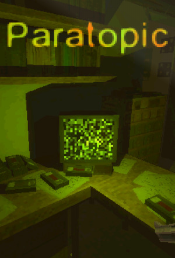
I am powerless to resist Paratopic. It’s got: PS1 graphics that invoke psychological horror, pacing that resembles Thirty Flights of Loving, a soundtrack that recalls John Carpenter, FUN dialogue trees, moody drives through a hellscape and liberal use of the word “friendo.” It’s the full package. When I was a kid, I owned both a Playstation and an N64 because I was spoiled. I loved games, but that specific era of technology produced grimy, block-shaped graphics that left a lot to the imagination. In the right hands, you can make some *real* unsettling art with this aesthetic. It’s easy to be scared by something you can’t truly see. Paratopic reminds me of one of my all time favorite games, Lone Survivor, which used blown out, hyper zoomed in pixel art to reduce monsters to writhing, shambling collections of shapes. They were unknowable, and therefore creepy in spite of the otherwise quaint technology. Paratopic hits closer to the bone for me, as I grew up very much afraid of certain PS1/N64 games. There’s something sharp and unrelenting about enemies even in non-horror games like Turok or Defcon 5, and Arbitrary Metric have tapped into that vein expertly. It’s also just generally speaking an excellent mood piece. After completing this game once I had to immediately play it again, partially because I wanted to better understand the plot, but also partially because I just wasn’t ready for it to be over.

A breath of fresh air in a difficult year, Florence is a romantic comedy brimming with personality and spirit. I love this game. Without a single spoken word, Florence communicates more about finding yourself in your twenties – the joyless repetition of an office job, the dreams set aside, the feeling of escaping into your headphones to get respite for just a moment or two – than nearly anything I’ve seen, read, or played in recent memory. I say ‘almost’ because, fortunately for everyone under 35, Greta Gerwig exists. Contrasted with intentionally bloated AAA titles like Fallout 76 and Red Dead Redemption 2, Florence also feels like one of the *smartest* games of the year. This is a game without any wasted space whatsoever. Its gameplay mechanics are largely metaphoric, and always charming. My favorite scene in the game is the one in which Florence goes on a first date with her crush. The player is tasked with making small talk by filling a speech bubble with a half dozen misshapen puzzle pieces. Doing so is awkward, and requires attention to detail. As the date goes on and the two develop a rapport, the puzzle pieces become larger and easier to fit together until they no longer require attention from the player at all; the conversation begins to flow thoughtlessly, naturally. This moment is not only brilliant – it’s also cute. How often can you apply the word cute to a game mechanic? Not so often! At least, not since that Boy and His Blob remake with the hug button was released.

I guess I would be doing Tetris Effect a disservice by calling it the most transformational experience I've ever had playing Tetris. The long and the short of it is, Tetris Effect is an *emotional* journey - it's a rousing, exciting challenge for casual puzzle fans like me, too, but it's a staggering, weird, transcendent experience, and that's what made it such a fixation among critics at the time of release. It's a pure distillation of Tetris' mechanics that also acts as a complex art piece. It's simple, but that push and pull of Tetris Effect's challenge mixed with the implied narrative of each stage really does hit home. I played Tetris Effect via the Tetris Effect: Connected upgrade, which adds a phenomenal suite of multiplayer modes to accompany the original game's single player narrative. These are great, but there's something so singular about Tetris Effect's original 'story' mode that I honestly couldn't bring myself to return to it so soon. Completing Tetris Effect feels like a moment - it feels like, at the end of Tetris Effect, your game console should grow wings, say goodbye in your native language, and fly off into space.

Mutant Year Zero’s cover art *screams* derivative, but at the end of the year it was the only game I regularly wanted to play. A lot of that comes from how friendly the developers have managed to make XCOM-style combat, but mostly I just can’t help but love Borman, Dux and Farrow. But mostly Borman. I *love* Borman. He’s a squat pig man who is a gruff war-hardened mercenary. There’s a level in which the crew stumbles onto a camp ground with a cartoon drawing of a moose advertised on a billboard, which is popularly referred to as ‘the horned demon’ by post-apocalypse dwellers. With no irony whatsoever, Borman asserts that the horny demon can blow him, which is just such a *thing* to say for a gruff pig mercenary. He’s also relatable! There’s one optional high difficulty dungeon that is littered with bodies in its first few rooms. When you see them, Borman immediately says ‘OK I’m just gonna say it: this is like *really* scary.’ Borman: he’s great! Also, who knew stealth would work so naturally in a genre like this? Granting the player the ability to decide when the game becomes a traditional turn based RPG is a smarter way to handle those old fashioned mechanics than almost any other game in the genre I’ve played.

LIS 2 Episode 1 doesn’t quite have the tidy singular nature of its prelude, The Awesome Adventures of Captain Spirit, but it doesn’t matter: this is one of the most important games of the year. Many developers do what they can to make the world a friendlier place via queer/POC visibility, but this game is just *about* being a Mexican American in 2016. There are heavier moments of action-drama and the usual LIS paranormal twists, but they only underscore the story Dontnod clearly want to tell. There are threats of calling ICE. There is talk of ‘The Wall.’ None of it is from an armchair. All of it is difficult. I’d rather not throw out anything on here as a spoiler, so I won’t get too heavily into it, but it’s rare that a game this intense and political is released from a major publisher. I’ll be waiting with baited breath for episode 2.