5 ★ (1)
4 ★ (8)
3 ★ (4)
2 ★ (0)
1 ★ (0)
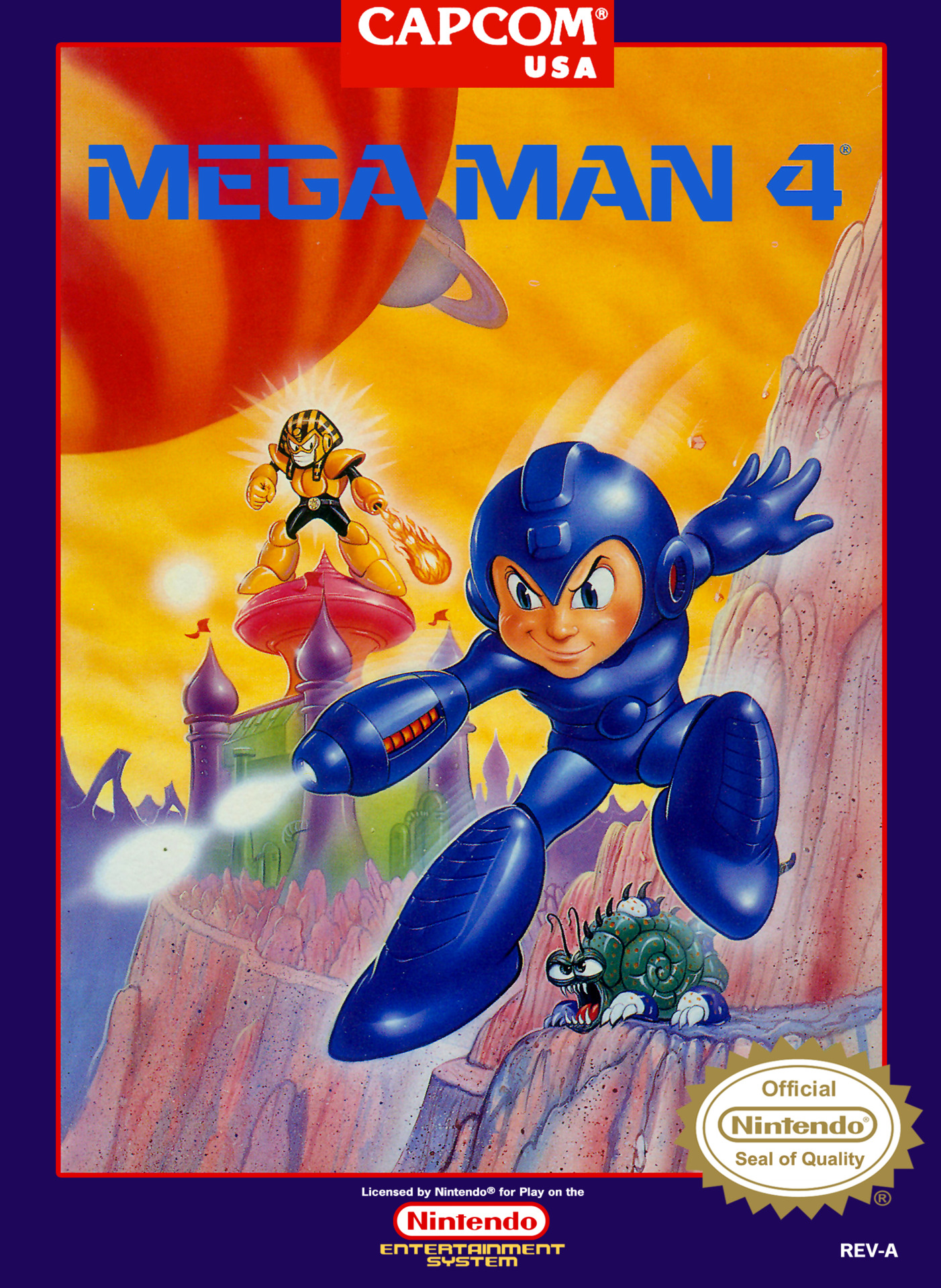

Mega Man 4 (known in-game as Mega Man IV, not to be confused with the Game Boy game Mega Man IV (Game), and known in Japan as Rockman 4: Aratanaru Yabou!!, which loosely translates to "Rockman 4: A New Evil Ambition!!") is a side-scrolling action platformer developed and published by Capcom for the Nintendo Entertainment System on December 6, 1991 (in Japan), January 15, 1992 (in North America), and August 1993 (in Europe).
The fourth installment of the original Mega Man series (and the sequel to Mega Man 3), Mega Man 4 expands on the series by adding a new version of protagonist Mega Man's arm cannon (called the "Mega Buster") that allows him to charge up a shot for a powerful attack. This is also the first game to include Eddie (Character), a helper robot who grants Mega Man a random item at certain points of the game.
Set in the year 20XX, the game takes place a year after the events of Mega Man 3 (in which the humanoid robot hero Mega Man (Character) defeats the evil roboticist Dr. Wily a third time, who is believed to have perished during the collapse of his castle). Russian scientist Dr. Cossack sends Mega Man's creator, Dr. Light, a message claiming himself to be the greatest robot engineer of all time. When Dr. Cossack assembles a robotic army (led by eight of his Robot Masters) to destroy Mega Man and conquer the world, it's up to Mega Man himself to stop his plans and uncover a conspiracy (with the help of new ally Proto Man (Character)).

The biggest change to Mega Man 4's gameplay is the new inclusion of the Mega Buster charge shot, which would become a standard feature even in the Mega Man X series. It allows Mega Man to store up a powerful burst that can inflict three units of damage to enemies and even Robot Masters. In fact, it becomes the preferred weapon to use against a few of them. Certain enemies also have a gimmick requiring the use of the Mega Buster to defeat them.
Mega Man also keeps all of his previous abilities from Mega Man 3, including the slide and his canine compatriot Rush (Character). Additionally, Mega Man can also find two special items called the Wire and Balloonhidden in certain stages. The Wire acts like a grappling hook that can launch Mega Man vertically, and the Balloon creates floating platforms nearly identical to Item-1 from Mega Man 2. The inclusion of Eddieis a minor addition as the items he dispenses are chosen at random.
Dr. Cossack's mechanical minions consist of a standard group of eight Robot Masters. As usual, Mega Man will gain their weapon powers when he defeats one.

Bright Man's stage evokes a power plant, with enemies that can either turn out and turn on the lights when defeated. Mega Man will also have to make use of robotic grasshoppers to cross dangerous spike floors also guarded by robotic totem poles.
Bright Man can stop time with his Flash Stopper, which can be dangerous if he decides to tackle Mega Man with his body.

Pharaoh Man's desert tomb consists of sinking quicksand and robotic mummies with heads that aren't wrapped too tight.
Pharaoh Man also takes a page from Mega Man's new book with his charge-up Pharaoh Shot.

Excavating god-knows-what in the name of science, Drill Man's stage is fairly straightforward until the end, where switches must be used to make an invisible ground appear.
Drill Man himself likes to burrow into the ground and reemerge at Mega Man's feet, then drill-baby-drill him with his Drill Bomb.

Ring Man calls home amongst a bizarre circus/planetarium crossover. Things come full circle with Ring Man and his fast-acting Ring Boomerang, but like many Robot Masters, the true danger comes from how quick Ring Man is and the high amount of damage the player will take if Mega Man so much as touches him.

Taking a page from some turtles, Toad Man's sewer hideout is initially drenched in some pretty heavy precipitation that will push Mega Man back as he jumps. Toad Man himself will shake and shimmy a rain dance to summon rain.

The humble Dust Man doesn't mind hanging out in a rubbish-themed stage whose most significant feature is a huge trash compactor that Mega Man will have to blast his way through. Dust Man's Dust Crusher is used in tandem with a powerful vacuum that makes him temporarily invulnerable.

Safety takes a dive, Fridays after five in Dive Man's dangerous aquarium. The rising and falling of the tide can affect the height of Mega Man's jump as he battles robotic whales and stingrays. The submarine-themed Dive Man can both fire his homing Dive Missiles and pretend he is one as he barrels toward Mega Man.

Skull Man's mountainside dinosaur dig is comprised itself almost entirely of bones. It's not so much scary as it is arduous. His Skull Barrier makes him invincible, but Skull Man can't do anything but stand there while using it. More dangerous is when he deactivates his shield, he'll make a quick sprint towards Mega Man.
In addition to the Robot Masters, Mega Man will also have to fight through both Dr. Cossack's and Dr. Wily's castles. This was the first Mega Man game to feature multiple castles, starting a trend subsequently seen in Mega Man 5and Mega Man 6of a "psyche-out" acting as a thinly-veiled ruse to hide Dr. Wily's involvement.
While the original game was released as a Virtual Console title for the Wii (on April 19, 2010), Nintendo 3DS (on April 25, 2013), and Wii U (Platform) (on June 11, 2013), the game received some ports:
Mega Man 4's music was composed by Capcom employees with the pseudonyms Ojalin(Minae Fujii) and Bun Bun(Yasuaki Fujita). Yasuaki Fujita had previously composed the music for Mega Man 3.