
Inspired by an identical foray by two friends, I recently decided to start playing through the whole Legend of Zelda series by order of release. This kind of undertaking, while not only providing great entertainment for a long time, provides a great perspective of the series as a whole and its evolution from the beginning to present day. This list will be continuously updated throughout the playthrough as a sort of log to keep track of my progress as well as writing down some of my own thoughts about the individual games, my personal connections and their roles in the series.
CD-i games, Tingle games and other such derivations are naturally excluded, unless I make random exceptions because I feel like it.
Showing 1-10 of 15 items

*** System played: Wii *** Version: GameCube, Collector's Edition *** Date started: 27 December, 2009 *** Date finished: 29 December, 2009 *** Observing other players and internet research aside, my first personal experience of the first game came very late, at the acquisition of the Collector's Edition disc in 2004. With a mindset grown from Ocarina of Time, it's easy to see how this debut might come across as a bit shallow in the aesthetics department. I'm perfectly capable of jumping into older games with an open mind though, and while the simplicity of the first game's design didn't throw me off, the difficulty did. With no more than two dungeons completed, this game has hardly been touched for the last few years until now. This time, I entered the game with will and determination... and internet maps! Today, with good knowledge of what the future would hold for the series, The Legend of Zelda (uhm, "the first") becomes a very interesting game to analyze in regards to its similarities and differences to the games that followed. The whole game nearly feels like a prototype for a game idea, not yet technically capable of being executed in the way Miyamoto & Co had in mind. That kind of early undeveloped feel in itself makes The First a fun game to play, in the same way looking at pictures of yourself from ten years ago creates astonishment over how things have changed. Although perhaps that fun is not from the proper perspective. Looking at the game in its proper contemporary context, what it was when it was more than The First, when it was The Only One, in an age when gameplay and aesthetics were relatively simple, you see a game way ahead of its time. Complex and challenging like Tetris, but with depth that can hardly be compared to anything short of rivaling adventure or role-playing games of its time. While still no fan of the frequent death rate and almost too well hidden secrets, I was left rather impressed when I finally gave this game a proper chance. From picking up the wooden sword to finishing off Ganon with a silver arrow, it's not hard to see how this game managed to enthrall a whole world back in the day.
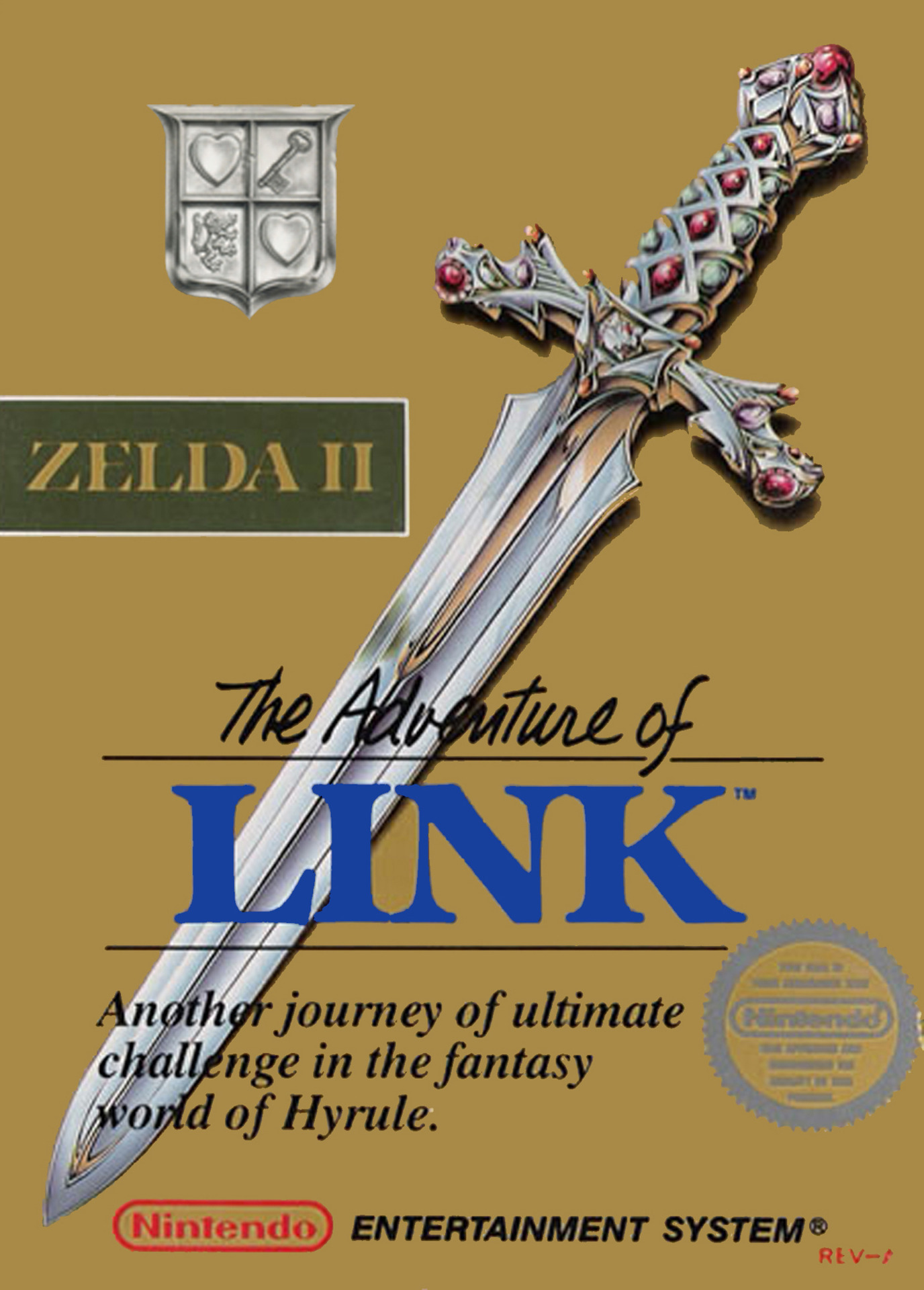
*** System played: Wii *** Version: GameCube, Collector's Edition *** Date started: 29 December, 2009 *** Date finished: 30 December, 2009 *** Oh yeah, the legendary "black sheep", so legendary it doesn't even need "The Legend of" in its name. My previous history with this game is pretty much identical to that of The First, even roughly down to completion progress before putting it down. Much like other low-regarded sequels that get shafted by the general public for being too different though, I personally prefer this game over its predecessor, a lot. The Zelda feel is totally there, only experienced through an interesting kind of platformer hybrid rather than just top-down perspective four directional movement. I'd even say this game comes much closer to aesthetically creating the atmosphere of a typical Zelda game than The First, with a varied world and towns full of life. What this game undeniably also has a lot more of is sheer difficulty, not so much for the brain as for the reflexes. As fun as the experimental gameplay is, it stands without question that the number one requirement for actually completing Zelda II is a whole lot of patience. You play, you die, you return to the beginning and work your way back, lather, rinse, repeat. I wouldn't even recommend playing this game without some kind of helpful reference, be it a walkthrough or just a marked map. There's enough challenge in the action to keep one person occupied and frustrated for two, and getting stuck with no knowledge of how to progress in addition to that can only be good for psychiatrists' wallets. No doubt, completing the game after several hours of attempts at the final palace alone is something I can regard as part of the year's biggest accomplishments. Leaving the challenge subject however, it has to be said further that Adventure of Link, while far from being on the same level as the many games that followed, was a very interesting way of making a follow-up without repeating the gameplay. It could perhaps be considered a shame that there will likely never be another game like it, but in truth that uniqueness is probably what makes the game fun as a stand-out. Admittedly the Zelda series would not have been the same if the subsequent entries had taken their inspiration from the sidescrolling bits of "the black sheep". If Adventure of Link had to be summarized, it could be called a successful shot, but a bold attempt that got once lucky.

*** System played: Nintendo DS Lite *** Version: Game Boy Advance, Game & Watch Gallery 4 *** Date started: 31 December, 2009 *** Date finished: 31 December, 2009 *** The final Game & Watch game ever made of the original line, known simply as Zelda. Played less as an actual part of the playthrough and more as a fun bonus inbetween A Link to the Past sessions, but nevertheless worth a mention. I am not fortunate enough to own a copy of the game in its vintage original version, but thanks to our unknown wonder developer TOSE, the less financially successful gamers can access this faithful port in the hopefully-not-last installment of the Game & Watch Gallery series... in the form of a tough-as-nails unlockable. In either case, what we have here is, above naturally, a simple LCD game using only a few buttons and movement between a few limited frames. No one's expecting more out of a Game & Watch game. That being said though, without guilt it can be admitted that this game has a surprising amount of depth for its limitations. Once you've figured out the goal and played past a few dungeons, whether you beat the dragon with a deadly tomahawk or Link's liquid crystal butterknife of doom, a sort of determination sets in, a determination to complete the Triforce and rescue Zelda. This is blissfully doable, and not particularly hard, thanks to the revolutionary continue function (irony yes), but it needs mentioning that at later parts of the game, some of the rooms actually provide a fair challenge (much depending on how often or not you get the Water of Life). Now, there's no way you can claim this game to be a full-fledged part of the series, but in any kind of Zelda marathon with friends, being able to break out this surprisingly enjoyable Game & Watch game to add to the experience will always be a nice party trick.

*** System played: Wii *** Version: Virtual Console *** Date started: 30 December, 2009 *** Date finished: 3 January, 2010 *** How can it be denied? If The First was the prototype, this was definitely the final product. The idea became concrete, and landed on our Earth in a spectacular 16-bit fashion (not necessarily including nausea-inducing Mode 7 backgrounds). Still not the first game of the series experienced by le lent moi, who still wishes he had begun playing these games earlier, but one of the earliest, in the shape of the Game Boy Advance remake in 2003. I was pretty mildly impressed. A fairly enjoyable game, but not much more. Let's be perfectly honest though, giving this game a retrospective review is one of the most superfluous things anyone can do. Even if the game isn't fully your cup of tea - which is okay, I can relate to that - there's simply no way you can actually criticize it for what it is. The atmosphere is beyond beautiful, the storytelling is magnificent, the overworld is full of excitement, the dungeon design is perfect, the parallel world concept is flawlessly executed, and perhaps most importantly, unlike both its predecessors the difficulty is perfectly balanced. If there is such a thing as a perfect game, this has to be one of them. Keep in mind that these words do not come from a fanboy, just an average gamer who personally thinks the game is "okay". If anything bad had to be said about the game, it would be the slightly rushed storytelling that happens once you reach the Dark World and finish its first dungeon. You're dumped in a wasteland with a few numbers on a map and have to go to each one of them, with little individual build-up to any of them (the most notable exception being the wonderful Thieves' Town). The storytelling here is not below satisfactory, but had a lot of potential for more. Comparing the game to the rest of the series, it's simple to say that A Link to the Past took the whole groundwork from The First and added all the details that have become the defining points of the whole series. It's a game of perfection, and probably the most important entry of them all. Everything else is purely up to personal preference, because this game holds little room for improvement. Simply a perfect game.

*** System played: Game Boy Advance SP *** Version: Game Boy Color, DX original *** Date started: 12 January, 2010 *** Date finished: 27 January, 2010 *** Here's where it gets really interesting. I haven't experienced all games in the series prior to starting this playthrough, making this the first time I even touch some of them. Ebayed for the occasion, Link's Awakening, in its superior color version, is one of those games. And the first impression was easily positive. An unfortunately common view within many popular game series is that the portable entries are often seen as inferior or less important than the "main games" on stationary consoles. If there's any series that successfully manages to break away from this, it's Zelda, and the very first such entry is a perfect example. Despite taking a step back in console power from A Link to the Past, Link's Awakening still keeps all the aspects of enjoyment and playability that its immediate predecessor established, instead of going all the way back to inaccurate sword stabs and fiendish puzzles with cryptic hints at best (although while keeping a healthy dose of challenge). The limits of portability do occasionally show, particularly in the impressive-but-compact overworld. But that only helps to make the action particularly enhanced. The game definitely stands on its own as a full part of the legend, and even creates astonishment over how well capable the Game Boy is of deep, immersive and lengthy games, a system probably more famous for single screen drop-block puzzles. Story-wise, Link's Awakening has to be mentioned as one of the most intriguing games in the series. Koholint Island, its purpose and history, left many questions unanswered. As you progress through the game, you may feel subtle hints of various philosophical topics such as existance and morality; can you really bring yourself to awake the Wind Fish if it means the end of these innocent people? The game wasn't finished without a tear, and I really wish I had taken the chance to experience this many many years ago. Some day I'll also have to try out the original monochrome version.

*** System played: Wii *** Version: Virtual Console *** Date started: 27 January, 2010 *** Date finished: 9 February, 2010 *** This is where my own legend started, a non-braggable 9 years ago, well past the release of Majora's Mask. From a bargain bin in a local electronics store, I would pick up a Nintendo 64-game that I had previously heard of as the best video game ever, all categories. I wish I could say playing it changed my life forever, but let's stay a bit closer to earth. I could see its qualities, but at the time I was somewhat reluctant to play it. At unease with the serious tone and dark atmosphere that the game presented, in comparison to the Mario and Donkey Kong Country games I was more used to at that time, I sometimes asked myself if I was only playing it in lack of interesting alternatives. For many years, I've been quick to bring up Ocarina of Time whenever the topic of "most overrated game" has been discussed. Obviously that must be true, since I've played it to the end at least half a dozen times, bought Wind Waker only for the Master Quest disc and, despite that uncomfortable feeling, really enjoyed it from the start... Okay, seriously, I hereby publicly apologize for all my bad-mouthing of Ocarina of Time. This game is nothing short of wonderful, and it's unbelievable how I couldn't admit that several years sooner. To begin comparing this game to its four predecessors, it's obvious that the third dimension is the primary topic of discussion. The most amazing thing with the Zelda series in its transition to 3D is how little it changed from the original formula, but how much greater it became in the process. Compared to Super Mario 64, which had the series' basic linear-scrolling-obstacle course concept changed to completing missions in large open worlds, Ocarina of Time changes very little from the overworld and dungeon concept as perfected by A Link to the Past. What the new dimension doesn't do with the gameplay however, it truly does with the immersion, the feeling of taking the role as Link and living the legend, and that's what makes the 3D Zeldas truly stand on their own high ground. As a Zelda game in itself, Ocarina of Time does not stand short in storytelling, dungeon design and enjoyable sidequests. Nowhere in the whole game does the story ever go stale, and the child/adult concept creates a fantastic parallel to A Link to the Past's Dark World, with a gracefully added difference in gameplay aside from the basic two-sided world. Yes, A Link to the Past is still more perfect for what it is, but compared to eachother as pure individual games, Ocarina of Time is a greater experience on many levels. I still won't admit the game as the very best of the series, let alone all video games ever, but no longer can I blame those who do. During this playthrough, with an honest mind and an excitement over the whole series in general, I got more enjoyment out of Ocarina of Time than ever before. It also became my first ever 100% completion.

*** System played: Wii *** Version: Virtual Console *** Date started: 9 February, 2010 *** Date finished: 18 February, 2010 *** It does get increasingly obvious how most of what I write about these games are things that have been said thousands of times before by all kinds of gaming fans and journalists already. But the more you play Zelda games, the more you notice how true those clichés actually are, and how difficult it becomes to strive away from them. Majora's Mask is a very clear example of this, because of four very clear defining points that make up the pillars of any kind of reflection about the game. 1) The three-day system. An ingenious concept with near flawless execution that keeps the replayability level high. 2) The emphasis on side-quests, that bold and very successful attempt at changing the delicate balance between the roles of the overworld and dungeons. 3) The transformations. The fun alternatives that created more gameplay diversity than any inventory in any Zelda game before or after. 4) The storytelling. The slightly creepy, slighty cosy and overall very lively atmosphere of the whole game. A fifth pillar would be the game's role as a proper sequel to Ocarina of Time and the interesting new uses of familiar character models. This relates well to the game's very interesting design process, a quick and somewhat spontaneous sequel thrown together as an alternative to Ura Zelda. Despite the short development time and the many obvious shortcuts, the result of this quick job was anything but half-assed. The many daring choices done for this game, perhaps most notably the fewer dungeons in favor of fleshing out the world areas and side quests to a magnificent breaking point, create what could be argued as the most unique experience offered out of any game in the whole series (barring the pure... difference of Adventure of Link). On the personal history, I mostly missed this game the first time around, only having tried out a friend's copy until I finally got to properly experience it with the Collector's Edition disc. For many of the reasons mentioned earlier, the amount of enjoyment I got out of Majora's Mask was copius, and I will not hesitate for a second to approve this game as the second best in the whole series, only to be outdone by an upcoming entry.

*** System played: Game Boy Advance SP *** Version: Game Boy Color original *** Date started: 18 February, 2010 *** Date finished: 11 May, 2011 *** As you can probably deduce by looking at the dates above, this one took quite a while to get through. I'm not going to pretend the reason was anything other than lack of interest, not so much caused by the game's quality as just overall ambition, but there was always an intention to pick it up exactly from where I left off, and eventually I did. Either way, let's start by establishing that I've never played any of the Oracle games before, and for the sake of this playthrough, the password system will be used to treat Ages as the sequel. Why did I go for Seasons first? I dunno, something about it feels like it makes sense, perhaps the daylight/twilight chronology in the two intro movies. But let's ignore the whole twin game aspect for now and let Oracle of Seasons speak for itself. What we've got here is a handheld Zelda that is shamelessly recycling a previous game engine, known from Link's Awakening, assembled in an unprecedented move by third-party developers Capcom (Flagship division). A description that oozes "fan-hack" if anything. But while in all honesty it often does feel like you're playing Awakening all over again, this game is in fact nothing short of a solid, good-quality, unique Zelda experience. While it doesn't bring any particularly exciting new gameplay aspects to the table, it manages to respectfully follow the formula without losing its own identity (this despite lifting the majority of its bosses directly out of The First). Atmospherically, the feeling is inevitably much the same as Link's Awakening, but in a good way. Holodrum is a comforting world that feels full of life, especially enhanced by the season-changing system. Even Subrosia, the game's Dark World Jr., for all of its intimidating landscape, constantly holds this feeling of a rather cosy place where you get to hang out with cute hooded creatures. New villain Onox is doomed to never likely get a position among memorable antagonists, but he provides a worthy climax and a fair challenge after the buildup of this well-paced Zelda game. Oracle of Seasons is not a classic, but it makes itself well deserved of my approval. Now then, I haven't compared for myself yet, but supposedly this game is more action-oriented than its puzzle-oriented counterpart, the counterpart which is going to conclude the arching storyline (this time). More on that in the next entry...

*** System played: Game Boy Advance SP *** Version: Game Boy Color original *** Date started: 11 May, 2011 *** Date finished: 27 May, 2011 *** And so we continue, the twin games are brought to completion as the blue version is finished off. All as expected, Oracle of Ages brings more of the same gameplay handed down from Link's Awakening, but luckily enough this game is anything but identical to its counterpart. A completely different set of locations and puzzles, and most of the inventory traded off to give a whole different tool experience. It's actually very impressive how these two games are able to co-exist with so many similarities yet always feel like their own game, never blatantly stealing an idea from the other. The signature gameplay element of Oracle of Ages, time travel, may not feel that fresh in concept (didn't we have that in both Nintendo 64-games already?), but manages to execute itself surprisingly well. This is helped in particular by the past being a distant age of old legends, as opposed to a few years back, making you feel like you're actually creating the history of Labrynna (rather than being dumped into already existing lore of long-dead royal composers or villages built by bandaged tribes). The cleverness of the design means that coming down to it, Oracle of Ages might even possibly outdo Seasons in terms of sheer entertainment value. As for the connectivity between the two games: while the overarching plot of Twinrova leading Ganon's resurrection mostly feels like a distracting detachment, it is in the end a fun little addition that does its part in linking the duo and present the player with a justified ending. I applaud Capcom for creating two top-class games that have all the right to call themselves proper Zelda games. That all said, let's have some brutal honesty for a moment. Playing both of these games one after the other as you work your way through the whole series? You get fed up. Finally being able to move on from this territory comes with a good amount of relief. Still, great games, both of them.

*** System played: Game Boy Advance SP *** Version: Game Boy Advance original *** Date started: 29 May, 2011 *** Date finished: 29 May, 2011 *** My determination with this playthrough should be rather apparent when I mention Four Swords, seeing as I actually bought myself a double copy for the sake of playing it. Opinions differ on whether or not Four Swords, being included as a side-game along this port of good old ALttP, counts as a proper game in the series. While I personally do count it, it's easy to see why its disputable, but either way it's good enough for inclusion. Four Swords is, at its core, a simplified Zelda game created for the purpose of multiplayer, and the end product is not exactly a deep experience, mostly a mini-game for a bunch of friends to enjoy (given that you have access to the multitude of items required to play it). The gameplay is based around a few selectable dungeon-style levels, meaning no traversable overworld and no side-quests. That does not mean it's not fun or devoid of the Zelda feeling. Sure enough you'll have a pleasant run if given the chance to play it, but don't take it as a must-play that'll be sorely missed if left out. Worth noting here is also the extra dungeon unlocked in A Link to the Past with Four Swords' completion, an interesting addition with references to the bonus game and some fresh rewards at the end. Four Swords also gives us the first presentation of Link's toon self, starring in the upcoming entry and the majority of games following, but in this occasion more as a sneak preview than anything. Four Swords may not have the prominence to be a memorable entry in the franchise, but it's a decent enough romp that's well worth the rather short amount of time it requires. A shout-out goes out to my friend who played the role of player 2, cheers!