MERCH!
Giant Bomb - a website about video games and the people that make them

The Most Important Video Games in History

What makes a video game important?

This is a running timeline of the games that shaped video games as we know them, with a way to track what you've played and beaten. A game earns its spot by doing at least one thing that mattered: Broke New Ground, Influenced What Came After, Moved The Industry, or is a Cultural Touchstone. On top of that, it has to be playable today on hardware or an emulator.

This is not a "greatest games of all time" list. There are some real stinkers here. But we can promise you that everything on this list is important.

(There are some placeholder references for the included games, and we'll continue to update each entry's summaries and Why This Matters sections.)

152 games on the curriculum, spanning 1960s-2000s.

  • Beaten / Saw Everything / 100% (0)
  • Played / In Progress / Dropped (0)
  • Unplayed (152)

1960s

February 1962

Spacewar! cover art

Spacewar!

Steve Russell, Martin Graetz, Wayne Wiitanen

PDP-1

Spacewar! was conceived in summer 1961 by Steve Russell, Martin Graetz, and Wayne Wiitanen; Russell wrote the initial code beginning late December 1961, with a working two-ship version by February 1962 and public demonstration at the MIT Science Open House in April 1962. The game features two players piloting spaceships around a star, able to fire weapons at one another. The star in the center of the circular screen has its own gravity, which impacts the player ships.

Why this matters

I'm going to say it: Spacewar is the Citizen Kane of video games. I know it's nauseating to read that, but it's important to recognize just how early this medium revealed the aspects that make it special. Spacewar was the first video game with a display, but it also had detailed physics (that would model the arc of your path around a black hole) and random-number generation (for calculating where your ship would end up after you pressed the warp button). Nolan Bushnell and Ted Dabney (who would together found Atari) built 1971's Computer Space for the arcade after playing Spacewar at Stanford.
1970s

1971

Star Trek cover art

Star Trek

Mike Mayfield

Sigma 7, HP 2000C, Apple II

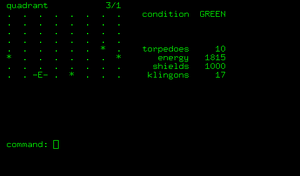
Star Trek is a simulation game where the player is in control of the Enterprise. They must travel around to different systems, eliminating Klingon ships in order to win. The player must manage their shields, scanners, torpedoes, and more. Mike Mayfield wrote the original Star Trek in 1971 (as a high-school senior with access to a UC Irvine computer lab), inspired after playing Spacewar!; it was programmed in BASIC for the SDS Sigma 7 mainframe and played on a Teletype Model 33 teleprinter since the Sigma 7 had no graphics display.

Why this matters

Star Trek is an early turn & text-based game that became ubiquitous on college campuses. There have been many versions of it, with the most well known version likely being Bob Leedom's "Super Star Trek." Hewlett Packard shipped Mayfield's 2nd version with their "Contributed Program" library in 1973. There were actually quite a few Star Trek inspired fan games released in the 70's, but this seems to be the earliest.

December 1971

Oregon Trail cover art

Oregon Trail

December 3, 1971Don Rawitsch, Bill Heinemann, Paul Dillenberger

HP 2100

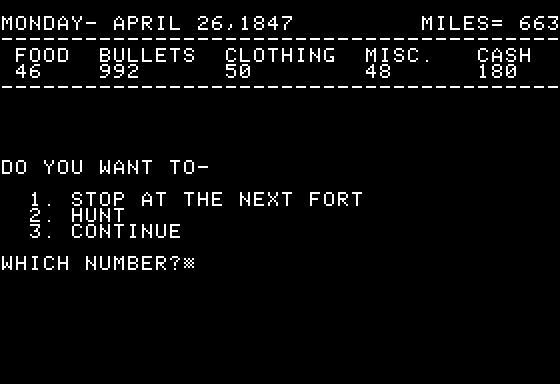
A text-based educational computer game where players make a wagon trip through the Oregon Trail in the year 1847. It serves as a precursor to the more popular 1985 game The Oregon Trail.

Why this matters

The game was created in 1971 by Don Rawitsch (a Carleton College history major/student teacher) with math-student programmers Bill Heinemann and Paul Dillenberger, built in about two weeks. Rawitsch debuted it on December 3, 1971 to his 8th grade history class at Jordan Junior High in Minneapolis, and it ran on the HP 2100 minicomputer via HP time-shared BASIC, accessed via teleprinter terminals.

Over the 1974 Thanksgiving weekend, Rawitsch (then at MECC) rebuilt the game for MECC's CDC Cyber time-sharing system, and it became the most-used program on the Minnesota school network.

An Apple II version was created in 1985, and the game became a huge edutainment hit.

November 1972

Pong cover art

Pong

November 29, 1972Atari, Allan Alcorn

Arcade

Pong was released to arcades on November 29, 1972, and is widely credited as the first commercially successful video game. Based on table tennis, players attempts to hit a ball past each other's paddles.

Why this matters

Nolan Bushnell, co-founder of Atari, had seen a version of Magnavox's tennis game that would eventually make it to the Magnavox Odyssey. When he and Ted Dabney hired Allan Alcorn as their first employee, Bushnell had him make a table tennis game as a test of his abilities, and told him it was for General Electric (this was a lie). Alcorn's version ended up being so good, they decided to manufacture it - they were later sued by Magnavox for patent infringement.

January 1973

Hamurabi cover art

Hamurabi

Doug Dyment, David H. Ahl

PDP-8, Altair 8800, Commodore 64, Commodore PET, TRS-80

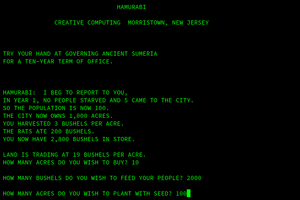
In 1964, fourth grade teacher Mabel Addis and programmer William McKay created 'The Sumerian Game,' a text-based strategy game as part of an investigation into educational computer programs for schools. It was written in Fortran for the IBM 7090 mainframe computer. In 1968, DEC's Doug Dyment recreated the concept in the FOCAL language on the PDP-8, titling it "The Sumer Game" / "King of Sumeria." Around 1971, DEC's David H. Ahl ported Dyment's version to BASIC, renamed it "Hamurabi," and added an end-of-game performance appraisal. Ahl published it in 101 BASIC Computer Games (1973) and later BASIC Computer Games (1978), the latter selling over a million copies and spreading the game to home computers.

The Sumerian Game's source code is lost, but a small set of slides and a few first-stage session printouts were recovered and donated to The Strong National Museum of Play.

Why this matters

Hamurabi is likely the oldest playable city management simulator, and a great example of early game development for education purposes. You can find a nice, slightly modernized port of Hamurabi here. The original game is fairly brutal, with no explanation of the math behind resource management - it's all trial and error.

1975

pedit5 cover art

pedit5

Rusty Rutherford

PLATO

Pedit5 is a game which ran on a mainframe server and accessed remotely via terminals. Gameplay is a single hero exploring one fixed dungeon level, fighting randomly generated monsters with weapons and spells, gaining hit points/experience levels, and collecting treasure.

Why this matters

Rusty Rutherford developed pedit5 (internally "The Dungeon") over roughly four to six weeks in late 1975 on the University of Illinois's PLATO network. Another game, simply titled "dnd," also emerged on PLATO around 1975, but most experts favor pedit5 as the earliest. It is widely regarded as the first dungeon-crawl game and one of the earliest CRPGs, and its random generation makes it an early predecessor of the roguelike genre. You can play pedit5 or dnd over at cyber1.org - you'll need to sign up for access as it's a PLATO mainframe emulator.

April 1976

Colossal Cave Adventure cover art

Colossal Cave Adventure

Will Crowther, Don Woods

PDP-10

Colossal Cave (also known as Adventure, ADVENT, or Colossal Cave Adventure) is one of the first text-based adventure games. Developed by experienced caver Will Crowther, the game was expanded upon by Don Woods. While the original version was more of a cave exploration game, Woods adapted it into a proper fantasy adventure, including a dragon.

Why this matters

When I think of the beginning of adventure games, I think of "Adventure" and specifically Colossal Cave Adventure. Will Crowther was a caver but also enjoyed Dungeons & Dragons, and the influence of both are very clear. Stanford grad student Don Woods discovered the game in early 1976, obtained Crowther's source, and released his expanded version in 1977, growing it to ~3,000 lines and adding high-fantasy elements including a dragon, a scoring system, and more treasures.

You can play a version ported to MS-DOS on archive.org.

Death Race cover art

Death Race

Exidy

Arcade

Death Race was developed and released by Exidy in April 1976 (North America); it was a modification of Exidy's 1975 game Destruction Derby, reworked by engineer Howell Ivy. Players used steering wheels and pedals to run down fleeing "gremlins," which squealed and were replaced by tombstones that cluttered the screen.

Why this matters

A 1976 Associated Press story ignited a national moral-panic controversy (New York Times, 60 Minutes) that is often cited as the first major video-game violence controversy - and the coverage boosted sales.

May 1976

Breakout cover art

Breakout

May 13, 1976Atari

Arcade, Atari 2600

Breakout is an arcade game, originally created by Atari in 1976, and has seen numerous remakes and re-releases in the last three decades.

Why this matters

The game was conceived by Nolan Bushnell and Steve Bristow as a single-player evolution of Pong. The prototype hardware was designed by Steve Wozniak, with Steve Jobs assisting as breadboarder/tester; Jobs took the assignment and recruited Wozniak, whose tight design used far fewer TTL chips than typical.

October 1976

Night Driver cover art

Night Driver

Atari

Apple II, Commodore 64, Arcade, Atari 2600

The arcade version is arguably the first successful first-person racing game, and the home version is also considered by many to be a true classic. Its first-person perspective renders the road via scaled rectangles marking the roadside pylons against a black night background.

Why this matters

Night Driver's first person driving perspective was preceded by Nürburgring 1, but to my knowledge there's no playable version of that available. The anecdote about Night Driver's development is that programmer Dave Shepperd was shown a flyer with a game cabinet on it with a portion of the screen visible, and that this served as the basis for Night Driver's first person perspective.

June 1977

Zork! cover art

Zork!

Tim Anderson, Marc Blank, Bruce Daniels, Dave Lebling

PDP-10, PDP-11

Inspired by the first text based adventure game (called "Colossal Cave Adventure"), Zork was originally a single game written and distributed on mainframes and minicomputers in the 1970's by a quartet of MIT students who were part of the school's Dynamic Modelling Group.

Why this matters

While Zork! was originally created and available on mainframe computers like the PDP-10, the developers went on to form Infocom and published it as three separate games from 1980-1982. Zork! was very popular and made its way onto many personal computers in the 80s.

1978

MUD1 cover art

MUD1

Roy Trubshaw, Richard Bartle

PDP-10, ARPANet

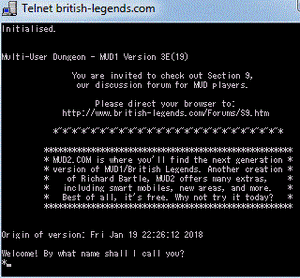
Multi-User Dungeon, or MUD (referred to as MUD1, to distinguish it from its successor, MUD2, and the MUD genre in general) is the first MUD and the oldest virtual world in existence. It was created in 1978 by Roy Trubshaw Essex University on a DEC PDP-10 in the UK, using the MACRO-10 assembly language.

Why this matters

MUDs were a pre-internet multiplayer experience inspired by text-based adventures (like Colossal Cave Adventure) and dungeon crawlers (Zork!) of the time. While they started on college campuses, they soon spread and became popular even into the 90s. Many MUDs are still playable today, with a version of MUD1 available at british-legends.com.

June 1978

Space Invaders cover art

Space Invaders

Tomohiro Nishikado, Taito

Arcade, Atari 2600

Space Invaders, released in arcades by Taito in 1978, is one of the most influential and successful video games of all time, laying the foundations for most shooters and action games that followed. It revolutionized the game industry and has become a pop culture icon. Bally Midway (Yeah, that Midway) had a license to produce it in the US, and later Atari ported it for the Atari 2600.

Why this matters

It's no exaggeration to say that Space Invaders changed everything. It's widely considered to be one of the highest grossing video games of all time when accounting for inflation, and pierced the public consciousness. There's a funny myth about how Japan ran out of coins at one point because of the game, but there's nothing really substantive to back that up.

August 1979

Lunar Lander cover art

Lunar Lander

Atari

Arcade

Released by Atari in 1979, this arcade game simulated the challenge of landing an Apollo Lunar Module on the Moon. It featured monochrome vector graphics and a unique analog throttle control. Two buttons controlled the tilt of the lander and a third button was used to abort a landing, expending precious fuel to do so.

Why this matters

The concept originates from a 1969 text-based game ("Lunar") written by high-schooler Jim Storer in FOCAL on a DEC PDP-8, inspired by the Apollo 11 landing; players managed vertical thrust from velocity/fuel readouts in timed turns.

November 1979

Asteroids cover art

Asteroids

Atari

Arcade, Atari 2600

Players steer a ship through a field of asteroids, breaking them apart into smaller and smaller pieces while avoiding being hit.

Why this matters

A landmark Golden age arcade release and one of the most influential vector titles. It is Atari's best-selling arcade game of all time (~70,000 arcade units), and the Atari 2600 port sold over 3 million copies. You can find an amazing design doc for the game here.

1980s

1980

Rogue cover art

Rogue

Michael Toy, Glenn Wichman, Ken Arnold

Unix

Rogue is a classic ASCII-based RPG, infamous for its difficulty. It is known for spawning its own genre, called Roguelikes, and its influences can still be seen in a wide variety of other games.

Why this matters

"Rogue was originally developed as a way to combine the asynchronous nature of chess with the dungeon crawling of Dungeons & Dragons. Like any good dungeon master, the devs quickly realized that they needed a way to keep adventures fresh for each session, and implemented random level and enemy generation. Today the majority of gamers can tell you (or argue with you about) what a “rogue-like” is, but probably haven’t played the progenitor of the genre. And while there’s not much to the game visually, or mechanically compared to modern rogue-likes, the original is still as engaging and infuriating today as it was in the ‘80s." - Ben Pack

Star Raiders cover art

Star Raiders

Atari

Atari 8 bit, Atari ST, Atari 2600, Atari 5200

Star Raiders is a real-time space combat and strategy game that blends tactical decision-making with first-person starfighter action.

Why this matters

Designed and programmed by Atari engineer Doug Neubauer (who also worked on the POKEY sound chip). It combined a first-person 3D cockpit view with a strategic 2D galactic map, establishing conventions of the space-combat sim genre. It would influence later space-combat games like Elite (1984) and Wing Commander (1990).

January 1980

FS1 Flight Simulator cover art

FS1 Flight Simulator

subLOGIC

Apple II, TRS 80

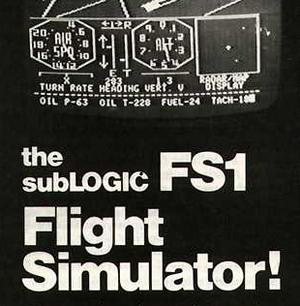
The first 3D flight simulator developed for the Apple II and TRS-80 with black and white wireframe graphics. Pilot a Sopwith Camel and press W for an optional WWI dogfight mode.

Why this matters

Bruce Artwick developed FS1 as a realization of his 1976 master's thesis, A Versatile Computer-Generated Dynamic Flight Display. It would go on to be licensed by Microsoft, and would become their longest-running software line, outlasting MS-DOS and predating Windows.

March 1980

Adventure cover art

Adventure

Atari

Atari 2600

In Adventure, the player controls a square pixel character, navigating an open environment to obtain a Golden Chalice and return with it to the Golden Castle.

Why this matters

Often credited as the first console action-adventure game, and also the origin of the video game "easter egg" - when a developer hides a secret in the game for players to find. In this case, Warren Robinett programmed a hidden room displaying "Created by Warren Robinett" because Atari did not credit its programmers.

May 1980

Mystery House cover art

Mystery House

Ken Williams, Roberta Williams

Apple II

An adventure game designed by Roberta and Ken Williams. Although the game itself is a text parser, it was the first adventure game to feature graphics. In each location, a wire-frame drawing was displayed above the description. The game places players locked inside a mansion, tasked with finding a way out.

Why this matters

Roberta and Ken Williams are nothing short of legendary game developers. They'd go on to found On-Line Systems (reincorporated as Sierra On-Line), which would develop games such as King's Quest, Gabriel Knight, Space Quest... and Leisure Suit Larry. They set a template for how adventure games would be made going forward.

Pac-Man cover art

Pac-Man

Toru Iwatani, Namco

Arcade, Atari 2600

One of the most popular arcade games of all time, Pac-Man was released in arcades in 1980 and became a pop culture icon for the decade. The player controls Pac-Man, a yellow circle making biting motions, as he navigates a maze to eat pellets and rack up a high score.

Why this matters

Pac-Man was one of the first games with a true mascot, released in the midst of Japan's "kawaii" craze (consider that Hello Kitty launched in the 70s in Japan). Atari licensed the game from Namco and held exclusive rights to develop and distribute it for the VCS 2600, which sold 7-8 million cartridges worldwide. Atari did overproduce Pac-Man, by some estimates by about 4 million cartridges.

November 1980

Battlezone cover art

Battlezone

Atari

PC, Apple II, Atari 8 bit, Atari ST, Commodore 64, ZX Spectrum

Released in 1980, Battlezone was an arcade machine where you assumed the role of a tank commander in a vector-based graphic world, giving the impression of 3D images.

Why this matters

Battlezone featured a custom "Math Box" coprocessor (a specialized ALU by Jed Margolin and Mike Albaugh) to handle its 3D vector math. A modified military variant, the "Bradley Trainer" (Army Battlezone), was built for the U.S. Army for Bradley Fighting Vehicle gunnery training; only two units were produced.

February 1981

Defender cover art

Defender

Williams Electronics

PC, Apple II, Atari 8 bit, Commodore 64, Arcade

Defender was developed by Williams Electronics and lead-designed by Eugene Jarvis, debuting at the AMOA trade show in Chicago in late 1980 before its wide rollout through 1981. You pilot a ship across a horizontally scrolling world, blasting waves of alien invaders while protecting humanoids from abduction - let the Landers carry one off and it mutates into something nastier. It's frequently cited as the first side-scrolling shoot 'em up.

Why this matters

Defender was famously, brutally hard - a game that respected exactly nobody's quarters - and it broke new ground by scrolling its action sideways across a world bigger than the screen, complete with a radar so you could find the trouble you couldn't see. It made Eugene Jarvis a legend and helped kick the side-scrolling shooter into being.

June 1981

Ultima cover art

Ultima

Richard Garriott

Apple II

Created by computer gaming pioneer Richard Garriott, a.k.a. Lord British, Ultima was one of the first computer role playing games and it set many standards for the genre. It was simply called "Ultima" at the time - the "Ultima I: The First Age of Darkness" title got applied retroactively after the 1986 remake - and it recycled code from Garriott's earlier Akalabeth: World of Doom (1980) for its first-person dungeon sequences.

Why this matters

Garriott didn't just make a game, he set standards - the sprawling tile-based world, the mix of overworld and first-person dungeons, the whole "build your character and go" ethos that the genre still runs on. Ultima became one of the pillars the entire CRPG world was built on, and Lord British one of its founding figures.

July 1981

Centipede cover art

Centipede

July 31, 1981Atari

Arcade, Apple II, Atari 8 bit, Commodore 64

Centipede is a vertical shooter in which you must destroy centipedes and other bugs before they reach the bottom of the screen and destroy you.

Why this matters

Co-designed by Dona Bailey and Ed Logg, Bailey had come to Atari from writing assembly for microprocessors in Cadillac engines, and she is generally credited as the first woman to program a coin-operated arcade game. Logg has described the split as his design, her programming, roughly.

Donkey Kong cover art

Donkey Kong

Shigeru Miyamoto, Gunpei Yokoi, Nintendo

Arcade, ColecoVision

Control Jumpman (later known as Mario) and save his girlfriend, Pauline, from the evil barrel-tossing gorilla known as Donkey Kong. Designed by Shigeru Miyamoto, this was the game that set the template for the platformer genre.

Why this matters

Nintendo at the time of Donkey Kong's development was a toy company, attempting to crack the arcade market. Their first release, Radar Scope, was a hit in Japan but failed to entice U.S. consumers. The arcade version of Donkey Kong was a huge success in the U.S. market, and Coleco secured the exclusive rights to produce Donkey Kong for their console, the ColecoVision. It helped Coleco compete directly with Atari for consumers' attention at home. Shigeru Miyamoto, the game's designer, has gone on to the become one of the greatest and most influential video game designers of all time.

September 1981

Wizardry: Proving Grounds of the Mad Overlord cover art

Wizardry: Proving Grounds of the Mad Overlord

Sir-Tech

Apple II, Commodore 64

The first chapter of what would become one of the defining series for PC-based RPGs, this instant classic pit a group of adventurers against the evil wizard, Werdna, in a quest for an amulet that they must retrieve for Trebor, the Mad Overlord.

Why this matters

Wizardry took the tabletop dungeon crawl and made it a party-based computer institution, selling over 500,000 copies and, crucially, jumping the Pacific - it directly influenced Dragon Quest and Final Fantasy, effectively helping seed the entire Japanese RPG tradition.

December 1981

Utopia cover art

Utopia

December 31, 1981Mattel Electronics

Intellivision, PC

What is regarded to be the first sim and strategy game to ever come to a console platform, Utopia sets up two rival nations and hands players the reigns of leader.

Why this matters

Utopia was an early arrival of real time strategy games on consoles when the genre was primarily dominated by turn based ones, and even more interesting was that it shipped as a two player multiplayer only game, though many gamers played solo with the other island sitting idle.

Zaxxon cover art

Zaxxon

December 26, 1981Sega, Ikegami Tsushinki

PC, Apple II, Atari 8 bit, Commodore 64, MSX, ZX Spectrum

Zaxxon is an arcade shooter developed by Sega with help from Ikegami Tsushinki, released in Japan on December 26, 1981 and reaching North America in April 1982. Its trick was axonometric (isometric) projection, presenting the action at an angle from a third-person view to fake a real sense of depth - the technique was so central it gave the game its name (z-axon).

Why this matters

When Zaxxon first appeared, that angled pseudo-3D look was genuinely jaw-dropping - you really felt like you were flying into the screen, banking over walls and judging your altitude against a shadow. It's also one of the first arcade games Sega bothered to advertise on television, dropping something like $150,000 on a commercial.

1982

Pinball Construction Set cover art

Pinball Construction Set

Bill Budge

PC, Apple II, Atari 8 bit, Commodore 64

Bill Budge's Pinball Construction Set gives you a set of tools that let you create and save your own virtual pinball tables. A big early example of user-created content and accessible level editing tools.

Why this matters

Pinball Construction Set shipped with the promise of allowing players to create their own games - the tool was the product. First developed and released by Bill Budge in 1982, Electronic Arts picked it up and released it in 1983 for the Atari 8-bit and Commodore 64. Will Wright has cited it as an influence on SimCity, and it would be followed by games like RPG Maker, LittleBigPlanet, and Mario Maker, and more.

Robotron: 2084 cover art

Robotron: 2084

Vid Kidz

Arcade, Atari 8-bit, Atari 5200/7800, Atari Lynx, Apple II, Commodore 64, IBM PC, Atari ST

Robotron: 2084 drops you into a single screen swarming with robots, where your only jobs are to blast everything and rescue the last surviving human family before the machines get them. It was built by Eugene Jarvis and Larry DeMar's two-man studio Vid Kidz and released to arcades by Williams Electronics in March 1982.

Why this matters

Two joysticks, no buttons: one hand moves you, the other aims your fire in any direction. That control scheme was the whole innovation, and it launched the twin-stick shooter as we know it.

September 1982

Pitfall! cover art

Pitfall!

Activision

Atari 2600, Atari 5200, Atari 8-bit, ColecoVision, Commodore 64

Pitfall! is a 2D platforming adventure in which you guide Pitfall Harry through a scrolling jungle to collect 32 treasures inside a 20-minute time limit, dodging rolling logs, snakes, scorpions, quicksand, and crocodile-infested swamps along the way. Designed and programmed by David Crane for the Atari 2600, it became one of the console's biggest hits and was later ported to the ColecoVision, the Atari 5200 and 8-bit line, and the Commodore 64, among others.

Why this matters

Activision was formed by programmers that left Atari after they failed to negotiate better pay for their efforts. They'd realized that some of their individual works were responsible for large percentages of the company's profits, but felt they were never credited for their work appropriately. Pitfall! is proof they were right - it was a best seller on the console, and its gameplay also paved the way for future titles like Prince of Persia and Super Mario Bros.

Atari lost exclusive control over who could create games for its system when their lawsuit against Activision ended in a 1982 settlement that let third parties in, and this would greatly contribute to the video game crash of 1983.

October 1982

Q*bert cover art

Q*bert

Warren Davis, Jeff Lee

Arcade

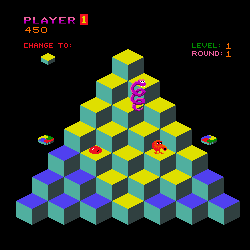
Q*bert has you hopping a little orange creature around an isometric pyramid of cubes, changing every cube to a target color while dodging enemies like the coily snake.  It was conceived by Jeff Lee, who drew the character and the pyramid, and built into a game by Warren Davis at Gottlieb, releasing to arcades in October 1982.

Why this matters

Q*bert is an early example of creating the illusion of a 3D scene using 2D images. Jeff Lee was inspired by M.C. Escher's art and its illusions of perspective.

December 1982

E.T. the Extra-Terrestrial cover art

E.T. the Extra-Terrestrial

Howard Scott Warshaw, Atari

Atari 2600

E.T. is an adventure game based on the Spielberg film, in which the alien wanders an overworld of pits collecting phone parts to call home. Howard Scott Warshaw designed and programmed the entire thing for the Atari 2600 in just over five weeks to hit the Christmas 1982 deadline after Atari bought the rights. It flopped hard: some 669,000 copies were reportedly returned, and unsold cartridges were buried in an Alamogordo, New Mexico landfill - an urban legend until the site was actually excavated in April 2014 and the carts dug back up.

Why this matters

E.T. the Extra-Terrestrial is sort of a mascot for the 1983 Video Game Crash - but the factors playing into the crash were truly a perfect storm. Atari had lost a court case pertaining to outside developers of Atari games, and the market was flooded by cheap cartridges. This combined with the arrival of the VCR and price wars in the PC market devastated video game sales.

March 1983

Nobunaga no Yabou cover art

Nobunaga no Yabou

March 31, 1983Koei

NEC PC 8801, MSX, NEC PC 9801, Sharp X68000, Sharp MZ, NEC PC 6001

Nobunaga's Ambition is a turn-based historical strategy game set during Japan's Sengoku (Warring States) period, developed by Koei and designed by Kou Shibusawa - a pen name of co-founder Yoichi Erikawa - and released in Japan in March 1983 for the NEC PC-8801.

The player commands a daimyō and sets out to conquer the seventeen provinces of central Japan from a 1560 start, developing each province's rice economy and gold, training and paying soldiers, conducting diplomacy, and waging war - one action per province each turn, with battles resolved on a separate tactical map.

Why this matters

Nobunaga's Ambition is regarded as one of the originators of the grand-strategy genre: turn-based rule of a domain through economy, military, and diplomacy with the goal of conquest. Its success established Koei as a strategy publisher and began the company's long-running historical-simulation output, which grew to more than fifteen Nobunaga's Ambition titles alongside the parallel Romance of the Three Kingdoms series.

April 1983

Attack of the Mutant Camels cover art

Attack of the Mutant Camels

Jeff Minter, Llamasoft Ltd.

Commodore 64, Atari 8-bit

Attack of the Mutant Camels (AKA Advance of the Megacamel) was developed by Llamasoft. The game is very similar to the 2600 version of Star Wars: The Empire Strikes Back.

Why this matters

While the 1983 Video Game Crash was crushing American games developers, a burgeoning PC video game market in the United Kingdom was starting to spin up. The UK home micro game scene was rife with weird and surreal titles, many inspired by Monty Python. Jeff Minter's games are an iconic example of this style, and Attack of the Mutant Camels is probably the most well known example of the era.

June 1983

Portopia Renzoku Satsujin Jiken cover art

Portopia Renzoku Satsujin Jiken

June 1, 1983Yuji Horii

MSX, Nintendo Entertainment System, NEC PC 8801, Sharp X1, FM 7, NEC PC 6001

An adventure game created by Yuji Horii and published by Enix in 1983 where the player controls a detective solving a murder mystery.

Why this matters

The title helped establish the template for the Japanese adventure genre, which many other titles would imitate and build upon. When asked "Can you remember one of the first times a story in a game really struck you?" Hideo Kojima cited Portopia Renzoku Satsujin Jiken. "Along with my encountering Super Mario Bros., experiencing this game led to my working in this industry. The player is a detective and tries to solve this murder case with his colleague called Yasu. There’s mystery, a 3D dungeon, humor, and a proper background and explanation of why the murderer committed the crime. That is why there was drama in this game. My encountering this game expanded the potential of video games in my mind."

July 1983

Dragon's Lair cover art

Dragon's Lair

Advanced Microcomputer Systems, Don Bluth

Arcade, Coleco Adam, Amstrad CPC, ZX Spectrum, Commodore 64

Dragon's Lair is an interactive cartoon that lets players help guide the actions of brave knight Dirk the Daring, as he ventures through the dangerous castle of Singe the Dragon in order to rescue his beloved princess Daphne.

Why this matters

Dragon's Lair was first released as a Laserdisc arcade game in 1983 by Cinematronics, featuring artwork created by former Disney animator Don Bluth. In an arcade full of blocky sprites, Dragon's Lair looked like a movie - because it basically was one. The LaserDisc's storage let it deliver fidelity years ahead of anything running on contemporary hardware, and players lined up (and paid a premium quarter) just to watch Don Bluth's animation play out.

"Dragon's Lair is the intersection between classic arcade games and the hand-drawn animated movies I love. I'd always spend a few quarters on a cabinet if I saw one in the wild, even if I usually failed a QTE and died. But, hey, those death animations were worth the price of admission." - Mike Minotti

September 1983

Track & Field cover art

Track & Field

September 30, 1983Konami

Arcade

Players button mash their way through Olympic events in this arcade and console classic

Why this matters

Not the first sports game by a long shot, but the button-mashing translation of athletics would go on to become a full genre. Hyper Sports, Daley Thompson's Decathalon, Epyx Summer Games, and even Mario & Sonic at the Olympics Games would follow in its footsteps.

November 1983

M.U.L.E. cover art

M.U.L.E.

Ozark Softscape

Atari 8-bit

M.U.L.E. is a four-player economic strategy game set on the colony planet Irata - "Atari" spelled backwards - where players compete and cooperate to mine resources, work the market, and master the planet. It was built by Ozark Softscape and published by Electronic Arts as one of EA's very first titles, released in 1983 for Atari 8-bit computers.

Why this matters

M.U.L.E. was doing four-player, simultaneously competitive-and-cooperative multiplayer economics in 1983, and designers have been quietly cribbing from it ever since. It was lead designer Danielle Bunten Berry's early work, and its fingerprints run deep: Will Wright dedicated The Sims to Bunten's memory, and Shigeru Miyamoto has named it as an influence on Pikmin.

1984

King's Quest cover art

King's Quest

Sierra, Microsmiths Inc, AGD Interactive

IBM PCjr, Amiga, PC, Sega Master System, Apple II, Atari ST, Mac

Sir Graham has been given the task to return three royal items to King Edward of the kingdom of Daventry. If he can return all three items, Sir Graham will become the next king of Daventry.

Why this matters

King's Quest gave you an animated character you steered through a pseudo-3D world you could move around and behind, not just a static illustration with a text parser bolted on. Roberta Williams had already helped invent the graphic adventure with Mystery House; here she set the template Sierra would follow for a decade and a half of King's Quests.

March 1984

The Black Onyx cover art

The Black Onyx

March 31, 1984Bullet Proof Software Inc

NEC PC-8801, PC-9801, FM-7, MSX, Sega SG-1000, Famicom

The Black Onyx is a first-person, party-based dungeon crawler cut from the same cloth as Wizardry: build a party, gear them up, and grind your way down a multi-level dungeon toward the jewel it's named for. Dutch-born designer Henk Rogers built it for the NEC PC-8801 and released it in Japan in 1984, deliberately sanding down the imported-RPG formula - he pared his full "fighters, warriors, wizards, clerics" D&D vision to fit memory, added a build-your-own-character face, and put equipment on-screen instead of buried in menus. It went on to become one of Japan's best-selling computer games.

Why this matters

Rogers spotted the gap in a single glance: "there were no computer role-playing games in Japan. The US had Ultima and Wizardry" - so the same man that flew to Moscow to negotiate the rights to Tetris also worked to popularize role playing games in Japan.

The Black Onyx was built from the ground up to be approachable for players who'd bounced clean off the imports. It cracked open a market that Dragon Quest and Final Fantasy detonated two years later; Rogers cheerfully admits those Japanese-made games "struck a more effective cultural chord" and blew right past him.

June 1984

I, Robot cover art

I, Robot

June 28, 1984Atari, Inc.

Arcade

I, Robot is an arcade game where you play a rebellious robot hopping across tilted floor grids, shooting the watchful eye of "Big Brother." Designed by Dave Theurer and published by Atari, it hit North American arcades on June 28, 1984. It flopped commercially, with only roughly 750–1,500 cabinets ever manufactured.

Why this matters

I, Robot holds a Guinness World Record as the first arcade game to render filled 3D polygons - not wireframe outlines like Battlezone, but actual solid, shaded surfaces computed in real time.

Tetris cover art

Tetris

June 6, 1984Alexey Pajitnov

Elektronika 60, IBM PC, Spectrum HoloByte, Nintendo Game Boy

Tetris, sometimes known by its Russian name Тетрис, is a falling-block puzzle game developed by Alexey Pajitnov for the Electronika 60 in 1984-1985, with a later IBM PC release (co-developed by Vadim Gerasimov) in 1985-1986. It took Henk Rogers flying to Moscow to negotiate the handheld rights directly with Elorg, the state's software-export agency, to untangle it - and that deal made Tetris the Game Boy's killer app and eventually built The Tetris Company in 1996 (founded by Pajitnov and Rogers).

Why this matters

The story of how Tetris escaped the USSR is genuinely wild. Pajitnov, as a Soviet state employee, couldn't sell his own game for a profit and saw no royalties for years, while the international rights got juggled, misassigned, and fought over between publishers.

July 1984

Karate Champ cover art

Karate Champ

Technos Japan

Arcade, Apple II, Commodore 64, NES

Karate Champ puts two fighters in one-on-one kumite matches, scoring clean karate techniques across a range of strikes and stances. Generally credited to Technos Japan and published by Data East, it reached arcades in 1984 (Japan in May, worldwide in September) before porting to the Apple II, Commodore 64, and NES.

Why this matters

Karate Champ is the game that laid down the modern one-on-one martial-arts fighter - the round structure, the judged scoring, the whole two-guys-facing-off template that Street Fighter and everything after would inherit. It didn't invent the very idea of a fighting game - Sega's Heavyweight Champ got there back in 1976 - but this is the one whose DNA you can still feel every time two characters square up on a health-bar screen.

September 1984

Dragon Slayer cover art

Dragon Slayer

September 10, 1984Nihon Falcom Corp

Game Boy, MSX, NEC PC 8801, NEC PC 9801, Sharp X68000, Sharp X1

Dragon Slayer is an early action RPG played from a top-down view: you move through a maze-dungeon a block at a time, fight by bumping into monsters and watching both HP bars crawl toward zero, and pump up your Strength stat by hauling power stones back to your home base.

Why this matters

Dragon Slayer is one of the earliest action RPGs, pairing real-time combat with character growth at a point when most games kept the two apart. It also started a long-running Falcom line - the Dragon Slayer name carried on through Xanadu, Sorcerian, and Legend of Heroes - and the design it worked out runs forward into Ys and much of the action-RPG genre that came after.

Elite cover art

Elite

Ian Bell, David Braben

BBC Micro, Acorn Electron, Commodore 64, ZX Spectrum, Amstrad CPC

Elite is an open-ended space game of cockpit-view flight, trading, piracy, bounty hunting, and the occasional dogfight, rendered in wireframe 3D with hidden-line removal. Created by Ian Bell and David Braben and published by Acornsoft for the BBC Micro in September 1984, it later ported widely and spawned sequels running all the way to 2014's Elite Dangerous.

Why this matters

How do you fit an entire galaxy into 32K of memory? You don't store it - you generate it. Elite used procedural generation to conjure eight galaxies of 256 planets each on the fly, a trick that let two guys on a BBC Micro build a universe bigger than any hard drive of the era could have held. Just as important, it handed you no goals: dock, upgrade, trade, hunt, explore, become whatever kind of spacer you wanted.

November 1984

Knight Lore cover art

Knight Lore

Chris Stamper, Tim Stamper, Ultimate Play the Game

ZX Spectrum, BBC Micro, Amstrad CPC, MSX

Knight Lore is an isometric puzzle-adventure in which you guide a cursed character through room after room of a wizard's castle, solving object puzzles by day and turning into a werewolf by night. It was developed and published by Ultimate Play the Game, founded by brothers Chris and Tim Stamper, and released in 1984 for the ZX Spectrum.

Why this matters

Knight Lore ran on Ultimate's "Filmation" engine, which used masked sprites to render a convincing isometric 3D room you could move freely around inside, which made a splash among the British computer scene. It wasn't the literal first isometric game, but it was the one that spawned an entire sub-genre of imitators on home computers seemingly overnight. And the Stamper brothers weren't done: they'd go on to found Rare, famous for Donkey Kong Country, Banjo-Kazooie, GoldenEye 007, and more.

September 1985

Super Mario Bros cover art

Super Mario Bros

September 13, 1985Nintendo

NES

Focusing on a humble plumber and his brother setting out to rescue a Princess who has been kidnapped by a vile lizard king, Super Mario Bros. is a side-scrolling platformer released September 13, 1985 for the Famicom, designed by Shigeru Miyamoto and co-designer Takashi Tezuka.

It's one of the best-selling video games of all time - roughly 40 million copies of the original NES release, north of 58 million across every version - and it held the all-time sales record for more than twenty years, until Wii Sports.

Why this matters

Widely considered one of the best video games ever made, and deeply influential for every 2D platformer that would follow. While Donkey Kong introduced the world to Mario and its particular brand of platforming, Super Mario Bros. and the Nintendo Entertainment System could be credited as foundational elements of the revival of the video game business in the United States after the crash of 1983. Koji Kondo's phenomenal soundtrack paired with the feel-good precision of its controls have made it a true classic - the kind of thing people who've never held a controller can still hum.

Ultima IV: Quest of the Avatar cover art

Ultima IV: Quest of the Avatar

September 16, 1985Origin Systems

Apple II, Commodore 64, Atari 8-bit

Released September 16, 1985 on the Apple II, Ultima IV is a seminal role-playing game focused on the protagonist's moral journey rather than defeating a nemesis - in fact, it has no villain to slay at all. The goal is spiritual: become the Avatar by mastering eight virtues - Honesty, Compassion, Valor, Justice, Sacrifice, Honor, Spirituality, and Humility - then descend the Stygian Abyss to claim the Codex of Ultimate Wisdom.

Why this matters

Richard Garriott's long-running Ultima series changed drastically with Quest of the Avatar. Bothered by his players' amoral approach to his previous games - and, by his own account, partly motivated by angry letters from parents - he built what may be one of the first real morality systems in a video game.

October 1985

Gauntlet cover art

Gauntlet

October 15, 1985Atari Games

Arcade

A top-down fantasy action arcade game that launched October 15, 1985 as a dedicated four-player cabinet, Gauntlet let up to four players simultaneously fend off hordes of enemies through treacherous mazes as the Warrior, Valkyrie, Wizard, or Elf.

Why this matters

Gauntlet made a splash in the arcades with its four player dungeon crawler gameplay as game developers were looking for ways to innovate and create experiences in the arcade that players couldn't get at home. John Howard Palevich's Dandy (1983), an MIT thesis project published through the Atari Program Exchange, shares Gauntlet's core so closely that designer Ed Logg openly acknowledged it as inspiration - and Palevich threatened legal action, and settled out of court (reportedly for a Gauntlet machine of his own).

Little Computer People cover art

Little Computer People

Activision

Amiga, Amstrad CPC, Apple II, Atari ST, Commodore 64, ZX Spectrum

Players look after a virtual person in this early precursor to The Sims, designed by David Crane (with Rich Gold) and published by Activision, with the C64 version arriving in North America in 1985. Also known as "House-on-a-Disk," it hands you a little autonomous man and his dog living inside your computer; you don't so much control him as feed him, play records, and watch him get on with his day.

Why this matters

Fifteen years before Will Wright let you micromanage a household, Activision shipped a game with no score, no win state, and no enemies - just a tiny person to care for. Crane himself framed it as an early step toward the simulation genre, and it's now widely regarded as a direct ancestor of The Sims.

Space Harrier cover art

Space Harrier

Sega R&D

Arcade, Amiga, Game Gear, PC, Sega Master System, Amstrad CPC, Atari ST

Play as a flying dude holding a large cannon as he takes on giant mechs, flying mushrooms, and fire-breathing dragon skeletons. A fast, third-person rail shooter designed and programmed by Yu Suzuki, released in Japanese arcades on October 2, 1985 - originally conceived as a realistic fighter-jet game before memory limits pushed Suzuki toward a floating human hero and a psychedelic sci-fi world.

Why this matters

Space Harrier was one of the first games built on Sega's "Super Scaler" hardware, which threw enormous sprites at the screen and scaled them in and out to fake a sense of speed and depth that wowed at the arcades. That pseudo-3D horsepower - and the deluxe hydraulic cabinet that rolled with your movements - set the template for Sega's arcade dominance and for Suzuki's own follow-ups like OutRun.

February 1986

The Legend of Zelda cover art

The Legend of Zelda

February 21, 1986Nintendo EAD

NES

A young boy named Link explores a huge overworld of enemies and dungeons, collecting the eight scattered fragments of the Triforce of Wisdom so he can confront Ganon and rescue Princess Zelda. Directed and designed by Shigeru Miyamoto and Takashi Tezuka, it debuted in Japan on the Famicom Disk System on February 21, 1986, then reached North America on cartridge in 1987 as one of the first games with an internal battery to save your progress.

Why this matters

The Legend of Zelda asks players to poke at every rock and search every corner of its map, and the battery-backed save system meant that the adventure could persist between gaming sessions, a genuinely new idea on consoles. The Legend of Zelda has gone on to become one of gaming's most beloved franchises with its curiosity-first design philosophy.

May 1986

Dragon Quest cover art

Dragon Quest

May 27, 1986Chunsoft

NES, MSX, MSX2, PC-9801

Rescue Princess Gwaelin and defeat the evil Dragonlord - who's made off with the Ball of Light from the kingdom of Alefgard - in this landmark RPG from Enix, originally released on the Japanese Famicom on May 27, 1986. It was designed and written by Yuji Horii, developed by Chunsoft, and reached the West in 1989 retitled "Dragon Warrior."

Why this matters

While turn-based RPG's are deeply associated with Japanese game developers now, role playing games in general were not popular with Japanese consumers before 1984 - imports like Wizardry and Ultima (Horii's own cited influences) introduced the concepts to a wary audience. In 1986 the seminal Japanese turn-based RPG arrived: Dragon Quest, streamlined for newcomers and dressed up with a killer pop-culture team - character art by Akira Toriyama (of Dragon Ball fame) and music by Koichi Sugiyama. It resonated with Japanese audiences, launched a national institution, and has since become a worldwide mainstay of the genre.

August 1986

Metroid cover art

Metroid

August 6, 1986Nintendo R&D1, Intelligent Systems

NES

Don the Power Suit of intergalactic bounty hunter Samus Aran, sent to the planet Zebes to destroy the stolen Metroid organisms, wreck the Space Pirates' operation, and take down Mother Brain. Originally released August 6, 1986 in Japan on the Famicom Disk System, it's a 2D exploration game with an interconnected map you gradually unlock by finding new abilities.

Why this matters

Metroid, co-developed by Nintendo R&D1 and Intelligent Systems, fused shooting and platforming with a maze you had to map in your head and re-open with power-ups, so backtracking became discovery rather than a chore. That structure was influential enough to eventually get named after the game itself (half of the "Metroidvania" label).

September 1986

OutRun cover art

OutRun

SEGA AM2

Amiga, Game Gear, Genesis, PC, Sega Master System, Amstrad CPC

Yu Suzuki's classic Sega arcade "driving game" puts players behind the wheel of a Ferrari Testarossa-style red convertible on a breezy trip through American- and European-inspired landscapes.

Why this matters

OutRun took the Super Scaler pseudo-3D tech from Space Harrier and leveraged it for a perfect Miami-sunset driving experience, complete with a radio to swap between tracks by Hiroshi Kawaguchi. The hydraulic sit-down cabinet made it an arcade event.

April 1987

Double Dragon cover art

Double Dragon

April 22, 1987Technos Japan

Arcade, Amiga, Atari Lynx, Game Boy, Game Gear, Genesis, PC

A two-player cooperative, side-scrolling beat 'em up starring martial-artist brothers Billy and Jimmy Lee, Double Dragon debuted in arcades on April 22, 1987, developed by Technōs Japan and directed by Yoshihisa Kishimoto. Kishimoto conceived it as a follow-up to Nekketsu Kōha Kunio-kun (Renegade), reworked with brawling co-op and a grittier street-fight look for international appeal.

Why this matters

This is the game credited, in part, with the popularity of the brawler in the arcade craze of the 1980s and '90s. It kicked off a genuine golden age of beat 'em ups, and you can draw a straight line from the Lee brothers to Final Fight, Streets of Rage, and the whole flood of side-scrolling brawlers that followed.

July 1987

Metal Gear cover art

Metal Gear

July 13, 1987Konami

MSX2, NES, Commodore 64

Metal Gear tells the tale of Solid Snake, a rookie FOXHOUND operative on his first mission, as he infiltrates the fortified compound Outer Heaven to destroy a bipedal, nuclear-launching super-weapon called Metal Gear.

Originally released on the MSX2 in Japan on July 13, 1987, it marked Hideo Kojima's directorial debut and built its whole design around avoiding fights rather than winning them - sneaking past guards, dodging sight-lines, and running when you're spotted.

Why this matters

Metal Gear flipped the era's shoot-everything logic on its head: here, getting into a firefight usually meant you'd already screwed up. It's the game that made stealth a mainstream, marketable idea and launched one of gaming's most beloved (and most talkative) franchises, with Kojima steering it for decades.

NetHack cover art

NetHack

July 31, 1987

Amiga, PC, Atari ST, Mac, Android, iPhone

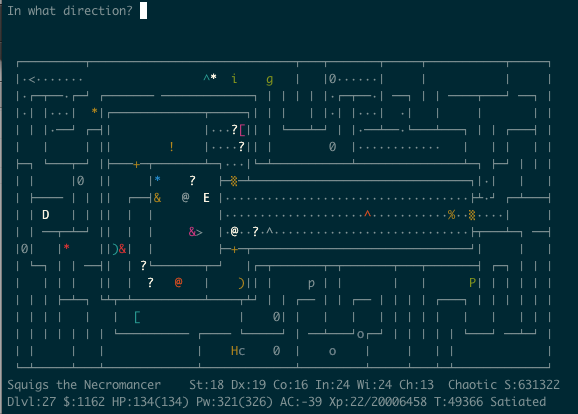
Inspired by Rogue, NetHack is an ASCII-based RPG in which the player must navigate the Mazes of Menace in search of the Amulet of Yendor for his deity.

Why this matters

NetHack has a design premise that every object should interact or behave as expected with everything else in the game - the interaction matrix is dense, and combined with its procedurally generated dungeons and D&D style mechanics (NetHack is a fork of Hack, which was heavily inspired by Rogue), has made for an experience that left a lasting impression on many game developers.

October 1987

Maniac Mansion cover art

Maniac Mansion

October 5, 1987Lucasfilm Games

Amiga, PC, Apple II, Atari ST, Commodore 64, Nintendo Entertainment System

Maniac Mansion is a graphic adventure game originally released in 1987 by Lucasfilm Games and designed by Ron Gilbert and Gary Winnick. When the innocent Sandy is kidnapped by the maniacal, meteor-controlled Dr. Fred, it's up to her boyfriend Dave and two friends you choose to break into the mansion and save her. Instead of typing commands, you click a menu of verbs at objects - a friendlier way to poke at the world.

Why this matters

That verb-menu interface was powered by SCUMM (the Script Creation Utility for Maniac Mansion), an engine Gilbert built for this game - and it went on to run the entire golden age of LucasArts adventures, from Monkey Island to Day of the Tentacle. Maniac Mansion also had a cast of swappable kids, multiple endings, and a sense of humor that made point-and-click feel playful instead of punishing. It was Lucasfilm Games' first self-published product, and it set the template for a studio that would define the genre.

November 1987

Méwilo cover art

Méwilo

Coktel Vision

Amiga, Amstrad CPC, Atari ST, MS-DOS, Thomson TO7

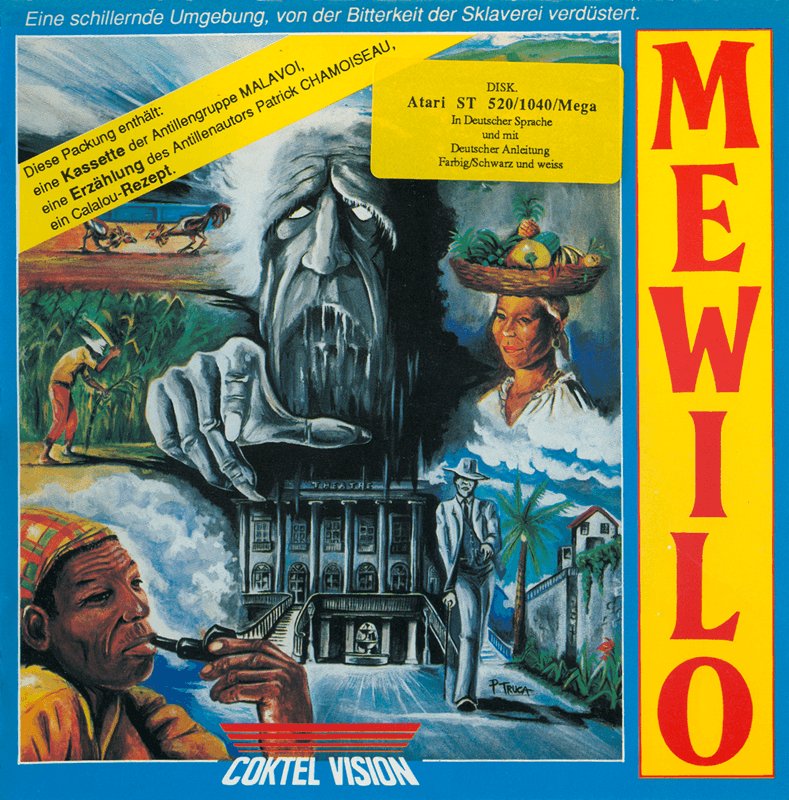
Méwilo is a mystery adventure designed, written, and directed by Muriel Tramis - her debut game - set in Saint-Pierre, Martinique on May 7, 1902, the day before Mount Pelée erupted and erased the town. You play a parapsychologist chasing supernatural (zombie) sightings through a story Tramis co-wrote with Martinican novelist Patrick Chamoiseau, pulled straight from Caribbean legend.

Why this matters

Méwilo designer Muriel Tramis is widely credited as the first Black woman video game designer, and she drew on her own Martinican heritage for a game set on the eve of a real catastrophe most players had never even heard of. French developers like Tramis were treating games as a consciously artistic medium - with actual literary collaborators - years before anyone was giving the format that kind of credit.

December 1987

Dungeon Master cover art

Dungeon Master

December 15, 1987FTL Games

Amiga, PC, SNES, Atari ST, Sharp X68000, Apple IIgs

Dungeon Master, released on the Atari ST on December 15, 1987, is a real-time, first-person dungeon crawler in which you steer a party of up to four champions through a maze of combat and puzzles to recover the Firestaff and destroy Lord Chaos.

Why this matters

Dungeon Master took the first-person party RPG concept from turn-based to real time, and became the Atari ST's best-selling game - moving around 40,000 copies in its first year. Its influence is easy to trace: Eye of the Beholder, Ultima Underworld, and most grid-crawlers that followed borrowed from it in some way.

Final Fantasy cover art

Final Fantasy

December 18, 1987Square

PC, MSX, Nintendo Entertainment System

Final Fantasy is the first entry in Square's role-playing series, released for the Famicom in Japan on December 18, 1987, directed by Hironobu Sakaguchi, programmed by Nasir Gebelli, and scored by Nobuo Uematsu.

The player builds a party of four "Light Warriors" from six classes - Fighter, Thief, Black Belt, White Mage, Red Mage, and Black Mage - then explores an overworld of towns and dungeons, fights random encounters in turn-based battles, and works to restore four elemental crystals (fire, water, air, and earth) to a darkening world. Characters earn experience and gold, buy equipment, and learn white or black magic as they level up.

Why this matters

Alongside Dragon Quest, Final Fantasy helped establish the console JRPG, and it set several of the genre's lasting conventions: side-view turn-based battles showing the player's whole party facing the enemy - a break from Dragon Quest's lone first-person view - and a high-fantasy story told on an epic scale at a time when most console games carried little narrative.

It saved progress on a battery-backed cartridge, still a novelty in 1987, and it launched Square's flagship franchise, selling roughly 700,000 copies in North America and building an early Western audience for the genre.

March 1988

Wasteland cover art

Wasteland

Interplay

PC, Apple II, Commodore 64

 Wasteland is a post-apocalyptic role-playing game set in a Southwestern United States destroyed by nuclear war, in which the player leads a squad of Desert Rangers through irradiated ruins. It was developed by Interplay and published by Electronic Arts in 1988, originally for the Apple II, Commodore 64, and MS-DOS.

Why this matters

Interplay used Wasteland's setting and concept as the basis for Fallout (1997) after it was unable to reclaim the Wasteland license, and co-founder Brian Fargo has described Fallout as effectively a Wasteland sequel. Its consequence-driven, character-based approach to a nuclear-ruined world supplied much of the template later carried forward by the modern computer RPG.

February 1989

SimCity cover art

SimCity

February 2, 1989Will Wright

Amiga, PC, Super Nintendo Entertainment System, Amstrad CPC, Atari ST, Commodore 64

SimCity is the first installment of Will Wright's series, a simulation in which the player zones land, places infrastructure, and manages a city's growth, budget, traffic, and disasters. Wright began development around 1985, but major publishers passed on it, so Jeff Braun co-founded Maxis specifically to publish it; it launched on the Amiga and Macintosh in February 1989.

Why this matters

SimCity has no win condition, no opponents, and no score, and publishers considered it unsellable before it went on to define its genre. It demonstrated that open-ended software toys could sell, started the "Sim" line, and influenced later management and city-building games.

March 1989

Populous cover art

Populous

Bullfrog Productions

Amiga, Game Boy, Genesis, PC, Sega Master System, Super Nintendo Entertainment System

Populous, designed by Peter Molyneux at Bullfrog Productions and published by Electronic Arts, casts the player as a deity who reshapes the land to grow a population of followers and directs them to eliminate the followers of a rival deity. The player does not control people directly but raises and lowers terrain and triggers disasters.

Why this matters

Populous is widely recognized as the first god game and established the genre. It was the breakthrough title for Bullfrog and Peter Molyneux, whose studio went on to make Theme Park and Dungeon Keeper.

October 1989

Prince of Persia cover art

Prince of Persia

October 3, 1989Broderbund

Apple II

Prince of Persia, created by Jordan Mechner and developed and published by Broderbund, debuted on the Apple II in North America on October 3, 1989. It is a platformer in which the player races a countdown to rescue a princess held by a usurping vizier; its animation was produced by rotoscoping, with Mechner filming his younger brother David running and jumping in white clothing and tracing the footage frame by frame.

Why this matters

The rotoscoped animation gave the running and jumping character a weight and momentum uncommon on home computers in 1989. The game launched a franchise that sold around 2 million units across ports and later produced the Sands of Time series.

December 1989

Herzog Zwei cover art

Herzog Zwei

December 15, 1989TechnoSoft

Sega Genesis

Herzog Zwei, released in Japan on December 15, 1989 for the Sega Mega Drive/Genesis, is a two-player strategy game in which each commander pilots a mech that transforms between a fighter jet and a bipedal robot. The player uses that mech to buy, transport, and issue orders to ground units while managing fuel and ammunition, played in real time on a console.

Why this matters

Herzog Zwei ran real-time strategy on console hardware years before the genre became established on PC. It is widely regarded as an early proto-real-time-strategy game that predates Dune II, and the creators of Warcraft, StarCraft, and Command & Conquer have cited it as an influence.

Sweet Home cover art

Sweet Home

December 15, 1989Capcom

Famicom

Sweet Home, released December 15, 1989 on the Famicom, is a horror role-playing game in which a five-person film crew enters an old mansion to study and restore the late owner's frescoes and becomes trapped by the spirits inside. It was a tie-in to a 1989 Japanese horror film of the same name, directed by Tokuro Fujiwara, who toured the film's set for reference; it was never officially released outside Japan.

Why this matters

Capcom later set out to remake Sweet Home, and that project became Resident Evil (1996), produced by Fujiwara and directed by Shinji Mikami. Its use of limited resources, environmental storytelling, and permanent character death laid groundwork that survival horror was later built on.

1990s

September 1990

Sid Meier's Railroad Tycoon cover art

Sid Meier's Railroad Tycoon

MPS Labs

Amiga, PC, Atari ST, Mac, NEC PC 9801, FM Towns

Sid Meier's Railroad Tycoon, designed by Sid Meier and Bruce Shelley at MPS Labs and published by MicroProse in 1990, is a business-management simulation in which the player lays track, schedules trains, manages an economy, and competes against rival rail companies. It combines construction, scheduling, and stock-market play on a single map.

Why this matters

Railroad Tycoon was where Sid Meier developed the management-simulation design he carried into later games, and where he began working with Bruce Shelley, the collaboration that produced Civilization the following year. Its name marked the start of the "Tycoon" economic-simulation label later reused by many builders.

Wing Commander cover art

Wing Commander

September 26, 1990Origin Systems

MS-DOS, SNES, Amiga, Sega CD

Wing Commander, created by Chris Roberts and developed and published by Origin Systems, launched on MS-DOS on September 26, 1990.  It is a space-combat simulator built around a branching, cinematic campaign in which the player's performance in each mission steers the story; it shipped alongside two expansions, "The Secret Missions" and "The Secret Missions 2: Crusade."

Why this matters

 Wing Commander framed its dogfighting with mission briefings, a named squadron, and pilots who could be killed permanently, presenting space combat as a narrative war. It produced a franchise of direct sequels - II, III, IV, and Prophecy - plus spin-offs including Privateer and Armada, and set Chris Roberts on the path that led to Star Citizen.

November 1990

John Madden Football cover art

John Madden Football

Park Place Productions

Sega Genesis

John Madden Football on the Sega Genesis, developed by Park Place Productions and published by Electronic Arts in November 1990, was the first console entry in what became the annual Madden series. It was based on EA's 1988 computer original - designed and programmed by Robin Antonick - but was rebuilt by Park Place for 16-bit hardware.

Why this matters

John Madden had required an authentic 11-on-11 simulation with full playbooks, a demand that made the earlier computer versions difficult to build, and the Genesis hardware was the first to render that design for a mass audience. The game sold roughly 400,000 copies against an EA projection of 75,000 and won best 16-bit console game at the 1990 Golden Joystick Awards, becoming a Genesis killer app and launching one of the longest-running annual sports franchises.

1991

Out of This World cover art

Out of This World

Delphine Software International

Amiga, Game Boy Advance, Genesis, PC, Super Nintendo Entertainment System, Atari ST

A critically acclaimed "cinematic platformer" in which players control an unassuming young scientist trapped on an alien planet.

Why this matters

Solo developer Eric Chahi created his own game engine, leveraging vector graphics to reduce memory requirements on the Amiga and Atari ST. It was lauded for its use of cutscenes and real time cinematics, inspiring developers like Keiichiro Toyama, creator of Silent Hill.

January 1991

Sid Meier's Civilization cover art

Sid Meier's Civilization

MicroProse Software Inc

Amiga, PC, Super Nintendo Entertainment System, Atari ST, Mac, PlayStation

Build a monumental empire (that can stand the test of time) in this turn-based strategy game by MicroProse.

Why this matters

Drawing from SimCity, Railroad Tycoon, and Empire, Sid Meier worked late nights on Civilization with Bruce Shelley serving as his play tester. It started as a real time strategy game before becoming the iconic turn based 4X game we know today. A real advancement in strategy games comes from Meier's Advances Chart, a timeline of research achievements in science, technology, and culture, which progresses the player empire through historical advancements. Shelley (who was by this time becoming more and more a game designer) and Meier pored over books and papers learning about which advancements should be included, and this ended up inspiring non-violent means of winning the game - a spaceflight trip to Alpha Centauri. Civilization also introduced "Wonders," special structures that could only be built once and would provide a bonus of some kind. Civilization is full of design elements like this that would be endlessly copied by future franchises.

It shipped six weeks late. Meier and Shelley had their bonuses cut for missing the Christmas season, then watched the game keep selling month after month when every other title's sales fell off: 850,000 copies in four and a half years.

February 1991

Lemmings cover art

Lemmings

February 14, 1991DMA Design

Amiga, Atari Lynx, Game Boy, Game Gear, Genesis, PC

Guide hordes of helpless green-haired rodents away from peril in this landmark puzzle game.

Why this matters

What started as an animation of little guys getting killed to make some coworkers laugh became a real-time puzzle game about herding them. The player never controls a lemming directly, instead assigning roles to individual lemmings as they march. Each level demands a percentage saved rather than everyone, and the intended solution often means spending a few on purpose. The game rewards quick decisions, because the stream doesn't stop while you think.

DMA Design would later develop Grand Theft Auto, and eventually be rebranded as Rockstar North.

Street Fighter II: The World Warrior cover art

Street Fighter II: The World Warrior

Capcom

Arcade

The one-on-one arcade fighting game that kicked off the "fighting game revolution" of the 1990s. Play as one of eight martial artists and travel the world to knock your opponents out of the tournament!

Why this matters

Two major competitive fighting game mainstays were popularized in the competitive fighting game scene in Street Fighter II and mostly accidental - combos, and distance normals. Skilled players found that correctly timed sequences left no room to recover between hits - Capcom's team found it during development but thought the timing would be too strict for players (it wasn't). They'd later embrace it with an on-screen combo meter in Super Street Fighter II. Normals were the result of an attempt at Final Fight-style chained hits, reworked after pushback kept breaking it.

June 1991

Sonic the Hedgehog cover art

Sonic the Hedgehog

June 23, 1991Sonic Team

Game Boy Advance, Game Gear, Genesis, PC, Sega Master System, Android

The inaugural game in Sega's flagship series starring Sega's most iconic character the blue hedgehog known as Sonic. Sonic the Hedgehog infused conventional platforming with thrilling speed.

Why this matters

Sega launched an all out assault on Nintendo's vice grip on the international console market, and it decided to pack in its answer to Mario with Sonic the Hedgehog. Sega wasn't shy about it, either - its marketing line "Genesis does what Nintendon't" is some iconic console wars mudslinging.

March 1992

Ultima Underworld: The Stygian Abyss cover art

Ultima Underworld: The Stygian Abyss

Blue Sky Productions

PC, Mac, PlayStation, FM Towns

Ultima Underworld is one of the first free-roaming, first-person CRPGs. In this game, the player as the Avatar must rescue the daughter of a Baron from the Stygian Abyss. There, amidst the ruins of a once utopian colony, the Avatar will also discover the dark horror that lies far below.

Why this matters

The first role-playing action game in 3D, and is considered an early predecessor to the immersive sim genre. It directly inspired titles like Deus Ex, The Elder Scrolls, Half-Life, Tomb Raider, and more. Paul Neurath's original concept for The Stygian Abyss was borne out of wanting more immersive visual elements after working on Space Rogue, which was 2D tile based with 3D space flight.

May 1992

Wolfenstein 3D cover art

Wolfenstein 3D

id Software

PC, SNES

Considered by many to be the progenitor of the first-person shooter genre, Wolfenstein 3D is a 1992 first-person action game that pits the player, as Allied spy William "B.J." Blazkowicz, against the might of Nazi Germany.

Why this matters

The story behind id Software and its hacker ethos development practices made the team the 90s rock stars of gaming. They moved fast, innovated on PC, and pushed what games on the platform could do. John Carmack's engine development skills introduced early 2D smooth side scrolling in Commander Keen, and he followed that up with the engine that could run a first-person shooter with smooth controls. Combined with the talented level designers he worked with at Softdisk, Wolfenstein: 3D became a hit and shifted the direction of games for the decade.

June 1992

Night Trap cover art

Night Trap

Digital Pictures

3DO, Sega CD

A controversial horror-themed FMV adventure game starring semi-famous actress Dana Plato. As an operative of a special task force, players have to use a hacked surveillance system and numerous traps to protect a group of teenage girls from vampiric creatures.

Why this matters

Originally developed for a never-released VHS based console, Night Trap is a full motion video game that features a sleepover beset by vampires. The player is tasked with protecting the girls at the sleepover and help them survive the night. Fairly tame by today's standards, its release in close proximity to the bloody Mortal Kombat led Senator Joseph Liebermann to decry violence in games & push for a proper rating system, which would eventually result in the ESRB.

July 1992

Alone in the Dark cover art

Alone in the Dark

Infogrames

PC, Mac, 3DO, FM Towns, Acorn Archimedes

Widely considered to be the first survival horror game to use polygonal graphics. Initially released on the PC by Interplay, and developed by Infogrames, in 1992, Alone in the Dark would go down as a historical landmark in video gaming history.

Why this matters

Along with Sweet Home, Alone in the Dark is an early landmark survival horror title and helped spawn an entire genre. Its game engine is the first known use of interpolation, computer rendered animation between key frames for smoother flow. The franchise has gone on to sell millions of copies across 8 games, with none received as well as the 1992 classic.

August 1992

Mortal Kombat cover art

Mortal Kombat

Midway Games

Amiga, Game Boy, Game Gear, Genesis, PC, Sega Master System

By combining digitized character graphics and extreme violence, Midway's 1992 fighter revolutionized the U.S. fighting game genre, spawned a long-running series, and helped create controversy regarding video game violence.

Why this matters

Acid spit melting the flesh off an opponent. Ripping a head complete with spine out of the enemy. The secret button combinations that would reveal FATALITIES in Mortal Kombat became chlidhood arcade legend, and home releases on Sega and Nintendo consoles cemented it as a fighting game classic that riffed on the genre with violent flair. Mortal Kombat and Night Trap are commonly held as the origin of the ESRB.

Super Mario Kart cover art

Super Mario Kart

August 27, 1992Nintendo EAD

Super Nintendo Entertainment System

The first installment in the long-running Mario Kart franchise features eight iconic characters from the Mario universe.

Why this matters

It's hard to imagine Nintendo without kart racers - and it makes sense: they invented the genre. The split screen car racer featured Mario and friends hucking shells at and lapping one another in this multiplayer classic, and would be followed by many best seller entries on every Nintendo console since, as well as competitor copy cats like Wacky Wheels, Atari Karts, and Sonic Drift.

December 1992

Dune II: The Building of a Dynasty cover art

Dune II: The Building of a Dynasty

Westwood Studios Inc

Amiga, Genesis, PC, Acorn Archimedes

Whoever controls Dune controls the spice - lead your House to planetary conquest in this pioneering RTS game from Westwood Studios.

Why this matters

The original Dune game was a more straightforward adventure, while Dune II would establish the blueprint for successful RTS games for decades. Real time management of units, resource gathering, exploring the fog of war, and base-building are hallmarks of the genre that came together in this influential title. Blizzard Entertainment's first game, Warcraft: Orcs & Humans, was a direct flip of Dune II, and Westwood would later release Command & Conquer.

February 1993

NBA Jam cover art

NBA Jam

February 10, 1993Midway

Game Boy, Game Gear, Genesis, Super Nintendo Entertainment System, Arcade, Sega CD

A two-on-two arcade basketball game by Midway, known for its exaggerated rules-light take on the sport and its official use of NBA teams and players. Boomshakalaka!

Why this matters

Over-the-top gonzo basketball that's less simulation and more arcade cotton candy. It emphasized fast-paced competitive action over strategy and accuracy: players' dunks ignore gravity, there are no fouls or violations, and gamers were encouraged to play dirty. It was a commercial and critical success, with over $2 billion in lifetime revenue.

Star Fox cover art

Star Fox

February 21, 1993Nintendo EAD, Argonaut Games

Super Nintendo Entertainment System, Nintendo Switch

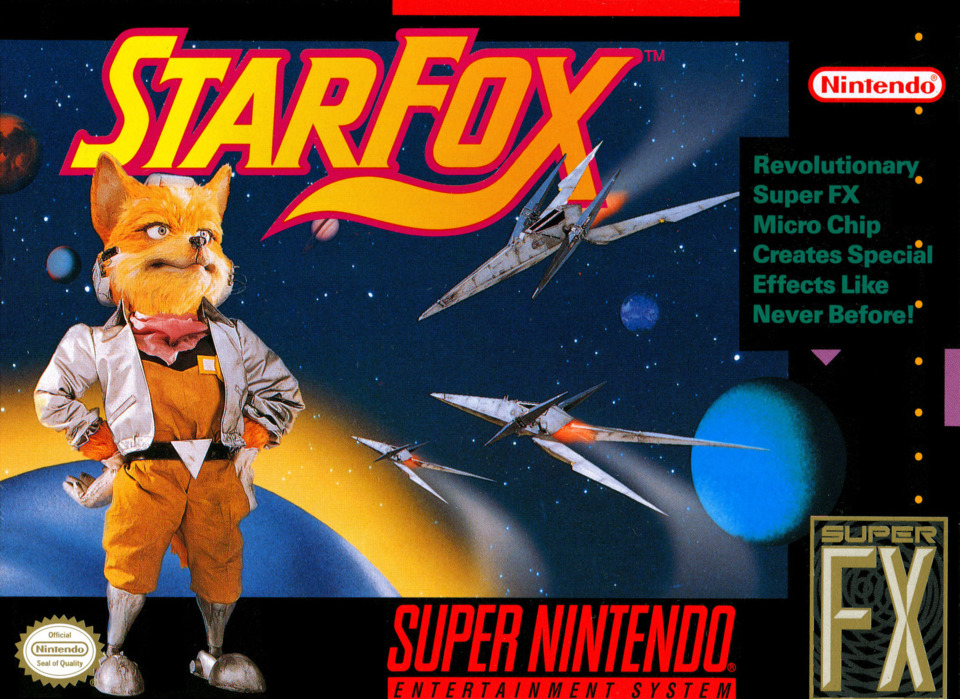
As the leader of an elite squad of anthropomorphic animal pilots, fly throughout the Lylat star system in the prototype Arwing spacecraft to prevent the galactic conquest of a mad scientist in this 3D shooter for the SNES (with real-time polygonal graphics powered by the new Super FX chip).

Why this matters

With Star Fox on the SNES, Nintendo brought real-time polygon 3D to the console using the Super FX co-processor - a chip designed by Argonaut Software. It was the same trick as Battlezone's Math-Box thirteen years earlier: the main CPU couldn't do the 3D math on its own, so a dedicated chip handled it.

April 1993

The 7th Guest cover art

The 7th Guest

Trilobyte Inc

PC, Mac, CD i

Widely considered to be the CD-ROM's first "killer app", The 7th Guest was a technical marvel that changed the face of adventure gaming and set the stage for Myst.

Why this matters

What started as "Clue meets Twin Peaks" became something else entirely when Graeme Devine and Rob Landeros noticed the capabilities of CD-ROM when seeing the tech demo'd at a conference. They used full-motion video (FMV) of live actors in their horror puzzle game, and The 7th Guest became a massive hit. It sold over two million copies on release and became one of the first CD-ROM "killer apps."

September 1993

Myst cover art

Myst

Cyan

Amiga, PC, Mac

A mysterious book transports you to a puzzle-filled deserted island in this immersive 1993 point-and-click adventure game from Cyan.

Why this matters

Myst was accessible to an audience that hadn't been introduced to video games. It leveraged a non-existent UI with the ability to tap and touch anything on screen while exploring the main island and various ages. Rand and Robyn Miller spent time reading about consumer design for things like doors, switches, and teapots in order to understand how to make their game appeal to a wider audience.

"We imagined a computer illiterate user – and we often thought of our grandmother – or we imagined the type of user that doesn't have the time to learn how to play a game; these were the users that would have to be immediately drawn into a game. We wanted to create an interface that would appeal to this type of user." - Robyn Miller

December 1993

Doom cover art

Doom

id Software

PC, SNES, Mac

In one of the most revolutionary first-person shooters of the 1990s, players control the last remaining space marine in the demon-infested stations on Mars' moons.

Why this matters

Games released in 1996 were chasing Doom. Games releasing in 2026 still are. The game had (has!) rabid fans, and its fast paced action and gameplay elements all serve the core focus of "ripping and tearing" - and has made Doom one of the most influential shooters of all time. id Software released their engine in 1997 on Linux, and thirty years later games are still being made on forks like GZDoom.

Virtua Fighter cover art

Virtua Fighter

SEGA AM2

Arcade, Sega 32X, R Zone, Saturn

The first in a long-running 3D fighting game series from Sega's AM2 team. It is best known as the first fighting game where each combatant is rendered using 3D polygons in real-time.

March 1994

Daytona USA cover art

Daytona USA

SEGA AM2

PC, Arcade, Saturn

One of Sega's signature arcade racing games, loosely based on stock car racing events at the Daytona International Speedway.

Why this matters

Shown as a prototype at the Amusement Machine Show in Tokyo to warm reception in 1993, Daytona USA quickly populated Japanese arcades and it later landed on the Sega Saturn in April 1995. It was the first game to run on the Sega Model 2 board, which was built in collaboration with GE Aerospace. Cabinets for the game are still running at arcades 30 years later, and it's considered one of the highest-grossing coin-op titles of all time.

X-COM: UFO Defense cover art

X-COM: UFO Defense

March 1, 1994MicroProse Software Inc, Mythos Games Ltd

Amiga, PC, PlayStation, Amiga CD32

A genre-defining strategy game where you counter an alien invasion by managing operations of top-secret "X-COM" military bases and sending out X-COM squads in highly-volatile ground skirmishes.

Why this matters

Julian Gollop cut his teeth on board games and tabletop RPGs like Dungeons & Dragons, and its influence on X-COM and future computer strategy titles are obvious. He pitched MicroProse a sequel to his squad tactics game Laser Squad; they liked it, but wanted something with the scope to stand next to Civilization, so he tacked on a global campaign onto the unit tactics he already excelled at. At one point the game was actually cancelled - MicroProse's new owners reviewed the UK lineup and killed it, and the UK office just kept quietly developing it anyway. The fusion of the global campaign layer with the tactical one made for a remarkably deep player experience in 1994, and it's still the template that everyone borrows.

November 1994

Donkey Kong Country cover art

Donkey Kong Country

November 24, 1994Rare Ltd

Super Nintendo Entertainment System

For the first time in Nintendo history, take control of Mario's former adversary as he travels through the island (with his nephew Diddy Kong) to recover his stolen banana hoard in this side-scrolling platformer from Rare (now Rareware).

Why this matters

"Donkey Kong Country reinvented Nintendo’s ornery ape into a flourishing franchise in its own right, full of iconic new heroes and villains. Its take on 2D sidescrolling was more moody and naturalistic than the Mario alternative, with lush landscapes and ambient audio. This more realistic aesthetic, groundbreaking at the time, was the result of cleverly used pre-rendered visuals that translated technologically advanced 3D graphics back into humble 2D sprites. With your mind filling in the details, Donkey Kong Country on the beloved yet aging Super Nintendo looked just as futuristic as anything on the truly next-gen Sony PlayStation just starting to hit store shelves. The trick worked. Along with extending the life of the SNES, DKC’s success also further solidified the partnership between Nintendo and Rare. The British studio would be a vital workhorse during the inconsistent N64 era." - Jordan Minor

May 1995

DonPachi cover art

DonPachi

May 1, 1995CAVE Co Ltd

PlayStation, Arcade, PlayStation Network PS3, PlayStation Network PSP, Saturn

The first game of the DonPachi series.

August 1995

Roberta Williams' Phantasmagoria cover art

Roberta Williams' Phantasmagoria

August 24, 1995Sierra, Outrigger Koubou

PC, Mac, Saturn

A full-motion video adventure game from King's Quest creator Roberta Williams, Phantasmagoria was one of the best-selling Sierra titles of all time and the subject of controversy for its graphic violence and sexual themes.

February 1996

Pokémon Red/Green  cover art

Pokémon Red/Green

Creatures Inc, Game Freak Inc

Game Boy

Pokémon Red version and Green version were the initial two releases in the Pokémon franchise. Red, a Pokémon trainer from Pallet Town who Ash Ketchum, the anime protagonist, was later based on, starts a journey to become a Pokémon Master and ultimately catch 'em all.

March 1996

Resident Evil cover art

Resident Evil

March 22, 1996Capcom

PlayStation, Saturn

The first in a long line of action-oriented survival-horror games, Resident Evil pits a small group of special forces agents against hordes of zombies and other mutated creatures in a mysterious mansion.

June 1996

Super Mario 64 cover art

Super Mario 64

June 23, 1996Nintendo EAD

Nintendo 64

Super Mario 64 takes the Mario franchise into polygonal worlds, setting numerous standards for 3D game design along the way.

July 1996

Quake cover art

Quake

id Software

Amiga, PC, Mac

The follow-up to id's 1993 game Doom, and one of the earliest first-person shooters to make full use of 3D polygonal graphics and level design. Featuring a dark and gritty atmosphere inspired by gothic and Lovecraftian fiction, players traverse numerous dimensions in an attempt to stop the invasion of eldritch forces led by the mysterious "Quake".

November 1996

Tomb Raider cover art

Tomb Raider

November 14, 1996Core Design Ltd

PC, Mac, PlayStation

Tomb Raider stars Lara Croft in her first title as she races through the jungles of Peru to the sands of Egypt in pursuit of the Scion, an ancient artifact reputedly holding the key to the ancient mystery of Atlantis itself. It would later be remade as Tomb Raider Anniversary.

December 1996

PaRappa the Rapper cover art

PaRappa the Rapper

December 6, 1996NanaOn Sha Co Ltd

PlayStation

Parappa the Rapper is a hip-hop themed rhythm game for the Playstation and PSP starring a rapping dog and his adventures to impress his secret crush.

January 1997

Diablo cover art

Diablo

Blizzard North

PC, Mac, PlayStation

An isometric action RPG that takes place in and below the town of Tristram. Gothic fantasy weapons and spells are used to defeat hordes of monsters from hell through randomized dungeon levels, continuously gaining experience points, gold, and a variety of equipment to bolster the hero's monster-killing potency along the way.

Final Fantasy VII cover art

Final Fantasy VII

Squaresoft

PlayStation

The seventh numbered entry in the Final Fantasy franchise brings the series into 3D with a landmark title that set new industry standards for cinematic storytelling. Mercenary Cloud Strife joins the rebel group AVALANCHE in their fight against the power-hungry Shinra Company, but their struggle soon becomes a race to save the entire Planet from an impending cataclysm.

March 1997

Castlevania: Symphony of the Night cover art

Castlevania: Symphony of the Night

March 20, 1997Konami Computer Entertainment Tokyo, Konami Computer Entertainment Nagoya Co Ltd

PlayStation

Dracula's castle has risen from the mist and the Belmont heir is missing! The open-ended gameplay mixed with RPG mechanics in this installment of Castlevania platformers set the template for later games in the series.

Symphony of the Night has players take on the role of Alucard, the son of Dracula, as he ventures into his father's castle to "end this." Alucard is initially stripped of his armor and magic, but as he explores the castle gains new powers, abilities to shape shift, allies, and weapons. The game features non-linear exploration, with new areas unlocked by acquiring movement abilities like a double jump or flight.

Why this matters

The label "Metroidvania" would be used to describe the non-linear exploration and "search action" gameplay of Symphony of the Night and Metroid. Journalist Jeremy Parish did not coin the term (he learned it from Scott Sharkey at 1Up) but he maintains a site cataloguing all games that fit the genre, metroidvania.com.

August 1997

GoldenEye 007 cover art

GoldenEye 007

August 23, 1997Rare Ltd

Nintendo Switch, Xbox One, Xbox Series X S, Nintendo 64

A first-person shooter for the Nintendo 64 and a video game tie-in with the 1995 James Bond film GoldenEye. It paved the way for a long line of shooter games based on the universe of the British secret agent and is often credited for helping establish first-person shooters for consoles.

Why this matters

How does a first person shooter work on a gamepad in a living room? Goldeneye on the Nintendo 64 brought the answer, with split-screen deathmatches and a N64 controller compromise on aiming that would be perfected by later controllers.

September 1997

Ultima Online cover art

Ultima Online

September 24, 1997Origin Systems

PC

Ultima Online is a popular massively multiplayer online role-playing game, released on September 24, 1997, by Origin Systems of Electronic Arts.

Fallout cover art

Fallout

September 30, 1997Interplay

PC, Mac

A critically acclaimed role-playing game developed by Interplay and Tim Cain in 1997, Fallout established itself as a prominent post-apocalyptic universe with a dark sense of humor.

November 1997

Grand Theft Auto cover art

Grand Theft Auto

November 28, 1997DMA Design

PlayStation, PC

Grand Theft Auto is a free roaming crime saga with multiple settings and a top-down view.

December 1997

Gran Turismo cover art

Gran Turismo

December 23, 1997Polys Entertainment

PlayStation

Polyphony Digital's seminal racing simulator for the PlayStation.

April 1998

StarCraft cover art

StarCraft

April 1, 1998Blizzard Entertainment

PC, Mac, Nintendo 64

StarCraft has been called the greatest real-time strategy game ever and it's certainly one of the most critically acclaimed. StarCraft features three powerful, yet balanced races: the Terrans, the Zerg, and the Protoss. You play as each race fights to the death for the fate of the universe.

Why this matters

StarCraft enjoyed explosive success in South Korea, setting the stage for institutional, professional eSports on an unheard of scale. Professional gamers playing video game matches aired on local TV stations in the 90s - StarCraft cemented an industry.

May 1998

Unreal cover art

Unreal

May 22, 1998Epic Games, Digital Extremes

PC, Mac

A first-person shooter where the player is stranded on the alien world Na Pali, ruled by the oppressive Skaarj, and must find a way off the planet.

September 1998

Dance Dance Revolution cover art

Dance Dance Revolution

September 26, 1998Konami Computer Entertainment Tokyo

PC, PlayStation, Arcade

The original arrow stomping game that started the worldwide phenomenon. Set to high energy dance music, this game would spawn countless sequels in arcades and at home.

Lineage cover art

Lineage

NCsoft Corporation

PC, Mac

Why this matters

The first game to cross 100,000 concurrent players. Lineage's engine is a fork of Nexus: The Kingdom of the Winds (1996) by the same developer, Jake Song, and Nexus holds the Guinness record for longest-running MMORPG. South Korea's gamers flocked to gaming cafes, and games like Lineage and StarCraft were immensely popular.

Metal Gear Solid cover art

Metal Gear Solid

Konami Computer Entertainment Japan Inc

PlayStation

Metal Gear Solid, released in 1998, is a game developed and published by Konami Corporation. The game follows recent retiree Solid Snake in his return to active duty as he attempts to rescue DARPA Chief Donald Anderson and President of ArmsTech Kenneth Baker, both taken hostage by a terrorist group, in order to prevent the terrorists from launching a nuclear warhead.

October 1998

Grim Fandango cover art

Grim Fandango

October 28, 1998LucasArts Entertainment Company LLC

PC, Mac

A LucasArts adventure game that follows skeletal travel agent Manny Calavera's four-year journey across the Land of the Dead in a film-noir-inspired tale of love, betrayal and corruption.

Why this matters

Grim Fandango is a game about the afterlife, and you could say it also helped usher the point and click adventure game into its twilight years. Critically acclaimed and considered a point and click adventure game all-timer, but simply didn't sell. It was directed by Tim Schafer, who would go on to found DoubleFine Productions after LucasArts began to exit the adventure game business.

Trespasser cover art

Trespasser

October 28, 1998DreamWorks Interactive L L C

PC

Trespasser is a first-person action game set in the Jurassic Park universe. As Anne, an oddly clueless woman with a broken arm and a magical tattoo on her cleavage, you must escape from Isla Sorna before you are messily devoured by hungry dinosaurs.

Why this matters

"After System Shock I had it in my mind to do a world where anything was possible and the universe of mechanical solutions was available to the player. But this necessitated making the player and the Dinos also physical, so I had to jump in and make compound joint models work, which are now called ragdolls. This was a first and it was hard as fuck." - Seamus Blackley, Executive Producer & Programmer on Trespasser

November 1998

Half-Life cover art

Half-Life

November 19, 1998Valve Corporation

PC, Mac, PlayStation 2

Take on the role of Gordon Freeman as he escapes the disastrous aftermath of an experiment gone wrong in the Black Mesa Research Facility.

Why this matters

The story of Gordon Freeman dealing with an inter-dimensional invasion is told in Half-Life entirely without cut-scenes and in first person, resetting expectations for how stories are told in video games. Valve's game engine also lent itself to a lively mod scene, which produced extremely prolific series in Counter-Strike and Team Fortress.

The Legend of Zelda: Ocarina of Time cover art

The Legend of Zelda: Ocarina of Time

Nintendo EAD

Nintendo 64

The first 3D Legend of Zelda game, Ocarina of Time was created for the Nintendo 64 in 1998 and introduced innovative mechanics such as Z-targeting as well as many of the series' other trademarks. It has frequently been ranked as the greatest game of all time by many publications.

Why this matters

Ocarina of Time's Z-targeting became a template for 3D melee combat everywhere.

December 1998

Thief: The Dark Project cover art

Thief: The Dark Project

December 3, 1998Looking Glass Studios Inc

PC

Thief is a first person sneaker made by the now defunct Looking Glass Studios. Unlike most first person shooters, Thief emphasizes being stealthy and tactically creeping past your opponents rather than plowing through them in combat.

Why this matters

Thief: The Dark Project wields an extraordinary soundscape as players navigate its complex, interweaving levels. Stereo sound cues are essential tools in avoiding detection in this deeply influential stealth title, and lighting also factors in a major way. Garrett's "light gem" informs the player if they're visible to enemies, and by stepping into the shadows, Garrett the Thief can effectively disappear. On top of that, the player can create their own shadows by dousing torches with water arrows.

Ken Levine did the initial design work for Thief: The Dark Project, and would go on to be the lead designer of System Shock 2 and the creator of the BioShock series.

January 1999

Super Smash Bros. cover art

Super Smash Bros.

January 21, 1999HAL Laboratory Inc

Nintendo 64

Characters from popular Nintendo franchises meet up for the first time (and then duke it out) in this crossover fighting game by HAL.

March 1999

EverQuest cover art

EverQuest

March 16, 1999Verant Interactive, Westlake Interactive, Darkpaw Games

PC, Mac

EverQuest is one of the original MMOs that helped to define the genre. With thirty-two expansion packs and over twenty-five years of being online, this game is still enjoyed daily by thousands all over the world.

September 1999

Tony Hawk's Pro Skater cover art

Tony Hawk's Pro Skater

September 29, 1999Neversoft Entertainment

PlayStation, N Gage, Dreamcast, Nintendo 64

Take control of real skaters and perform strings of crazy tricks in the first entry of the long-running Tony Hawk skateboarding series.

December 1999

Crazy Taxi cover art

Crazy Taxi

December 31, 1999SEGA Studios

Dreamcast, PlayStation 2, GameCube, Arcade

A high-octane taxicab driving game for arcades. Instead of racing other opponents, the cabbies must race the clock and dodge traffic to deliver their patrons to their destinations as fast as they can.

Shenmue cover art

Shenmue

December 29, 1999SEGA AM2

Dreamcast

An action-adventure game set in 1980s Japan that follows one young man's journey to avenge his father's murder. It was praised for its ambitious scope and pioneered several gameplay features such as realistic open-world environments and Quick Time Events.

2000s

February 2000

The Sims cover art

The Sims

February 4, 2000Maxis Software, Westlake Interactive

PC, Mac

Construct and furnish a home, and then influence the day-to-day lives of its occupants (called Sims) in an isometrical "people simulator" by Will Wright.

June 2000

Deus Ex cover art

Deus Ex

June 22, 2000Ion Storm Inc

PC, Mac

A celebrated cyberpunk-themed first-person role-playing game, Deus Ex puts players behind the shades of JC Denton--an operative thrust into a world of byzantine global conspiracies.

October 2000

Alien Resurrection cover art

Alien Resurrection

October 19, 2000Argonaut Games

PlayStation

Alien Resurrection is a science fiction first person shooter based on the movie of the same name. It was generally considered a commercial failure and received mixed reviews from publications worldwide.

Why this matters

Argonaut, also the developers of the Super FX chip in use on SNES games like Star Fox, shipped twin-stick controls for Alien: Resurrection as the default scheme a full year before the arrival of Halo: Combat Evolved.

Alien Resurrection was panned by critics, who found the new control scheme confusing to use:

"The game’s control setup is its most terrifying element. The left analog stick moves you forward, back, and strafes right and left, while the right analog stick turns you and can be used to look up and down. Too often, you’ll turn to face a foe and find that your weapon is aimed at the floor or ceiling while the alien gleefully hacks away at your midsection."

November 2000

Bejeweled cover art

Bejeweled

November 1, 2000PopCap Games Inc, HotGen Ltd

PC, Mac, Browser, Xbox, iPod

Credited with popularizing the "match-three" style of tile-matching puzzle games, Bejeweled has players attempting to swap jewels on a replenishing 8×8 board to form matches.

Counter-Strike cover art

Counter-Strike

November 8, 2000Valve Corporation

PC, Mac, Linux, Xbox

Originally created as a modification of the original Half-Life, Counter-Strike has since become its own franchise, setting new standards in online team-based shooters, and was at one point the single most-played online game in the world with a huge competitive following.

Hitman: Codename 47 cover art

Hitman: Codename 47

November 19, 2000IO Interactive

PC

The first entry in the Hitman series has the player take control of Agent 47, who is expertly trained in the art of assassination. His missions take him to a variety of locations, targeting decadent criminals.

Why this matters

Hitman: Codename 47 founded the assassination-sandbox and social stealth - hiding in plain sight via disguises, rather than hiding in shadows as in a Metal Gear or Thief. Hitman would become a massive franchise, complete with a movie tie-in. Codename 47 is far from IO's best Hitman game, but it was a flawed and foundational first draft.

December 2000

Phantasy Star Online cover art

Phantasy Star Online

December 21, 2000Sonic Team

Dreamcast

In this multipayer focused spinoff of the Phantasy Star series, players take control of explorers from a dying world looking to find a suitable place to restart civilization.

March 2001

RuneScape cover art

RuneScape

March 29, 2001Jagex Ltd

PC, Mac

RuneScape is a popular MMORPG with large amounts of content for both free-to-play and pay-to-play users.

June 2001

Operation Flashpoint: Cold War Crisis cover art

Operation Flashpoint: Cold War Crisis

June 22, 2001Bohemia Interactive Studio

PC, Xbox

Operation Flashpoint is a combat simulator released in 2001 by Codemasters, the game has been praised for its accurate portrayal of combat scenarios, and has been used in virtual training by the United States Marine Corps.

Why this matters

Bohemia Interactive's engine would go on to be used by BISim (Bohemia Interactive Simulations) to create Virtual Battlespace, which became an official "Games for Training" program for the U.S. Marine Corps. The modding community for Bohemia's games would further incubate two landmark entries in the genre: DayZ, and PlayerUnknown's Battlegrounds.

August 2001

Devil May Cry cover art

Devil May Cry

August 23, 2001Capcom

PC, PlayStation 2

Play as Dante, son of the legendary dark knight Sparda, as he takes on the emperor of the demon world, Mundus. With help from the lovely Trish, the Force Edge and his guns, Ebony and Ivory.

October 2001

Grand Theft Auto III cover art

Grand Theft Auto III

October 23, 2001DMA Design

PC, Mac, PlayStation 2

The third release in the Grand Theft Auto Franchise stars silent criminal protagonist Claude who, after having been betrayed and left for dead, is out for revenge. It was the first GTA game in 3D, an evolution that proved to be pivotal and helped establish the franchise as one of gaming's most popular (and controversial).

November 2001

Halo: Combat Evolved cover art

Halo: Combat Evolved

November 15, 2001Bungie

PC, Mac, Xbox

One of the launch titles of the original Xbox, Halo: Combat Evolved is a sci-fi first-person shooter telling the tale of an advanced cybernetic super-soldier known as the "Master Chief".

January 2002

Medal of Honor: Allied Assault cover art

Medal of Honor: Allied Assault

January 20, 20022015 Inc

PC, Mac

Battle your way across Europe and help the resistance push back the Nazis in this acclaimed first-person shooter.

May 2002

The Elder Scrolls III: Morrowind cover art

The Elder Scrolls III: Morrowind

May 1, 2002Bethesda Game Studios

PC, Xbox

The third entry in Bethesda's series of expansive first-person computer role-playing games. Arriving on the island of Vvardenfell as a prisoner, the player character is caught up in an ancient prophecy, as well as a power struggle between factions, races, and gods incarnate.

July 2002

Warcraft III: Reign of Chaos cover art

Warcraft III: Reign of Chaos

July 3, 2002Blizzard Entertainment

PC, Mac

Armies of chaotic demons and corrupted beings are preparing a foretold invasion of the world of Azeroth in the third installment of the long-running medieval-fantasy series.

September 2002

Battlefield 1942 cover art

Battlefield 1942

September 10, 2002DICE

PC, Mac

Battlefield 1942, the first in the acclaimed Battlefield franchise, pits Axis versus Allies in large-scale multiplayer battles.

Why this matters

It defined the combined-arms multiplayer FPS, featuring 64 players with seamless infantry that could hop into land, air, and sea vehicles on one continuous map. DICE ended up acquiring the mod team that built the Desert Combat mod and they went on to create Battlefield 2.

May 2003

EVE Online cover art

EVE Online

May 6, 2003CCP Games

PC, Mac

EVE Online is a loosely structured science fiction MMORPG published by CCP Games in which players take on the role of a spaceship pilot exploring a colonized galaxy.

July 2003

Star Wars: Knights of the Old Republic cover art

Star Wars: Knights of the Old Republic

July 15, 2003BioWare

PC, Mac, Xbox

Taking place in the Old Republic era of Star Wars, around 4000 years before the events of the films, Knights of the Old Republic is a third-person real-time-with-pause turn-based RPG where players travel the galaxy as a mysterious Republic soldier, racing against time to thwart a massive Sith fleet.

March 2004

Far Cry cover art

Far Cry

March 23, 2004Crytek

PC, PlayStation Network PS3, Xbox 360 Games Store

Far Cry is a first-person shooter PC game developed by Crytek Germany. Meet Jack Carver, who is having a rough day - they blew up his boat, they chased him into the jungle, and now they're shooting at him. Too bad they don't know Jack.

Why this matters

But can it run Crysis? Far Cry proved a PC could render a huge, seamless open world. It debuted the CryEngine and created the PC hardware benchmark era. CryTek's Yerli brothers built Crytek out of their X-Isle tech demo, which Nvidia had bundled as GPU benchmarking software.

November 2004

Half-Life 2 cover art

Half-Life 2

November 16, 2004Valve Corporation

PC, Mac, Android, Linux, Xbox, Fuze Tomahawk F1

Return to the HEV suit of Gordon Freeman as he re-awakens several years after the Black Mesa disaster, only to aid a human resistance movement against a collective of trans-dimensional aliens that have conquered Earth.

World of Warcraft cover art

World of Warcraft

November 23, 2004Blizzard Entertainment

PC, Mac

World of Warcraft is an MMORPG that takes place in Blizzard Entertainment's Warcraft universe. At its peak, it boasted a player base of over 12 million subscribers, making it the most popular MMO of all time.

January 2005

Resident Evil 4 cover art

Resident Evil 4

January 11, 2005Capcom

PC, PlayStation 2, GameCube

Special agent Leon S. Kennedy travels to rural Spain to rescue the U.S. President's kidnapped daughter in Resident Evil's sixth canonical installment. It is notable for a lengthy development cycle which involved a complete overhaul of the series' established gameplay mechanics.

May 2005

October 2005

Shadow of the Colossus cover art

Shadow of the Colossus

October 18, 2005Team Ico

PlayStation 2

Explore the Forbidden Land as Wander, a young warrior who must slay sixteen Colossi in order to restore the life of a sacrificed maiden.

November 2005

Geometry Wars: Retro Evolved cover art

Geometry Wars: Retro Evolved

November 22, 2005Bizarre Creations

PC, Xbox 360 Games Store

Geometry Wars: Retro Evolved breaks out into its own game with an Xbox Live Arcade release that rejuvenated the dual-joystick shooter genre.

Guitar Hero cover art

Guitar Hero

November 8, 2005Harmonix Music Systems

PlayStation 2

Guitar Hero allows players to step into the shoes of a rock god and play some of the most famous guitar songs of all time.

August 2006

Dwarf Fortress cover art

Dwarf Fortress

August 8, 2006Bay 12 Games

PC, Mac, Linux

Dwarf Fortress is a single-player, high fantasy simulation game in the style of old ASCII Roguelikes. You can control either a Dwarven clan attempting to build a settlement or a single adventurer in a randomly generated and persistent world complete with its own unique history.

The future...

Class is still in session.